
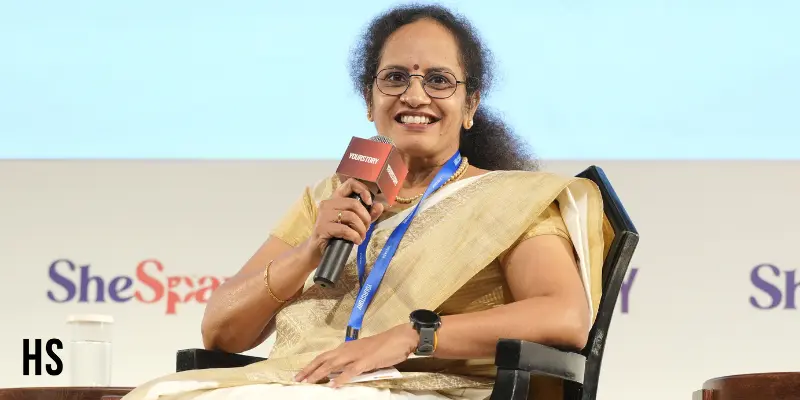

One constant that has remained through Sangeetha Yanamandra's life and career is to challenge herself, whatever situation she finds herself in.
The Vice President of Engineering and Site Leader for Hyderabad at OpenText India has over two-and-half decades of experience in building enterprise platforms, products, and services. At OpenText, she leads products in the analytics and legal tech.
A passion for challenges
Yanamandra grew up in Hyderabad, where she found joy in tackling challenges-no matter how tough or unconventional they might have been.
"I was a normal girl, but always thought how I could be different from what I was "yesterday"" she recalls. Her path towards excellence began unexpectedly in sixth grade, when she received a progress report that revealed she ranked 18th in the class, but first among the girls.
This led to a determination to overcome her fears, especially in mathematics and physics. "Slowly, within the sixth standard itself, I moved to the first rank and continued to be a topper through my school life," she shares.
This early success instilled in her a lifelong passion for venturing into the unknown.
"When I feel something challenging, I get some satisfaction when I achieve that," she explains, describing how she began driving a scooter in the eighth grade despite apprehensions. "My silent empowerment came from my father. He knew that I was driving a scooter. Though he was apprehensive, he didn't stop me."
Navigating early career demands
Yanamandra's entry into the IT sector wasn't smooth sailing, despite being a college topper. She completed her MCA in the mid-1990s, entering the job market during an industry slowdown. She decided she had to take on this challenge too, and be resourceful.
"I started taking classes part-time for IGNOU and Bharathidasan University," she recalls.
With encouragement from her husband, she pursued an MTech degree attending evening classes while working in the morning. She maintained her academic excellence by becoming a topper once again.
While pursuing her MTech, she got an opportunity to work on a project at Virinchi Technologies. The company later absorbed her as a lead, and this marked the beginning of her journey managing projects in diverse domains.
Mastering technical diversity in multiple domains
Yanamandra's career stands out for its remarkable diversity across technologies, roles, and domains.
"I started my journey with mobile technologies, and from the beginning, I always had to work on multiple projects at a time," she explains. "When I joined Virinchi, I had to manage three projects in parallel as a tech lead, where each project was in a different technology-one on J2ME, another on .NET Compact Framework, and yet another on Symbian C++."
This diversity led her to develop a unique approach to learning. "I learned the trick of how to quickly get onboarded on a new technology, not by the traditional way of going through the training material and learning from A, B, C, D, till Z in a systematic way. Instead, I discovered on my own how to study, how to get myself onboarded on the technology so that I can drive these projects and the products."
Her career has evolved from mobile technologies to enterprise solutions, cloud computing, and most recently, analytics and AI. She has worked across diverse domains including airlines, security, legal, and then clinical trials in companies like Infosys, Virtusa, Kony Solutions, and Barclays Technology Centre India.
While moving to OpenText over eight years ago, Yanamandra faced perhaps her biggest professional challenge. "I started with a team of eight people. But in a couple of quarters, I had to grow this team to 100 plus," she shares. This required her to wear multiple hats, "being the first line manager, a leader to managing and setting up teams."
The role demanded exceptional adaptability: "It's like every half hour I had to change my hat, not just with respect to the technology, but also with respect to the person and the culture."
At OpenText, Yanamandra supervises engineering and product management India teams in analytics and the legaltech space. She is also the site leader for Hyderabad, taking care of employee engagement, CSR, and also chairs the D&I committee.
Navigating work-life balance
Throughout her career, Yanamandra faced significant personal sacrifices. "All through my journey, I never sat on the bench, I was constantly working," she reveals. "I can count how many days I returned back home before 7 pm."
With a commute that consumed up to four hours daily, she often found herself starting work at 7:30 am and sometimes returning home as late as 2 or 3 am. Many times, she wondered whether the journey was worth it. But her passion and determination to take on challenges pulled her through.
It was not easy. But she believes partitioning and prioritising has helped her immensely.
"When I leave home, I don't think much about what happened there. Similarly, when I leave the office, I don't let things weigh me down," she says.
She emphasises the importance of quality over quantity when it comes to family time.
"All through my career, I never stayed close to the organisation I worked for. I didn't have much time with my daughter. But I used to take care of the little things that would help her. For example, she was scared of Mathematics. I would prepare question papers for her, covering the complexities and that would help her. The guilt was there, but my husband's support saw me through," she says.
Supporting women in tech and creating inclusive workplaces
Drawing from her diverse experiences, Yanamandra actively mentors women on her team, particularly those facing critical junctures like marriage or maternity leave. She says she is also in constant contact, especially with returning mothers, and advises them on managing their family situations without guilt.
"I also encourage them to take up challenges on the work front on new technologies or new projects. I tell them 'even if you are the one person ready to do it, still take it up'."
Yanamandra emphasises the need for "tailored programmes" and flexible workplace arrangements, especially for returning mothers to create a more inclusive workplace.
"We need more programmes from management and architect levels onward to help women see growth opportunities," she suggests.
She also highlights the importance of broadening women's awareness of career options beyond their current roles.
"Many women are only doing one role and focused on that," she observes. Through mentoring and women's networks like "Women in Search of Excellence" that she started in Hyderabad, she helps women explore lateral moves across functions."
Embracing AI as a companion
Yanamandra has a balanced view on the AI conundrum. Rather than fearing job displacement, she sees AI as a tool that creates space for higher-level thinking.
She encourages people to use AI as a starting point but to also add their unique perspectives: "Don't use it as is, apply your thoughts. AI should not overtake our thought process. We are unique in our thought process and that has to come out explicitly."
She is optimistic about AI and the future of work and believes that it frees us up to explore more and do a better job.
Another constant that guides her is viewing her inabilities as areas of improvement. "Public speaking or hosting town halls were not my comfort zones and I always shunned these possibilities. I realised during discussions with my female colleagues that preparation is key, and this helped me in my progress," she says.
Yanamandra is on a constant learning journey. She completed her LLB last year, runs half-marathons, and is preparing for a full marathon.
"Post retirement, I would like to empower women in technology through mentoring and also work in community development by upskilling those in need," she concludes.
Edited by Megha Reddy