
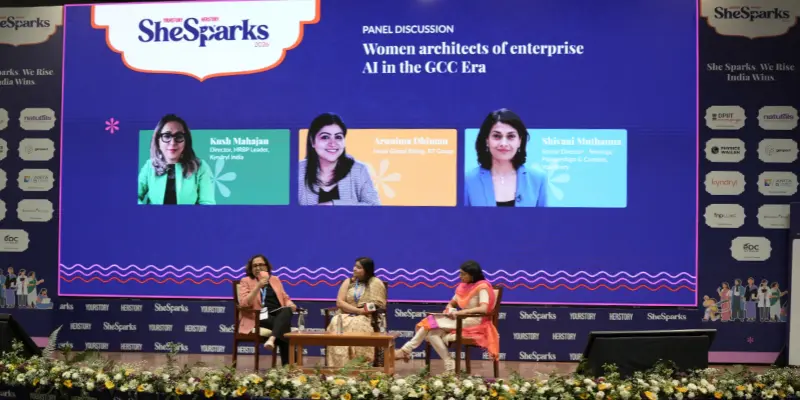

As Global Capability Centers (GCCs) evolve into strategic hubs for enterprise artificial intelligence (AI), conversations around the role of women in an increasingly AI-driven workplace are becoming critical.
At SheSparks 2026 on March 14, a session titled 'Women Architects of Enterprise AI in the GCC Era' brought together Kush Mahajan, Director, HRBP Leader, Kyndryl India, and Arunima Dhiman, Head Global Billing, BT Group, in conversation with moderator Shivani Muthanna, Senior Director - Strategic Partnerships & Content, YourStory.
The discussion explored how women leaders are navigating this shift, from shaping AI adoption to championing responsible innovation and building organizational ecosystems. At its core, it examined how women are translating AI ambition into meaningful business impact.
When human judgment leads, AI follows
A question on many minds today is whether AI will replace jobs. Mahajan addressed this directly, noting that the rhetoric around AI has become unnecessarily fearful. Instead of viewing it as a threat, she urged employees to see AI as an enabler.
Work is evolving, and workplaces are transforming. Analytics and decision-making are faster than ever. AI, she said, is simplifying work and enabling efficiency. Drawing from her own experience, Mahajan shared how tools like Copilot help her manage workflows: summarising emails and surfacing key information when she is pressed for time.
However, she emphasized that human judgment remains central. "AI is going to make my life simpler and help me do things faster, but it is also giving me the time and space to make a judgment and reach a decision when it comes to data. I don't have to spend too much time on an Excel file, because AI tools are evolving. So, I would say judgment will be the new skill in this AI era."
Dhiman echoed this perspective, drawing from her experience across aviation, banking, and telecom. At BT Group's GCC in Delhi, she has witnessed growing workplace complexity and the rise of critical datasets and platforms. AI, she noted, enables organizations to operate efficiently amid this complexity.
At the same time, she stressed that human intelligence is key to ethical AI usage. "While the growth of AI is immense, I believe that no one is going to take away the human touch," she said.
What holds women back in tech?
Despite progress, women remain underrepresented in data and analytics roles. The 2020 World Economic Forum Global Gender Gap Report notes that only 25% of data scientists are women, with even lower representation, under 20%, among data engineers and AI specialists.
Mahajan reflected on her own experiences to explain why this gap persists. As a student, she noticed that boys in her family were often asked to handle tasks like buying groceries from distant stores. Her father recognized her discomfort and encouraged her to learn how to ride a bike.
Today, Mahajan is an avid biker who has covered over one lakh kilometres. She credits her father for helping her overcome hesitation and self-doubt.
Using this example, she urged women to take ownership of their personal and professional lives, step beyond hesitation, and embrace opportunities. She emphasized that data and AI are not domains reserved for men, and encouraged women to lead discussions, boardrooms, and decision-making with confidence.
Ownership in the AI era
While Mahajan addressed representation, Dhiman focused on emerging roles in the AI landscape and how they intersect with gender.
She observed that women tend to perform strongly in areas such as revenue, customer experience, management, and risk management, functions where new AI-driven roles are emerging. Providing women with ownership and accountability in these areas allows their leadership to flourish.
"It is important as an organization to create opportunities for women, not just at a transactional level or as part of projects, but as decision-makers. Women need to own the architectures of these programs. These are the steps we are taking to give that psychological safety," she said.