
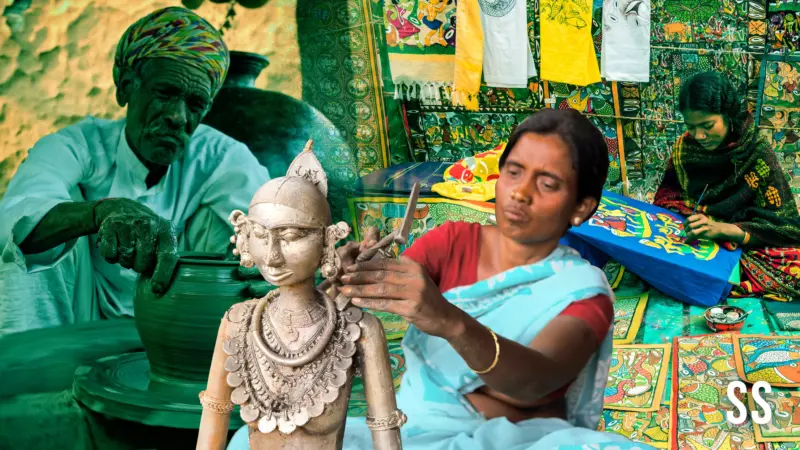

India's art and craft supports millions of artisans, yet many struggle with irregular work, unfair pricing, low income, and limited access to markets.
Artisans are frequently left out of conversations around growth, stability and dignity, even as their handicrafts are celebrated worldwide for their beauty. However, many organisations are trying to change this scenario by bringing artisans to the forefront and giving their work visibility.
Here are six organisations that work closely with artisan communities across the country, with a focus on building steady livelihoods, fair wages, and long-term systems for artisans.
200 Million Artisans
Founded by journalist-turned-social entrepreneur Priya Krishnamoorthy, 200 Million Artisans operates where the craft sector is weakest: systems and capital.
The organisation works with craft-led MSMEs, social enterprises, and investors to address the mismatch between traditional craft cycles and modern financing expectations.
Its flagship initiative, the Kula Conclave, has brought together hundreds of founders, policymakers, lenders, and investors to reframe handmade businesses as scalable creative manufacturing enterprises.
The organisation has also produced sector research used by funders to design patient, revenue-aligned capital products. The impact lies in enabling enterprises that collectively work with tens of thousands of artisans to access growth capital, shifting the sector away from grants towards sustainability.
Tisser Artisan Trust
Founded by Megha Phansalkar, Tisser Artisan Trust works across 18 states, supporting artisan clusters through long-term engagement rather than project-based interventions. Its focus is on women artisans, many of whom had limited exposure to formal markets.
Tisser's impact spans design innovation, quality upgradation, and digital enablement, helping artisans improve product relevance and price realisation.
By introducing standardisation and contemporary design inputs, the trust has enabled artisans to command higher margins while retaining traditional techniques. It works with a network of artisans, groups and SHGs across 100 art forms.
Tisser's cluster-based approach has helped artisans get repeat orders and more regular work. This has reduced migration and made incomes less uncertain. As a result, thousands of artisans now earn steadier incomes while continuing to live and work within their own communities.
EkiBeki
Products from Ekibeki
As an architect and furniture designer, Vishpala Naik spent years working with urban, well-travelled clients, many of whom would source art and décor from Europe but would rarely consider Indian crafts for their homes. What troubled her was not just the lack of awareness but the absence of respect for local traditions and the people who sustain them.
"Most people are unaware of the crafts we have in our country. Along with the lack of awareness, there is very little love or respect for local crafts. Artisans engaged in traditional practices are struggling to survive. Many are forced to migrate to cities, where they lose dignity, family life, and social roots," said Naik.
To address this, Naik founded Ekibeki in Mumbai in 2018. The organisation focuses on livelihood generation for women and youth artisans, building producer-owned groups that create largely handmade, sustainable products, supported by an ecosystem designed to become self-sustaining over time.
Ekibeki's work spans awareness-building across schools, corporates, and institutions; developing contemporary product ranges and new applications; ensuring consistent quality through technical inputs; and building artisan capacity across design, manufacturing, sales, and distribution. Market access is enabled through exhibitions, retail (online and offline), corporate gifting, and commissioned projects.
Kaarigar Clinic
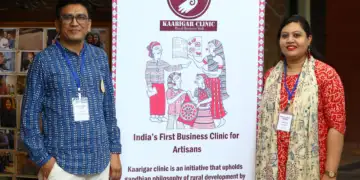
Nilesh Priyadarshi and Noopur Kumari
Founded by Noopur Kumari and Nilesh Priyadarshi, Kaarigar Clinic addresses one of the craft sector's most persistent inequities: invisibility. The organisation works directly with artisans to build individual and collective brands, covering pricing literacy, storytelling, digital presence, and customer engagement.
After extensive on-field research in Gujarat, Rajasthan, Madhya Pradesh, Odisha, Andhra Pradesh, Karnataka and Tamil Nadu to understand the challenges faced by artisans, Kumari and Priyadarshi found that 80% of artisans they met were looking for identity, value and recognition for their craft, more than money. Also, the 'faceless market culture' with the buyer and seller unaware of each other was affecting the artisans' identity.
Kaarigar Clinic helps artisans move from being anonymous suppliers to recognised creators, often selling under their own names.
Artisans like Pabiben Rabari, Rajiben Vankar and the uncle-nephew duo of Jabbar & Mubin are popular names associated with the organisation. Thanks to the efforts of Kaarigar Clinic, Pabiben was able to pitch on the Shark Tank India platform and become a global name.
Kaarigar Clinic works with a team of 'Kaarigar Doctors'-fresh management and design graduates who are trained to work on the ground with artisans.
Varnam Craft Collective
Karthik Vaidhyanathan of Varnam Craft Collective is keen on keeping the craft economy of Channapatna alive and ensuring fair wages to artisans without succumbing to cliches such as 'sustainability' and 'slow fashion'." align="center">Karthik Vaidhyanathan of Varnam Craft Collective is keen on keeping the craft economy of Channapatna alive and ensuring fair wages to artisans without succumbing to cliches such as 'sustainability' and 'slow fashion'.
Founded by Karthik Vaidyanathan, Varnam Craft Collective works with a small but deeply engaged group of artisans to keep the 200-year-old lacquered wooden toy tradition of Channapatna alive. Based in Karnataka, the organisation focuses on making products that sell, paying artisans fairly, and creating steady demand rather than one-off opportunities.
Varnam's impact comes from removing intermediaries and ensuring transparent pricing. Instead of seasonal collaborations, it builds long-term relationships with artisans.
The organisation has set up two production units using its own capital. The artisans themselves run these units. Varnam invested in the workspace and covered the rent so that artisans could focus fully on their craft. Each unit is managed by artisans, who also pay wages to others in their team-creating locally controlled, wage-paying enterprises rather than dependency-driven workshops.
To ensure regular income throughout the year, Varnam took charge of sales, a function many craft organisations outsource. By running its own stores in Bengaluru, Mysuru, and most recently Goa, the collective has reduced its dependence on seasonal or third-party orders and ensured more stable work for artisans.
Edited by Swetha Kannan