
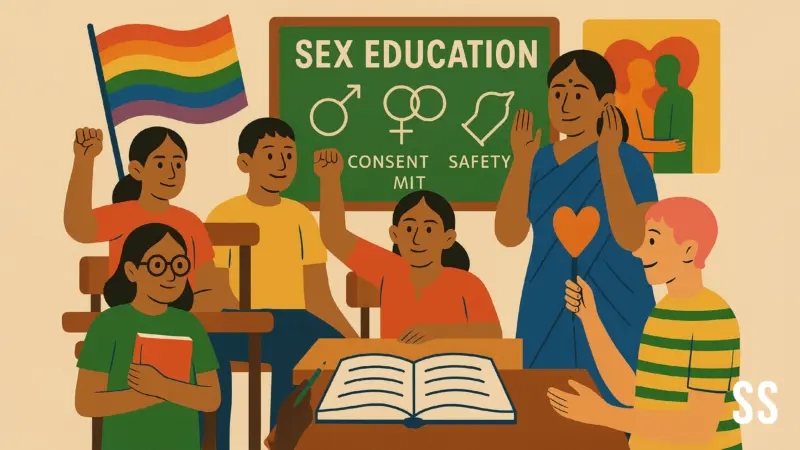

Sex and sexuality education in India is no longer limited to biology chapters or a rare workshop in school that tiptoes around words like desire or consent.
Across the country, a wave of radical, rights-driven, trauma-informed initiatives is challenging silence and stigma head-on by creating spaces where young people, queer communities, sex workers, educators and families can talk about relationships, boundaries, pleasure and safety with honesty and cultural ease.
From peer-led programmes to disability-inclusive curricula and art-based storytelling, their work shows just how inventive, intersectional and community-rooted sexuality education can be with a little effort.
Agents of Ishq, Mumbai
Agents of Ishq has done something no one else in India dared: they turned sex education into poetry, music videos, comic strips, Bollywood parodies, art projects and irreverent "how-to" guides that feel like they belong inside India's cultural bloodstream.
Started in Mumbai in 2014 by filmmaker and feminist voice Paromita Vohra, the platform set out to make conversations about desire, consent, sexuality, and heartbreak feel honest, joyful and deeply Indian. Their work is intersectional by design; they feature interviews with queer communities, stories from rural women, pieces on caste and sexuality, disability and pleasure, all presented with humour and emotional depth.
What makes them radical is how trauma is handled gently: many stories are first-person narratives that honour agency while acknowledging pain. Their recent posts continue to explore pleasure, relationships and LGBTQIA+ lives through films, podcasts and art collaborations.
Durbar Mahila Samanwaya Committee, Kolkata
Durbar is not a standard NGO; it's a sex-worker collective based in Sonagachi, Kolkata, which treats sex-work literacy and sexual health as labour rights. Since 1995, Durbar has trained thousands of sex workers in health, contraceptive choice, labour organising and legal literacy. Members run community schools, co-ops and anti-trafficking efforts.
Durbar's education is political and intersectional: it addresses caste, gender, migration, HIV, and the structural violence sex workers face, and it adopts trauma-informed peer counselling inside the community.
It recently celebrated 30 years with cultural programmes, fashion shows featuring sex-workers and transgender persons, panel discussions on HIV/STIs, cervical and breast cancer, menstrual hygiene, and stalls showcasing the community's culinary and handicraft talents.
For radical, rights-based sex ed grounded in lived experience, Durbar remains an important model.
Sahodari Foundation, Tamil Nadu
Sahodari, founded in 2008 by transgender artist-activist Kalki Subramaniam, blends art, scholarships and trans-led sexuality education. Their RedWall Artivism project features long-running interviews and artworks documenting trans and non-binary lives, flipping the 'victim' narrative, and instead centring agency, consent and community care.
Sahodari's Trans Education Project supports trans students, runs gender-diversity workshops for schools and designs curricula that address sexual violence, HIV, and livelihoods in trauma-informed ways. They teach educators how to hold disclosures, respect privacy and offer follow-up support.
Recently, Sahodari published outcomes from its RedWall interviews and scholarship announcements, which blended culture, documentation and direct educational work.
For sex ed that's by and for gender-diverse people, with creative methods and trauma-aware referral pathways, Sahodari is a standout.
Enfold India Trust, Bengaluru
Enfold has been a pioneer in disability-sensitive sexuality education and child personal-safety curricula. Founded in Bengaluru, Enfold's radical education includes tools such as Suvidha Suraksha and Suvidha Sparsh kits-tactile, visual tools for teaching personal safety to children with intellectual, sensory and communication disabilities.
In addition, they pair school and community work with restorative justice responses and psycho-social support for survivors. Enfold also runs programmes for teachers, caregivers and law enforcement to make reporting and reintegration less traumatic.
Recently, the organisation launched a child-safety app, and remains active on social channels advocating for inclusive curricula.
For anyone wanting sexuality education that holds trauma responses and different abilities at the centre, Enfold offers proven, ready-to-use tools.
Pratisandhi, Delhi
Pratisandhi began in 2018 as a youth-led push to normalise sex ed for adolescents and young adults. What grabbed attention early on was their style: bold campaigns, reels and workshops that refused euphemism and instead talked about pleasure, lubrication and boundaries without blinking. They pair peer-led workshops with a sex ed library and trainer certification so young people become educators for their peers.
The group is explicit about harm-reduction and trauma sensitivity, through workshops that inform how to respond to disclosures.
Recently, Pratisandhi announced and showcased their busy months of school and community workshops on social media and won small grants for youth programming. Their work is fast, frank and peer-centred, ideal when you want sex ed that meets young people where they already are-online and in friendship circles.
TARSHI, Delhi
TARSHI has spent three decades doing something most sex-ed groups don't: it trains the adults around young people-teachers, counsellors and health workers-to manage their own discomfort before they talk to kids about sex and sexuality.
Born in Delhi in 1996 out of a small group of activists wanting accurate sexual-health information, TARSHI's work mixes frank information with reflective practice, so educators can deliver Comprehensive Sexuality Education without shame or panic.
What makes them unique is a pedagogy that includes burnout prevention, consent culture, and how to handle disclosures. They've been technical partners on national CSE initiatives and offer accredited online CSE courses for professionals.
Recently, TARSHI updated its CSE resources, keeping its training modules current for schools and NGOs. This is sex ed that starts with adults' safety, so young people get safer homes and classrooms.
(The story has been updated to correct the location of Enfold)
Edited by Jyoti Narayan