
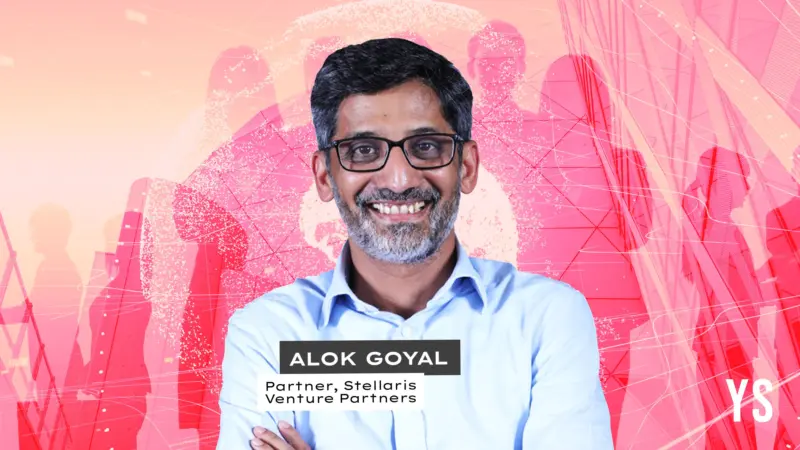

Venture capital firm Stellaris Venture Partners is doubling down on AI and deeptech startups in India. But it's not rushing headlong into the AI frenzy.
Instead, the VC firm is taking its time to find its 'sweet spot' amid the flurry of AI startups and wannabes mushrooming across the country-a vantage point from which it can evaluate and back use cases it believes in.
Last year the company said it would invest $100 million-$150 million on AI startups in India. According to Alok Goyal, Partner at Stellaris, the firm's focus will be on application enablers within the AI ecosystem. "We are looking at everything from agent builders, to guardrails, to security… We are more bullish on these AI use cases," he notes.
Having said that, the firm is not pigeonholing itself when it comes to its investment bets. It is not hung up on a particular thesis or an investment target. It is open to ideas and ready to go with the flow with a founder-first approach.
"There are no rules in our business. We can have our thoughts, and then one meets a fantastic founder who is doing something, and our thesis can go out of the window at that point in time," says Goyal.
He believes today's ecosystem is not just about enterprise AI, and consumer AI is gathering momentum quickly.
In January this year, Stellaris led a $3-million funding round in voice AI startup Arrowhead. The firm has also invested in B2B marketing and sales analytics platform Factors.ai and AI-driven intelligence platform OrbitShift.
While it is excited about firms building vertical AI applications and smart services, Stellaris is relatively less bullish on cloud players and companies building semiconductors and large language models (LLMs), primarily due to their higher capital requirements. "There are very large, but very few winners (in these sectors)," says Goyal.
Founded in 2016 by Ritesh Banglani, Alok Goyal, and Rahul Chowdhri. Bengaluru-based early-stage VC firm Stellaris Venture Partners has backed D2C brands such as Mamaearth and Nestasia, SaaS companies such as Whatfix, and consumer-tech companies including PlatinumRx and Goodscore.
In an interview to YourStory, Goyal breaks down how-is navigating the AI boom, its investments plans in deeptech, and how the firm is viewing early-stage funding.
Edited excerpts:
YourStory [YS What's your reading of the early-stage startup landscape in India today?
Alok Goyal [AGThe early-stage ecosystem was in a hyper-drive in 2025, and 2026 looks like a continuation of that momentum. In contrast, 2024 was slower. The dry powder was there, but investors were cautious after the 2021 highs and the reset through 2022-23. Add to that the rapid rise of AI, people were still figuring out the pace of change.
Now, investors are more comfortable. Cheque writing picked up in 2025, especially at Series B where deal count has reportedly doubled year-on-year. Growth investing is inching back, and with public market liquidity improving, late-stage confidence should strengthen in 2026.
Sector-wise, two clear themes stand out to us: consumer tech and AI. AI is no longer just enterprise, consumer AI is scaling fast. Overall, momentum is broad-based, but later-stage funding is where the real shift could happen next year.
Home interiors platform Material Depot raises $10M co-led by Accel and Stellaris Venture Partners
YS: Is there a particular layer of the AI stack you're focused on?
AG: If you break the AI stack down, it starts with semiconductors-the NVIDIAs building training and inference chips. Then come cloud players like AWS, Google Cloud, and Azure. On top of that sit LLMs, then application enablers and finally apps and services. Data and compute power the entire stack.
We're generally more bullish on the application layer, less on foundational models. That space needs heavy capital, deep PhD-level talent, and tends to produce few, outsized winners. India has strong teams, but not enough density yet.
Where we're excited is vertical AI applications. AI lets you rethink every cloud workflow and the opportunity is incredibly granular. You can go as micro as workers' compensation underwriting in US insurance or personal injury law call handling, and build large businesses there.
The other big shift: the line between software and services is blurring. The best companies aren't just selling tools, they're delivering outcomes. AI gets you 80-90% there; a thin human-in-the-loop layer closes the gap. It's not BPO-scale services, but a smart services wrapper around deep products.
That model plays to India's strengths: strong product talent plus cost-efficient service layers. That's where we see durable opportunities.
Insurtech startup Pibit.AI raises $7M led by Stellaris Venture Partners
YS: Given the surge in AI startups, what differentiates the ones you invest in? Is there a clear framework or is it more founder-led?
AG: At the stage we invest in, companies often pivot, sometimes dramatically, from what we originally backed. So our lens is deeply founder-first.
We look for edge. Learning agility. Obsession with the problem. And honestly, a streak of insanity-that unreasonable belief that they can bend reality. Without that, it's very hard to build something great.
Are we always right? Of course not. Even great founders don't win every race. But we've seen enough cases where we backed them for X and they built Y, and we're glad we backed the founder, not just the idea.
YS: Many VC firms today run structured cohorts and mentorship programmes for AI founders. Is that something you're considering as well?
AG: Different funds, different stages.
There are funds that come in much earlier. We come in a bit later, and our model is very concentrated. We do very few deals, but when we invest, we go all in. We aim for meaningful minority ownership and stay deeply involved. It's not a spray-and-pray approach. It's just what works for us.
We have seven people writing cheques. With the latest fund, we do about 10 investments a year, roughly one to two deals per partner annually. Fewer bets, deeper conviction.
YS: With more AI deals coming through, has your investment cadence shifted at all?
AG: No big shift. The only reason our deal count has gone up is capacity. We were three partners, now we're four, plus three principals. So seven people who can write checks. That's taken us from 6-7 deals a year to about 10 now. But we'll never be high-volume investors.
In deeptech, we're generalists, and nothing is off the table. But deal flow has increased significantly. Earlier, one of us looked at deeptech; now four or five do. And we don't treat it as one bucket anymore-semiconductors, biotech, robotics, spacetech are all very different.
We hadn't diligenced a semiconductor or biotech company in eight years. Last year, we did multiple. So, quality and volume have gone up.
That said, we're disciplined. Deeptech is exciting, but it has a long gestation and is capital-intensive. We have to underwrite risk: How far is revenue? How much capital before it shows up? Will returns justify the risk?
We've done a few deeptech investments that are not announced yet but we don't invest just because something is deeptech. It's always bottoms-up: founder, business, risk-reward.
YS: What kind of startups have you invested in?
AG: We've done one in space and one in biotech, both of which are exciting areas. Space, in particular, is heating up. India is one of the few countries globally that can commercially launch satellites. Outside of the US, China and a European bloc, there aren't many real options. That's a strategic advantage.
We're seeing strong talent spin out of ISRO, and even second-generation founders are emerging from earlier space startups. That virtuous cycle has begun.
Also, satellite volumes have exploded. Earlier, launches were limited and mostly geostationary. Now, low Earth orbit dominates-80-90% of satellites are there. Higher volumes mean new ancillary businesses: in-orbit servicing, repair, ground stations, communication layers.
With SpaceX resetting ambition globally, bold Indian founders are stepping up. It's a genuinely exciting space.
Spacetech is an exciting space today, says Alok Goyal of Stellaris Venture Partners. India is one of the few countries globally that can commercially launch satellites, he adds.
YS: Is there meaningful activity at the intersection of AI and spacetech that's caught your attention?
AG: It is important to note that AI isn't a sector, it's a capability. Like cloud. Today, almost every company uses cloud. AI is becoming the same. It gets embedded across dozens of workflows inside one product.
Take a satellite repair mission. You're approaching a damaged satellite in low gravity. The final 10-20 metres require extreme precision-tiny propulsion bursts, visual guidance, micro-adjustments. One wrong move and you damage a multi-million-dollar asset.
AI powers the navigation. Then it helps control the robotic arm that attaches a new component. That's another layer of intelligence.
So while it looks like 'one' space company, there could be 50 different AI applications inside that single system. That's how pervasive AI really is.
YS: From the $100 million-150 million allocation to AI, are you working towards a specific number of investments?
AG: We don't run with targets. It's very bottoms-up for us.
We're mindful not to get overly skewed in one direction, but beyond that, we're open. It could be consumer AI, enterprise AI, and stage isn't a constraint either. Most end up being seed, sometimes Series A.
We don't sit with a quota in mind. If we meet a great founder building something compelling, we back them. Simple as that.
Stellaris Venture remains focused on concentrated startup investments
YS: Is the cheque size in AI broadly in line with your standard investment range?
AG: Our cheque size is fairly broad, and we invest anywhere between $1 million and $10 million. It depends on stage and valuation. If the price makes sense for the ownership we want, we'll invest.
Our goal is to be a meaningful minority shareholder.
Follow-on investments-including for AI companies-come from the same fund pool. It's one fund, and both initial cheques and follow-ons are allocated from there.
YS: How much of the fund has been disbursed so far?
AG: We do not disclose that figure.
YS: Looking back, were there any sectors where your early optimism didn't translate into outcomes?
AG: Honestly, it's rarely a clean sector call.
Within the same sector, you'll see some companies doing exceptionally well and others struggling. That's just the nature of venture. It's less about this sector worked or that sector didn't, and more about the specific founder, timing, execution, and product-market fit.
You can pick almost any sector and find both outcomes. That dispersion is normal in our business and it's not always a top-down sector trend that determines success.
YS: How are you viewing exit opportunities right now? Have things picked up meaningfully?
AG: In general, exit markets in India have never looked better.
They're still largely IPO-led rather than M&A-led, but with the IPO window open, even M&A is seeing more momentum. India hasn't historically had many billion-dollar acquisitions and those are still rare. But in the $100 million-300 million range, activity is clearly picking up.
I think strong IPO activity will drive more acquisitions. Once companies go public, they have cheaper access to capital and high growth expectations. Some growth will be organic, but a meaningful portion will be inorganic.
YS: How have your funds performed? With exits picking up, are there any metrics you look at?
AG: I can share broad contours, since the detailed numbers are closely held with LPs.
Our 2017 fund is our most reliable performance indicator because of its maturity. On this fund, we are firmly in the top 10% globally, in terms of performance. For context, the top-decile return for 2017 is about 21.8% and we are well north of that.
Whether this puts us in the top 5% or top 2%, I can't say but across metrics such as IRR (internal rate of return) and DPI (distributions to paid-in capital), it has been a significant performer.
The newer funds are too early to benchmark meaningfully. We're a seed-stage investor, and Fund II only finished deploying about 15 months ago. It'll take a couple more years before comparisons are fair.
YS: For Fund III, what's the expected deployment timeline?
AG: We genuinely don't aim for a number.
It may sound evasive, but it's not. We're completely bottoms-up and feel zero pressure to deploy. Personally, I didn't write a single check in 2024. I evaluated plenty but just didn't have enough conviction. Last year, I did three.
No one tracks that internally. No one asks why you didn't invest. What matters is conviction.
Some months we may do two deals, some years maybe none individually. Across seven investors, it averages to about 10 a year.
Typically, over a 3-4 year window, we build the portfolio and then focus on follow-ons.