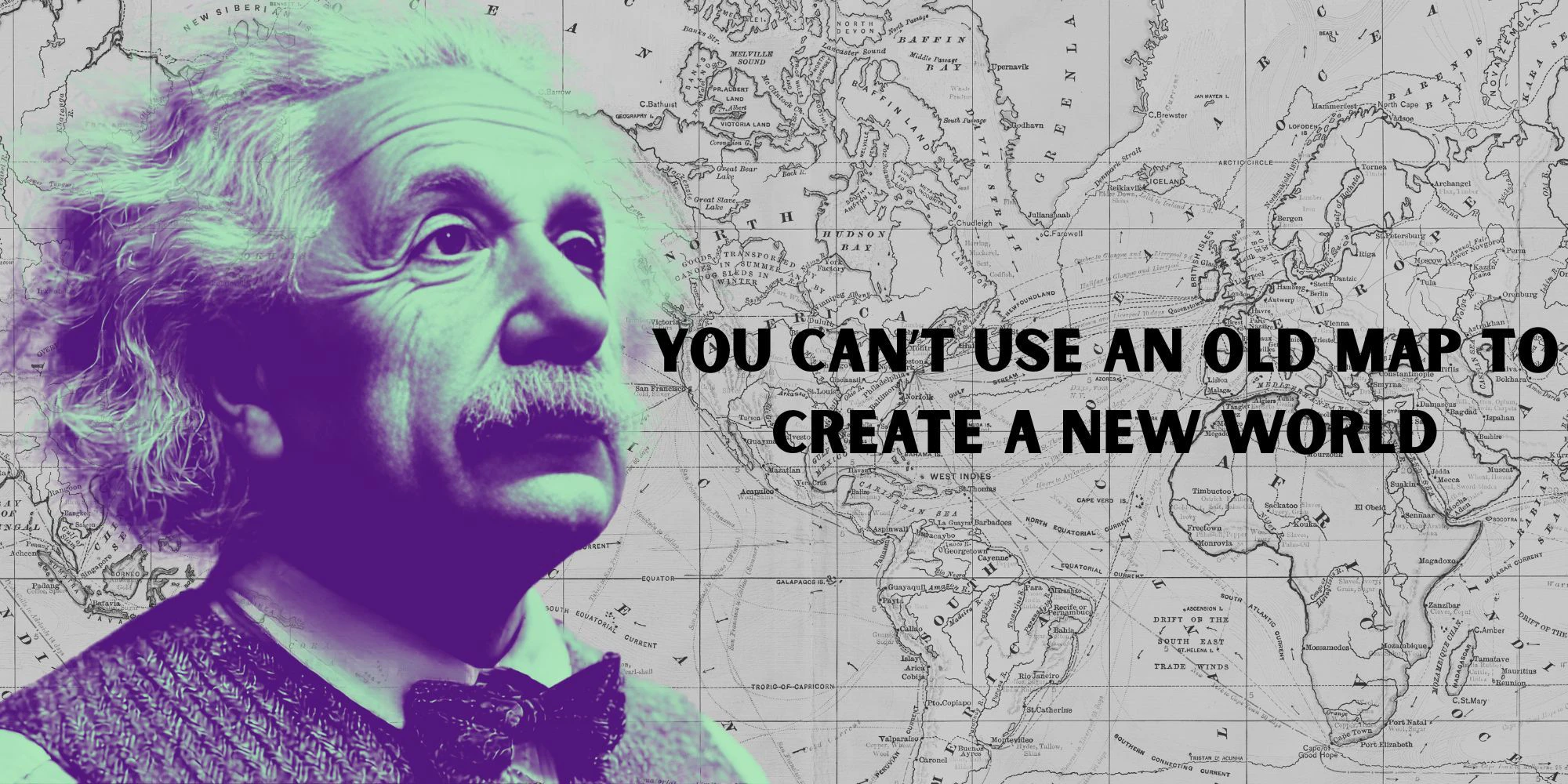

You can't use an old map to create a new world
While widely attributed to Albert Einstein, the idea resonates far beyond physics. It speaks to a fundamental truth about progress: transformation demands new thinking, not recycled frameworks.
The illusion of familiar solutions
In moments of uncertainty, individuals and organisations instinctively reach for what has worked before. Old strategies feel safe. Established models offer clarity. But in a rapidly evolving world, these "maps" often lead nowhere.
Consider how industries approach disruption. Legacy companies frequently try to apply outdated business models to emerging technologies. Instead of reimagining value, they retrofit innovation into old systems. The result is predictable: stagnation disguised as stability.
This is not just a corporate problem. It plays out in careers, education, and even personal growth. We attempt to solve modern challenges with outdated mindsets, expecting different outcomes from the same inputs.
Why old maps fail in new worlds
Every era rewrites the rules. The digital age, for instance, has fundamentally altered how we communicate, work, and create value. Traditional hierarchies have flattened. Information is decentralised. Speed has replaced patience as a competitive advantage.
Old maps fail because they are built on assumptions that no longer hold true. They rely on conditions that have changed, variables that have shifted, and behaviours that have evolved.
Take the workplace. A decade ago, linear career paths were the norm. Today, portfolios, side hustles, and skill stacking define success. Using an "old map" in this context means limiting oneself to outdated definitions of growth.
Reinvention as a mindset
Creating a new world requires more than new tools. It demands a willingness to question deeply held beliefs. Reinvention is not about abandoning the past entirely, but about recognising its limits.
This mindset is evident in the most transformative innovations. Companies that succeed in volatile environments do not just adapt; they redefine the game. They challenge assumptions, rethink customer needs, and build systems designed for the future rather than the past.
On an individual level, this translates into continuous learning. Skills that were relevant five years ago may no longer suffice. The ability to unlearn becomes as important as the ability to learn.
The cost of holding on
Clinging to old maps carries a hidden cost: missed opportunities. When we operate within outdated frameworks, we fail to see emerging possibilities. We optimise for a world that no longer exists.
History offers countless examples. Businesses that resisted digital transformation struggled to survive.
Professionals who failed to evolve found themselves replaced by those who embraced change. The pattern is clear-adaptation is not optional.
Building new maps
If old maps are unreliable, how do we create new ones?
It begins with curiosity. Asking better questions opens the door to new perspectives. It continues with experimentation. Trying, failing, and iterating allows us to navigate uncharted territory. Most importantly, it requires courage-the willingness to step into the unknown without guaranteed outcomes.
The future is not built by those who follow existing paths. It is shaped by those who dare to redraw them.
A principle for the present
The essence of this idea is simple but powerful: progress is incompatible with complacency. Whether in business, technology, or personal life, the path forward demands fresh thinking.
You cannot build tomorrow with yesterday's blueprint. And perhaps that is the real message behind the quote attributed to Einstein-not just a warning, but an invitation.
An invitation to rethink, to reimagine, and ultimately, to create a world that old maps could never have predicted.