
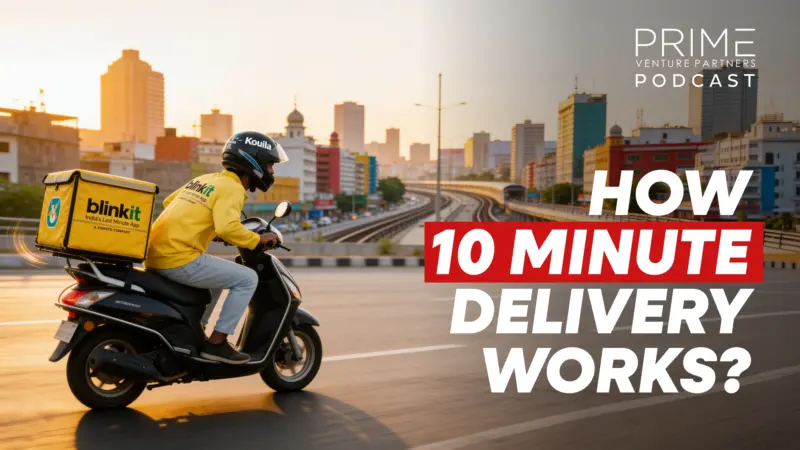

"When you experience quick commerce for the first time, it actually feels magical."
It is an observation most consumers would agree with.
The experience is seamless: a few taps on an app, a short wait, and everyday essentials arrive at the doorstep. What is less visible, however, is the system that makes this possible, one that operates with extraordinary precision, speed, and coordination.
In a conversation led by Brij Bhushan, Managing Partner, Prime Venture Partners, Inamo Co-founders Sumit Anand and Rupesh Thakare, unpack the operational reality behind quick commerce, offering a closer look at a layer of the ecosystem that is rarely discussed but increasingly central.
Recognising the shift early
The origins of Inamo are rooted less in abstract conviction and more in direct exposure. Both founders had spent years operating within consumer internet and supply chain environments, which allowed them to observe the early signals of change.
As Sumit explains, "We could see green shoots. At least one platform was solving the biggest problem in the industry, which is growing average order value (AOV) and online pick-up and delivery (OPD) together. That made us think this could become a very large category."
This realisation came at a time when quick commerce had begun to demonstrate consistent consumer traction, yet its underlying infrastructure remained uneven. Rupesh recounts a similar perspective shaped by his own experience: "I was already seeing the impact of it on our customers. We thought this is a real space and there is a real opportunity."
The opportunity, in their view, was not simply in demand generation but in execution, specifically, in the systems required to sustain and scale this emerging behaviour.
Building in an operationally-intensive layer
Unlike many founders who are drawn to the consumer-facing side of quick commerce, the decision here was to engage with the most operationally demanding part of the stack.
"Most founders will build an app. We had answers to how better than why," Sumit notes. "We knew we could put together a team. We enjoy ops. intensive assignments."
This orientation is evident in the nature of the problems they focus on. Rather than product features or customer acquisition strategies, their attention is directed towards store efficiency, picking speeds, workforce training, and inventory movement, variables that directly influence the reliability of the promise made to the end consumer.
The mechanics of a dark store
A central component of quick commerce infrastructure is the dark store. While often described as a smaller version of a warehouse, this characterisation overlooks its defining principle.
"The best way to imagine a dark store would be miniaturising a large fulfilment centre and placing it right in the centre of customer catchments," Sumit explains. "While a warehouse optimises for space utilisation, a dark store optimises for speed."
This distinction is critical. Every aspect of a dark store, from layout to inventory placement, is designed to minimise time. Once an order is placed, the margin for delay is negligible.
"You get an order, it has to be fulfilled within 15 minutes. Inside the store you get one and a half to two and a half minutes," he adds. Even individual actions are constrained: "Horizontal quick commerce allows you anywhere between 12 to 15 seconds to pick an item."
Such requirements demand not only disciplined processes but also carefully designed systems. As Rupesh points out, "We create simulators so that the workforce can train on workflows before they hit real orders." Given the high turnover typical in this workforce segment, system design must compensate for variability in human execution.
The drivers of rapid adoption
The rise of quick commerce is closely tied to both external circumstances and behavioural shifts. The pandemic, in particular, played a catalytic role.
"Covid has to get a lot of credit. Operators were forced to look at reinventing supply chains," Sumit observes. However, the sustained growth of the category has been driven by habit formation.
"Once consumers experience that convenience, there is no going back," Rupesh notes.
Today, the scale of operations reflects this shift. "It's almost 10 million orders a day," Sumit remarks. Despite this, the category remains underpenetrated. "Customer penetration is barely 10%. There are about 35 to 40 million users compared to 300 million in e-commerce."
This gap suggests that the current phase is still one of expansion rather than consolidation.
Understanding the economics
While the consumer experience appears straightforward, the underlying economics are considerably more nuanced. Revenue is derived from multiple streams, including product margins, convenience fees, delivery charges, and advertising.
"Advertisement is extremely important. You can decide whom your ad reaches," Sumit explains, highlighting the increasing relevance of targeted monetisation.
On the cost side, infrastructure, manpower, and last-mile delivery dominate. Among these, delivery economics are particularly sensitive to utilisation.
"Order per hour is a very important metric," he emphasises. "If you are able to fill up that one hour with enough orders, you don't need to add any incentives."
At the store level, there are already empirical benchmarks. "Anywhere between 1250 to 1400 orders should ideally make you break even." These thresholds underline the importance of density in ensuring viability.
The limits of full stack control
A common assumption is that large platforms will retain complete control over their operations. In practice, the scale and complexity of quick commerce make this difficult.
"It's a very difficult fulfilment model. To do that day in, day out, 24 hours, it is not easy," Sumit notes.
Fragmentation introduces further challenges. "If you outsource 500 stores and each vendor runs two, you are dealing with 250 vendors. Consistency becomes very low." At the same time, even internally managed networks struggle to maintain uniform performance. "Even under their own umbrella, there is no consistent experience across 2000 operating centres."
The issue, therefore, is less about ownership and more about managing distributed complexity at scale.
Emerging structural shifts
One of the inefficiencies increasingly acknowledged within the ecosystem is inventory duplication. As Sumit points out, "You will have four dark stores keeping the same unit in the same area."
This not only ties up capital but also reduces overall efficiency. A potential solution lies in shared infrastructure models.
"If you are able to generate discovery across platforms for the same inventory, you would have a better sell through," he explains. "Aggregation makes more sense. None of these sellers will have enough demand to make a viable business on their own."
Such models, if adopted, could reshape how brands engage with quick commerce, particularly in long-tail categories.
Defining "Quick" in the years ahead
The notion of speed itself is evolving. While grocery has established a 10-minute benchmark, other categories are likely to operate on different timelines.
"I think anything less than the same day will be labelled as quick," Sumit suggests. The appropriate delivery window will depend on category characteristics, demand density, and cost structures.
"If they target something too ambitious, the cost will be too high. If they are too slow, they will lose customers," he adds, indicating that equilibrium will vary across use cases.
Operating in a continuously evolving system
Perhaps the most revealing insight lies in how the founders think about time horizons.
"For us every day is difficult. Planning three months from now is a huge achievement," Sumit reflects.
In a rapidly evolving category, long-term certainty is limited. What remains constant is the need for disciplined execution and continuous adaptation.
As he concludes, "A lot of consumers will experience quick commerce because of us, but they might never know that we facilitated it."
In a system designed to be invisible, that may well be the most accurate measure of success.
(Disclaimer: The views and opinions expressed in this article are those of the author and do not necessarily reflect the views of YourStory.)