

For the past two decades, we have been told that software eats the world.
And it did. The most valuable companies on earth were built on code, distribution, and network effects.
Asset-light. Infinitely scalable. Compounding faster than any factory ever could.
But something is shifting.
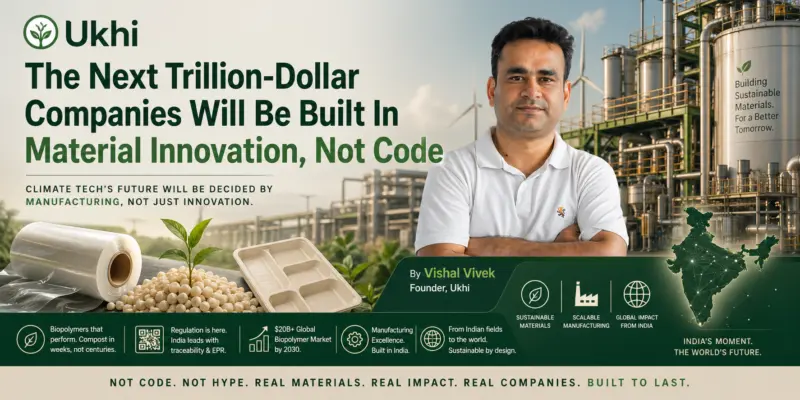
The next wave of truly large companies will not be built in server farms. They will be built in manufacturing plants.
They will smell like chemicals and feedstock. They will be measured not in monthly active users but in kilograms per hour, cost per tonne, and uptime percentages.
And the founders building them will spend less time on stages talking about disruption and more time on production floors solving problems that don't have elegant solutions.
Packaging material is where this is most visible.
Packaging: A system under pressure
Flexible plastics built the modern supply chain. Packaging that is cheap, light, and reliable enough to move food from farms to a billion households is not a small thing. It has enabled scale and affordability at a level that transformed how the world eats, ships, and consumes.
But that system is now under structural pressure from two directions.
The first is regulatory.
Let's take India's example.
India generates 9.3 million tonnes of plastic waste annually.
That's a problem so massive that only strict regulation can change that.
- From July 2025, every piece of plastic packaging is required to carry a QR code or barcode traceable to its producer.
- The government's stated target is 100% recyclable or compostable packaging by 2030.
- Extended Producer Responsibility compliance for compostable plastics is already mandated at 100%.
- Penalties for non-compliance range from Rs 10,000 to Rs 1.5 million, with the addition of daily fines.
So this is not a future conversation. The clock has already started ticking.
The second pressure is economic.
Large brands are not running sustainability pilots anymore. They are restructuring procurement. Packaging decisions that were once made on cost and convenience alone are now tied to compliance timelines, EPR obligations, and long-term supply chain risk. The question has shifted from "should we explore alternatives?" to "where do we find enough of them?"
So demand is immediate. Supply is still forming. That gap is where the next large companies will be built.
The packaging bottleneck nobody talks about
Here is the thing that gets missed in most conversations about sustainable materials.
Innovation is not the bottleneck.
Over the past decade, a remarkable amount of material science has been done. Today, we have biopolymers that perform like plastic, compost in industrial facilities within six to twelve weeks, meet global standards like EN 13432 and ASTM D6400while running existing extrusion and moulding lines without expensive retooling. Ukhi's EcoGran is one such material. And there are so many others as well.
What isn't solved is manufacturing.
For a material to survive contact with a real supply chain, it needs three things simultaneously:
- cost competitiveness,
- performance reliability,
- and consistent availability at volume.
Most alternatives manage one or two. Almost none manage all three. That is why so many promising solutions remain confined to pilot programmes years after their initial announcement.
The transition from a formulation that works in a lab to a product that ships on time, every time, to dozens of industrial customers is a missing rung on the ladder, and that is where most companies trip over.
So, what entrepreneurs like me are trying to solve is not a scientific problem. It is an industrial one.
India's unmined opportunity
India is a net importer of bioplastics.
That single fact should embarrass us, and it should also excite every entrepreneur reading this.
Here is a country with the world's third-largest agricultural base.
A country where farmers burn millions of tonnes of crop stubble every year because nobody will buy it.
A country with cost-competitive manufacturing, a deep base of process engineering talent, and an improving export infrastructure across the value chain.
And yet the sustainable materials that Indian brands are now being legally required to adopt are largely being bought from the US, Germany, the Netherlands, and China.
This is not a capability gap. India has all the right components to build this industry domestically. What is missing is the manufacturing layer: companies willing to do the unglamorous work of building production systems reliable enough that a global brand will stake its compliance programme on it.
There are no subsidies, no GST relief, or production-linked incentives for certified bioplastics. Building in this space means building without a safety net, which is precisely why most people haven't done it yet.
Gap = Opportunity
A useful reference point is what happened in the pharmaceutical industry.
India did not invent the molecules. It mastered the cost discipline and process consistency to manufacture at scale what others had developed, and became a global supplier in the process.
The feedstock is already here. The engineering talent is already here. The domestic market is being forced to move by regulation. The question is simply whether the manufacturing layer gets built in time to capture what's coming, or whether India continues to import solutions that its own fields could produce.
The global biopolymer market is expected to surpass $20 billion by 2030. The companies that capture that opportunity will not be the ones with the most sophisticated chemistry. They will be the ones who figure out operations.
A different kind of climate company
What is emerging, slowly and without much fanfare, is a new archetype - a manufacturing business with a genuine technology edge, building for the long term, in a space where the barriers to entry are operational rather than intellectual.
These companies will be capital-intensive. That is framed as a weakness, especially against asset-light software businesses. But in this category, capital deployed into production capacity is capital that builds defensibility.
Every tonne of reliable output is a reference. Every customer who integrates your material into their line is a switching cost. The moat is not a patent. It is execution, repeated at scale, until you become the obvious supplier.
The founders building these companies tend not to be the loudest voices in the room. They are usually on the production floor, working through a yield problem. They talk about feedstock costs and machine uptime more than they talk about market size. They measure progress in kilograms.
The decade ahead
The transition to sustainable materials is already underway. Regulation is forcing it. Economics will accelerate it. And the supply side is, right now, still catching up.
The companies that define this decade will be the ones that aligned sustainability with economics early, built manufacturing systems that could actually deliver at scale, and had the patience to compound operational capability before the market rewarded it.
India has every ingredient to produce several of those companies. The agricultural waste is sitting in fields. The engineering talent is sitting in colleges. The regulatory demand is sitting in brand procurement pipelines right now, with no domestic supplier large enough to fill it.
The opportunity is not in imagining what these materials could do.
It is in building the factories that make them real.