
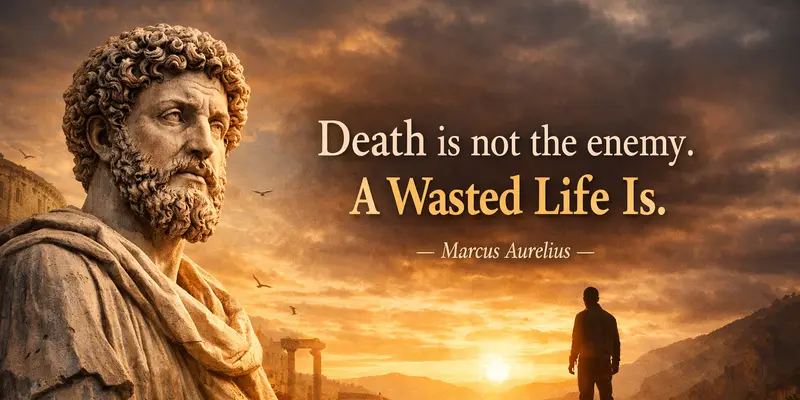

Death is not the enemy, a wasted life is: Marcus Aurelius' timeless lesson
Death is one of humanity's oldest fears. Across cultures and centuries, people have struggled with the idea of mortality and the uncertainty that surrounds it.
Yet the Roman emperor and Stoic philosopher Marcus Aurelius offered a radically different perspective. His reflection, "Death is not the enemy, a wasted life is," challenges the way we think about both life and mortality.
Rather than fearing death, Aurelius urged people to focus on something far more within their control: how they live.
The Stoic view of death
Marcus Aurelius wrote much of his philosophy in Meditations, a personal collection of thoughts recorded while he ruled the Roman Empire during the second century. As a Stoic thinker, he believed that death is a natural part of existence. Every living thing is subject to the same cycle of birth, growth, and eventual decline.
From the Stoic perspective, fearing death is unnecessary because it is inevitable and outside our control. What lies within our control, however, is how we spend the limited time we are given.
This is where Aurelius' quote becomes powerful. The real tragedy is not that life ends, but that people often live without purpose, awareness, or integrity.
The danger of a wasted life
A wasted life, according to Aurelius, is not measured by wealth, status, or fame. Instead, it is defined by the failure to live according to one's values and potential.
Many people spend years distracted by trivial concerns, endless comparison, or pursuits that bring little meaning. They postpone meaningful action, believing there will always be more time later. The Stoics warned against this illusion.
Life is finite, and every day that passes is a portion of our existence that cannot be reclaimed. When people allow fear, procrastination, or comfort to dominate their choices, they risk letting their time slip away without truly living.
In this sense, the real enemy is not death but indifference toward life itself.
Living with awareness and intention
Marcus Aurelius' philosophy does not encourage pessimism. In fact, it promotes a deeper appreciation for life. By recognising the certainty of death, people are encouraged to value the present moment.
Stoicism teaches individuals to focus on meaningful actions: contributing to society, acting with virtue, cultivating wisdom, and building relationships that matter. A life lived with awareness and intention becomes meaningful regardless of how long it lasts.
This idea resonates strongly in modern times. In a world filled with constant distractions, social media comparisons, and relentless productivity pressures, it is easy to drift through life without reflection. Aurelius reminds us that a meaningful life is not built through endless activity but through conscious choices aligned with our values.
A philosophy for modern life
More than eighteen centuries later, Marcus Aurelius' message remains surprisingly relevant. Many people today struggle with anxiety about the future or regret about the past. Stoic philosophy offers a different lens: focus on what can be controlled and accept what cannot.
Death will come eventually to everyone. What matters far more is how we live before it arrives.
If a person spends their life pursuing growth, helping others, and acting with integrity, then death does not diminish that life. But if time is wasted on resentment, distraction, or meaningless pursuits, the loss is far greater.
The real challenge
Marcus Aurelius' quote ultimately asks a simple but confronting question: Are we truly living, or merely passing time?
Death is inevitable. A wasted life, however, is not.
And that is a choice each person makes every day.