




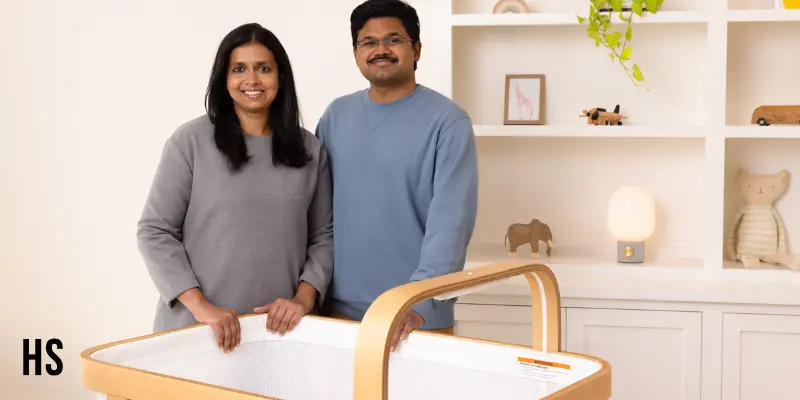

Recently, Sam Altman, CEO of OpenAI, publicly endorsed Cradlewise's smart crib for his newborn through a post on X. It was a moment of validation for its founders Radhika and Bharath Patil who started the company with a pilot of 30 cribs in Bengaluru in 2018.
Over the past seven years, Cradlewise, a YourStory Tech30 company, has navigated a journey of resilience, innovation, and importantly, the understanding of a universal parental challenge-sleep deprivation. Transforming the experience of early parenting, the smart crib has earned high praise from startup founders, CXOs, and celebrities.
OpenAI CEO Sam Altman's post on X recommending Cradlewise
"We were completely unaware and knew that we have a couple of celebrities who have used Cradlewise, but this was out of the world," Radhika shares her excitement about Altman's endorsement. "We were blown over to have his trust, especially when you are having a baby, right? You want to be very careful and want to use trustworthy products."
After helping babies in the US and Canada get nearly 30 million hours of restful sleep, Cradlewise has now brought its game-changing technology to India, where it all began. It is now available on cradlewise.com at Rs 1,59,000 and is shipped within seven days.
A passion project
The Patils, alumni of Indian Institute of Science (IISc), Bangalore, had successful careers-Radhika worked at Qualcomm and Bharath in Texas Instruments before they started Cradlewise as a passion project born out of a deeply personal need.
As young parents, they were looking for a solution to help their baby sleep better during the early months, and also earn some much-needed rest in the process.
Cradlewise was developed as a smart crib and bassinet that uses AI technology to detect early wake-ups and gently soothe babies back to sleep before they cry. Its features include automatic soothing, AI-enabled sleep monitoring, smart sleep insights, and a built-in baby monitor. The crib can be used from birth till the baby is 24 months old.
The initial idea behind Cradlewise was simple yet ambitious: collect sleep pattern data to create an adaptive solution for one of parenthood's biggest challenges.
"Every baby is unique in its sleep pattern, and you cannot have a one-size-fits-all solution. AI is a perfect use case for baby sleep. If your baby sleeps every day for an afternoon nap from 2 to 4 pm, and today the baby woke up at 2:30 pm, then the cradle will know that it's still sleeping time and it will try its best to bounce the baby back to sleep," Radhika describes.
This technology addresses a startling statistic, shares Radhika: "Parents lose 700 hours of sleep the first two years of their baby's life."
The marketing strategy pivot
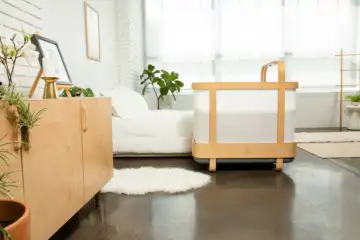
Cradlewise smart crib
Despite developing for the Indian market, Radhika says the direct-to-consumer category was not so popular in India at the time.
"Sleep was not viewed as much of a problem because of the joint family system and the availability of help to care for newborns," she says.
When Cradlewise was selected by HAX, a US-based hardware accelerator that chooses just two startups worldwide each month, they decided to focus on the US market that they believed would open doors to international market and funding.
"In contrast, the American market presented both greater need-with limited maternity leave policies-and greater readiness for smart home technology adoption," explains Radhika.
An exchange programme led them to China to develop the supply chain, and in 2020, they launched Cradlewise in the Bay Area and SF.
The response was encouraging and we had people who travelled 1,300 miles to pick up the crib because it was not available in the rest of the US," Radhika recalls. Cradlewise also won Time magazine's "Best Invention" award in November 2020. The product was officially launched at CES 2021 and became available across the US.
In 2022, the couple shifted manufacturing from China to Vietnam and in 2024, to Pune.
"We have a 20,000 square feet state-of-the-art manufacturing facility in Pune," Radhika says with pride.
"I hail from Pune, which is the automobile hub, and going back there and setting up a factory was like goosebumps for me last year."
Today, Cradlewise maintains operations across two continents-a 65-member tech team in Bangalore developing their AI solutions, 15 hardware specialists in Pune, and a successful sales presence across the US, Canada, and now India.
Important to ease the path for startups
Cradlewise continues to evolve with continuous focus on R&D. Despite the chipset shortages and clogged ocean freight during the pandemic, the company found alternative chipsets to survive through the challenges.
"We added weight detection sensors recently because they are markers for good health," she says.
Its go-to marketing strategy directly focuses on the customer because it relies on trust.
"It was very important to have a direct connection to the customer because it was important for a high-value product like ours. We take pride in calling ourselves the Apple of baby cribs. So, this was important for us instead of going through ecommerce or retail marketplaces," she elaborates.
They continue to receive requests from big box retailers and understand "multi-channel is crucial and parents need at least three to five touch points before making an emotional purchase."
Radhika sees a moment of opportunity for Indian manufacturing, particularly in hardware, especially with the thrust on 'Make in India' and other initiatives.
She believes that if India wants to lead the next wave of innovation in hardware and deep tech, it needs to ease the path for startups building at the intersection of manufacturing and IP.
"Fast-tracking GST refunds, enabling PO-backed financing, and extending PLI beyond consumer electronics are low-hanging fruits. We also need to think long-term about supporting mold development, subsidising wages for factory line workers, and prioritizing customs through Authorized Economic Operator (AEO) status can dramatically reduce friction for early-stage founders," Radhika emphasises.
Her journey as an entrepreneur has shaped her in every way-from building hardware to building teams, from debugging circuits to navigating global logistics and from bouncing ideas to bouncing babies while on calls.
"As an engineer, I learned to think in systems. As a mum, I learned to trust my instincts. As a founder, I've learned to lead with both logic and empathy. And somewhere in the middle of all that, I developed more tenacity than I ever thought possible. Motherhood gave me resilience. Entrepreneurship tested it. And the two together? That's a masterclass in persistence," she says.
The founders want to build an ecosystem of baby products and are looking at launching a toddler bed because as parents point out, "What after two years?" They will also expand to Australia, Dubai and the UK in the coming year.
Edited by Megha Reddy