

It is a tale of two contrasting narratives. On one hand, the ruling Bharatiya Janata Party (BJP) and official government channels paint a picture of a relentless workaholic-a Prime Minister who has not taken a single day off in over two decades.
On the other hand, opposition parties point to parliamentary broadcasts on Sansad TV, highlighting an often-empty seat belonging to the Leader of the House.
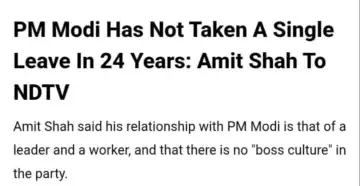
So, how does a leader who works 365 days a year end up facing accusations of chronic absenteeism in Parliament?
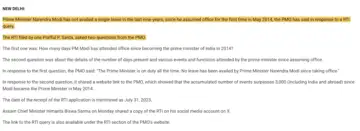
The narrative of Prime Minister Narendra Modi's tireless work ethic is not just a political talking point; it is backed by official government responses. According to multiple Right to Information (RTI) replies from the Prime Minister's Office (PMO)-most recently in 2023-the official stance is clear. The PMO has stated that the Prime Minister is on duty all the time and that no leave has been availed by Prime Minister Narendra Modi since taking office.
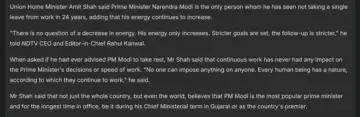
Union Home Minister Amit Shah recently amplified this, praising PM Modi for
While the PMO maintains a flawless attendance record at work, the opposition's ledger tells a drastically different story regarding his presence on the Parliament floor. For over a decade, the opposition has accused the PM of avoiding direct debates and legislative scrutiny. In 2018, the issue gained massive traction when a survey showed 61% of Indians felt Parliament would function better if the PM attended regularly. It escalated to the point where Aam Aadmi Party (AAP) MP Sanjay Singh threatened to file a case in the Delhi High Court, demanding the suspension of any MP-including the Prime Minister-with less than 75% attendance.
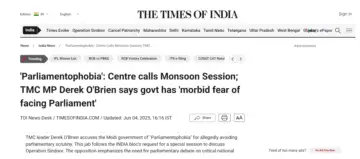
Adding to this, Trinamool Congress (TMC) MP Derek O'Brien has been a relentless critic, claiming in 2021 that the Prime Minister had spent a mere 4 hours in parliamentary sessions throughout the entire year. Critics have sarcastically asked if the PM suffers from "Parliamentophobia," juxtaposing his hours-long election rally speeches with his silence in the House. Furthermore, the criticism peaked during the 2023 Monsoon Session. As Manipur faced severe unrest, opposition parties stalled proceedings, demanding the PM's physical presence and a direct statement in the House. His initial absence during these crucial debates fueled further outrage.
The paradox between the "0 leaves" claim and the "empty chair" reality lies in the structural rules of the Indian government and parliamentary convention. Unlike regular Members of Parliament (MPs), who must maintain a 75% attendance record to claim daily allowances and avoid penalties, the Prime Minister and the Council of Ministers are exempt from signing the daily attendance register. They represent the executive branch. Their duties involve running ministries, managing international diplomacy, and attending cabinet meetings, meaning they are officially "on duty" even when not physically sitting in the Lok Sabha or Rajya Sabha.
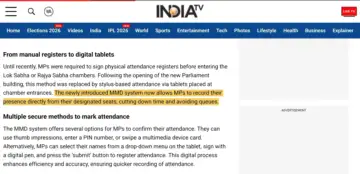
This exemption also applies to modern tracking methods. When Parliament recently introduced the new Multimedia Attendance (MMA) facial recognition system to log MPs, the Prime Minister and his cabinet were officially exempted. While the opposition decried this as special treatment, it perfectly aligns with existing parliamentary statutes that do not require ministers to log daily floor hours. Traditionally, the Prime Minister is not expected to sit through daily parliamentary proceedings. Convention dictates that the PM attends the House during major events, such as responding to the Motion of Thanks on the President's address, facing a No-Confidence Motion, or introducing the Council of Ministers. He is also present on specific days-usually Wednesdays-when questions related directly to the PMO or the departments he heads, like Space and Atomic Energy, are listed for answers.
Traditionally, the Prime Minister is not expected to sit through daily parliamentary proceedings. Convention dictates that the PM attends the House during major events, such as responding to the Motion of Thanks on the President's address, facing a No-Confidence Motion, or introducing the Council of Ministers. He is also present on specific days-usually Wednesdays-when questions related directly to the PMO or the departments he heads, like Space and Atomic Energy, are listed for answers.
Both sides are utilizing facts to fit their political narratives. The PMO is factually correct that the Prime Minister does not take official casual or sick leaves, operating under the framework that the head of government is always on duty. Conversely, the opposition is factually correct in pointing out that his physical presence on the parliamentary floor is sparse compared to regular MPs. Ultimately, the PM is legally immune from standard attendance registers, leaving the "empty chair" not as a violation of rules, but as an ongoing matter of political debate.