





On September 4, while Muslims in Kanpur, Uttar Pradesh, in northern India, celebrated the birth of Prophet Muhammad on Eid al-Milad al-Nabi, a neighbourhood posted an illuminated board that read, "I love Muhammad." Local Hindu organisations objected to this, arguing that a "new tradition" was being implemented in an area that was customarily used for Barawafat festivities.
Social media discussions, police clashes, and formal complaints have heightened the dispute and attracted the attention of religious and political figures.
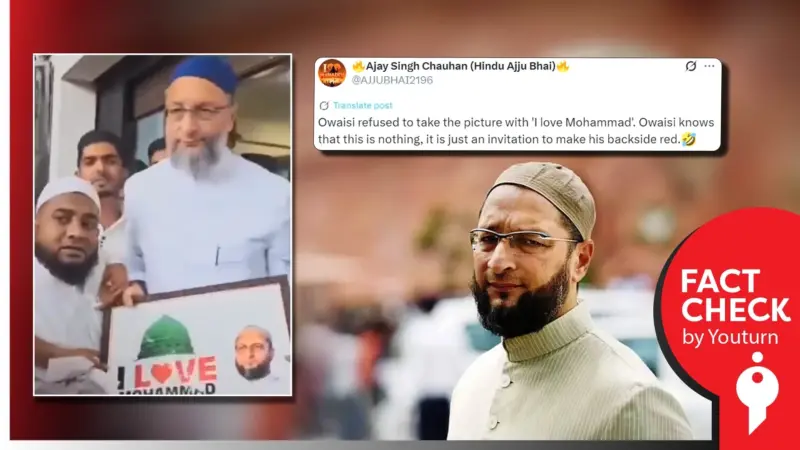
In this instance, AIMIM leader Asaduddin Owaisi can be heard rejecting the photoframe of "I love Muhammad" in a 19-second video. Asaduddin Owaisi's picture, a green dome, and the words "I love Muhammad" were all displayed on the frame.
This post is shared with a caption, "Owaisi refuses to take the 'I love Mohammad' photo. Owaisi knows that this is nothing; it is just an invitation to make his backside red."
A similar post can be viewed
What's the truth?
Using pertinent keywords, such as "Did Owaisi refuse to accept the photoframe?" and "Does Owaisi reject the 'I love Muhammad' frame in the video?", we began our investigation.
This led us to an Instagram post by the Etemaad Daily, which addressed the matter with a screenshot of the viral video showing Owaisi and the photoframe 'I love Muhammad.'
As per the post, "Where is the Gumbad-e-Khazra... Where is it...!" - Asaduddin Owaisi
Some people presented AIMIM President Barrister Asaduddin Owaisi with a photo framed with the words "Sabz Gumbad" and "I Love Muhammad" (peace be upon him). Owaisi's photo was also printed on it. When Asaduddin Owaisi saw the photo frame, he exclaimed, "Where is the Gumbad-e-Khazra... Where is it...!" He then asked to hide his own photo."
https://www.instagram.com/p/DPVlh--D67z/
NDTV also published the same video with the same caption on its X page, which you can view
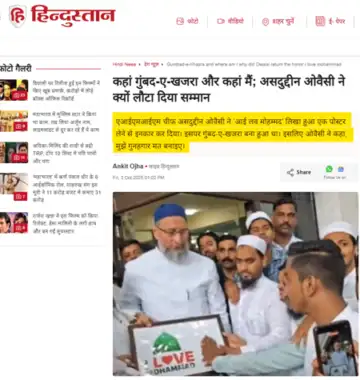
Further investigation brought us to a Hindustan article covering the incident. According to the source, Owaisi was given a picture frame with his photograph adjacent to the Gumbad-e-Khizra.
He said, "Where am I, and where is the Gumbad-e-Khizra? Why are you making me the culprit?
Later, he requested that visitors cover his picture with their hands before giving the picture frame back.
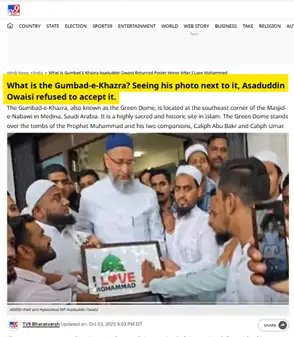
Next, we looked up the meaning of Gumbad-e-Khizra. This led us to a TV 9 Hindi report that discussed the incident and provided a rationale for Owaisi's decision to reject the picture. The Gumbad-e-Khazra, also called the Green Dome, is said to be situated in Medina, Saudi Arabia, in the southeast corner of the Masjid-e-Nabawi. In Islam, it is a very significant and sacred location. Overlooking the tombs of the Prophet Muhammad and his two companions, Caliphs Abu Bakr and Umar, sits the Green Dome.
In this case, a video shows Owaisi rejecting a poster that says, "I Love Mohammad."
Here, Owaisi initially receives the poster with a smile as the supporter offers it to him. Then, when his gaze lands on his image on the poster, which is situated directly adjacent to the Gumbad-e-Khazra, Owaisi first requests that the person hide his picture in the poster. The poster-giver then uses his own hand to conceal his image. Then, "Where is the Gumbad-e-Khazra, and where am I?" Owaisi asks his supporters. Owaisi then instructs the followers to keep the posters. As a sign of respect, they give the posters back. When Owaisi saw his picture next to Gumbad-e-Khazra, he withdrew the honour.
Eventually, we discovered that Owaisi had
The video of AIMIM leader Asaduddin Owaisi rejecting a picture frame with the words "I love Muhammad" on it is evidently shared out of context based on the information above. In actuality, Owaisi had declined the picture frame out of respect because it included Gumbad-e-Khizra's picture next to his own.
Conclusion:
Thus, we conclude that the video of Owaisi refusing to take the 'I love Mohammad' photo frame is shared with misleading claims on social media to create confusion among the people.