

For centuries, happiness was treated as a purely philosophical pursuit-something for poets and thinkers to debate. Today, however, it has evolved into a hard, measurable metric used to gauge a nation's true health.
Released every year on March 20th to mark the UN's International Day of Happiness, the World Happiness Report has become a vital scorecard for policymakers across the globe. The 2026 edition, put together by the Wellbeing Research Centre at the University of Oxford alongside Gallup and the UN, gives us a sweeping look at how 147 countries are faring in terms of life satisfaction.
For India, the 2026 report tells a complicated, fascinating story. On one hand, we are hurtling toward becoming the world's fourth-largest economy, with our GDP projected to hit the $4.5 trillion mark. Yet, on the global happiness index, we are sitting at the 116th spot. While this is a slight improvement from past years, it highlights a glaring paradox: our macroeconomic triumphs on the world stage are not translating into everyday life satisfaction for the common citizen. Furthermore, the 2026 report shines a spotlight on a crisis that is playing out in living rooms across India right now. It highlights the destructive impact of heavy social media consumption on the mental well-being of our youth-an issue that has escalated into a population-level threat.
To truly grasp what these rankings mean for a developing country like India, we first have to look at how the researchers at Oxford actually measure happiness. They do not track fleeting moments of joy or count how often people smile. Instead, they are looking at long-term life satisfaction.
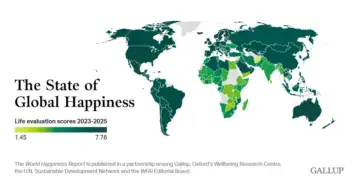 Their primary tool is the Cantril Ladder. During the Gallup World Poll, respondents are asked to imagine a ladder where the bottom rung is a zero and the top rung is a ten. The top represents the best possible life you can imagine for yourself, and the bottom is the absolute worst. People are then asked to honestly rank where they feel they stand right now. To make sure a sudden local crisis-like a temporary economic dip or a natural disaster-does not skew the results, the final rankings are based on a three-year average. For the 2026 report, the data covers 2023 through 2025. This creates a much more stable snapshot of how people are genuinely feeling over time.
While the ladder score determines the ranking, the researchers look at six key pillars to explain why certain countries score higher than others: 1) Gross Domestic Product (GDP) per capita: A measure of average economic wealth per person, adjusted for the cost of living. 2) Social support: Having friends or relatives to count on in times of trouble. 3) Healthy life expectancy: The average number of years a person can expect to live in good health. 4) Freedom to make life choices: How satisfied citizens are with their personal autonomy. 5) Generosity: Measured simply by asking if respondents have donated to charity recently. 6) Perceptions of corruption: The level of trust citizens have in their government and corporate institutions.
To standardize all this data, statisticians use a mathematical baseline called "Dystopia." Imagine a fictional, terrible country populated by the world's least happy people, possessing the lowest possible scores in all six categories. By measuring every real country against this rock-bottom baseline, researchers can clearly see how much each of the six pillars pushes a nation's happiness score upward.
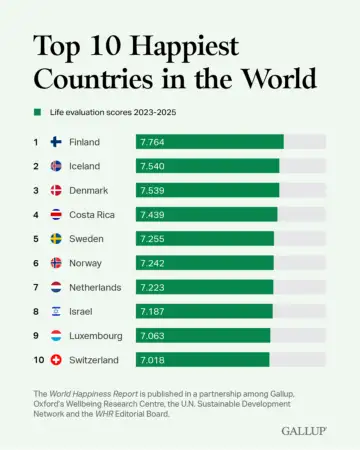
For an incredible ninth year in a row, Finland holds the crown as the world's happiest country, followed closely by its Nordic neighbors Iceland and Denmark. Their secret is not a geographic accident. These countries have engineered societies that combine immense wealth with remarkable equality. Their strong welfare systems ensure that citizens do not face total financial ruin if they lose a job or get sick. Pair that with incredibly high levels of trust-where people genuinely believe their government is transparent and their neighbors are honest-and you get a society that feels incredibly secure.
But the biggest surprise of the 2026 report belongs to Costa Rica.Rocketing up from 23rd place in 2023, the Latin American nation now sits at number 4.

On the flip side, countries torn apart by conflict and poverty remain at the bottom. Afghanistan remains the unhappiest country in the world at rank 147. The situation is uniquely tragic for Afghan women, whose life satisfaction has plummeted due to severe restrictions on their basic freedoms.
There is also a deeply concerning generational shift happening. We used to believe that youth was the happiest time of a person's life. But in countries like the United States, Canada, the UK, and Australia, youth happiness has plummeted drastically. The US has dropped to 23rd overall, and the UK to 29th, largely driven by a mental health crisis among those under 25.
India's position in the World Happiness Report shows a gradual recovery-from 126th in 2023 to 118th in 2025, and now 116th out of 147 countries. However, this remains concerning, especially as neighbors like Nepal (99th) and Pakistan (104th) rank higher, with India only ahead of Bangladesh (127th) and Sri Lanka (134th). The gap is explained by rising expectations. In a fast-growing economy like India, people aspire more, and when infrastructure, jobs, or quality of life don't match those expectations, dissatisfaction increases. Looking at the six pillars: Strong areas: Freedom to make life choices (61st), low perceived corruption (64th), and generosity (78th) Mid-level: GDP per capita (89th) and healthy life expectancy (95th) Weakest: Social support (123rd), highlighting a serious lack of emotional safety despite strong family culture
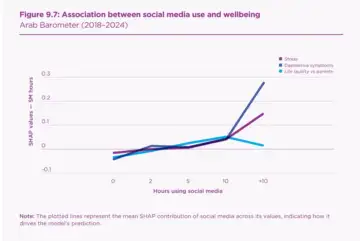
A key issue is the economic paradox. India is projected to reach a $4.5 trillion economy by 2026, yet inequality is stark-the top 10% earn 58% of national income. Constant exposure to wealth via smartphones worsens comparison, leading to dissatisfaction and financial anxiety, especially amid jobless growth and automation. At the same time, urbanization is weakening social bonds. Migration to cities breaks traditional family systems, and even when families exist, emotional support is often limited due to judgment around life choices. This has led to rising urban loneliness.
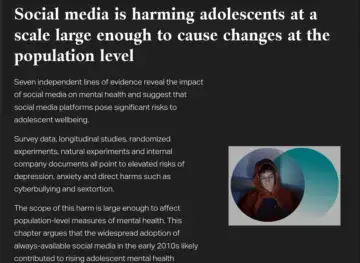
Another major concern is digital addiction among youth. Social media is linked to anxiety, low attention spans, and toxic comparison. In India, with 97 crore internet users, nearly half of urban children spend over 3 hours daily online. Parents report high addiction rates and behavioral issues like aggression and impatience. In response, initiatives like Tele-MANAS, a 24/7 mental health helpline in multiple languages, have handled over 32 lakh calls, showing demand for accessible mental health support. India's happiness challenge is not economic growth but emotional well-being. To improve, the country must reduce inequality, create meaningful jobs, address digital addiction, and rebuild strong, judgment-free social support systems. True progress lies in both economic and human well-being.