
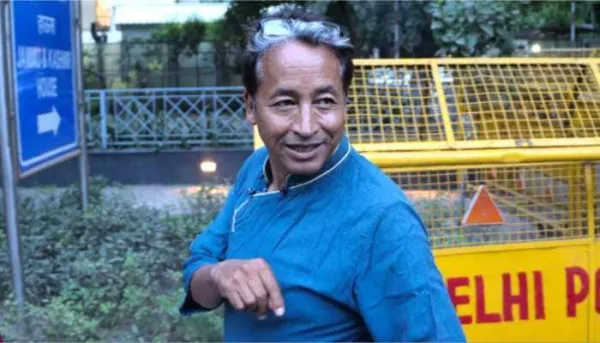

Renowned climate activist Sonam Wangchuk has warned that imprisoning him will not solve the ongoing unrest in Ladakh but could instead escalate tensions further.
His remarks come amid accusations from the Indian government, which blames his "provocative statements" for the recent violence and has initiated action through the Central Bureau of Investigation (CBI).
Wangchuk responded sharply to these allegations, accusing the Union Home Ministry of employing a "scapegoat tactic" by targeting him, while ignoring the root causes of youth frustration, primarily the unfulfilled promises of statehood and constitutional safeguards for Ladakh.
Anticipating his possible arrest under the Public Safety Act (PSA), Wangchuk reiterated that his imprisonment would not affect the ongoing peoples movement in Ladakh but would instead create more complications for the government.
He attributed the recent unrest to the Centre's failure to deliver on its commitments, particularly regarding statehood, environmental protection, and the tribal identity of Ladakh. According to Wangchuk, rising youth unemployment and broken promises have significantly contributed to the current discontent and eventual outbreak of violence.
Rejecting the Home Ministrys allegation that his words incited the mob, Wangchuk maintained that the accusation is a distraction tactic intended to deflect attention from the real grievances of the people.
Wangchuk had recently ended his 15-day hunger strike, coinciding with the eruption of violence. Expressing disappointment over the failure of his peaceful protest, he urged the youth of Ladakh to shun violence, which he believes only weakens their cause.
In an official statement, the Home Ministry accused Wangchuk of making "provocative statements" that allegedly led to mob attacks on a BJP office and government buildings in Leh. The government further claimed that "politically motivated individuals" are trying to derail the ongoing dialogue process.
Meanwhile, the CBI has launched a probe into Wangchuk's institutions, including the Himalayan Institute of Alternatives Ladakh (HIAL) and the Students' Educational and Cultural Movement of Ladakh (SECMOL). The investigation centers on alleged violations of the Foreign Contribution (Regulation) Act (FCRA). Reports also suggest that SECMOLs FCRA license has been canceled due to "repeat violations" of the law.
The government's actions have drawn sharp criticism from both regional and national opposition parties, including the Congress, Left parties, National Conference, and Peoples Democratic Party. These parties have accused the Centre of suppressing democratic rights and disregarding the legitimate demands of the Ladakhi people.
With tensions high, authorities have imposed a curfew in Leh and invoked Section 163 in Kargil. Additional security forces have been deployed across the region in an effort to maintain peace in the fragile Himalayan territory.