
Mercedes-Benz Electric C-Class: one of the year's most ambitious launches. aparece primeiro em AutoGear.
There are new cars, and there are cars that arrive with the responsibility of redefining an entire segment.
The new all-electric Mercedes-Benz C-Class clearly falls into the second category. Not only because it debuts a completely electric platform from the ground up within one of the brand’s most important ranges, but because it carries with it a delicate mission: to convince traditional C-Class customers that the transition to electrification does not mean losing what has always made this model desirable.
Mercedes-Benz knows this. And that is why the discourse surrounding this new C-Class does not revolve solely around batteries, range, or charging times. It revolves around continuity. Identity. Preserving elegance, comfort, intelligence, and sportiness, now reinterpreted in light of a new era. The promise is clear: this is not a deviation in the history of the C-Class. It is its logical evolution.
If it delivers on the road what it promises on paper, we are looking at one of the strongest candidates for reference among premium electric mid-size sedans.
First impression: it looks like a Mercedes, but a next-generation Mercedes
The visual impact of the new electric C-Class is one of its greatest assets. Mercedes-Benz has achieved a particularly difficult balance: creating a car that is immediately recognizable as a C-Class, yet distinct enough to assert its status as a 100% electric model.
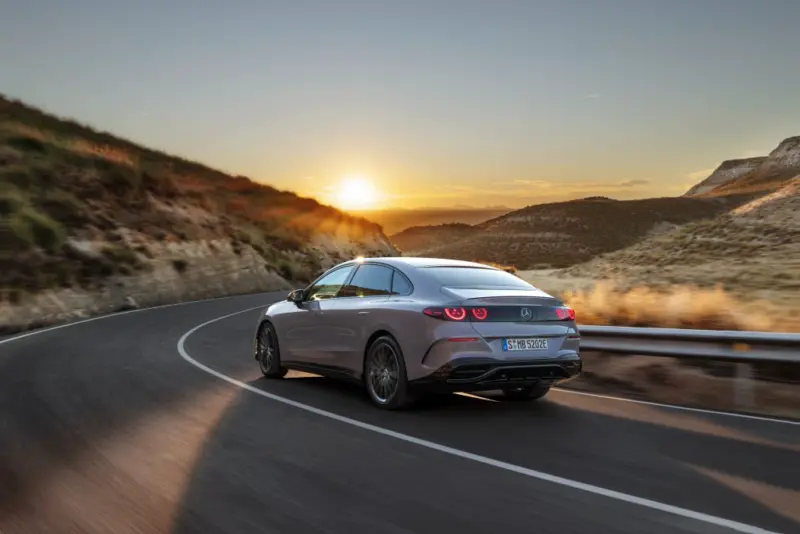
The silhouette is distinctly coupe-like, with a low front, taut roofline, and rounded fastback rear. It is a car that conveys fluidity but also muscle. The rear shoulders are pronounced, the surfaces are clean and taut, and the wheel arches have an almost athletic presence. Nothing here seems gratuitous. Everything has been designed to suggest efficiency and dynamism at the same time.
At the front, the new illuminated iconic grille with 1,050 luminous points is the most theatrical element. It may divide opinions among purists, but it is impossible to deny the scenic effect. The chrome frame, the integrated central star, and the opening, closing, or charging animations give the car a technological and stately appearance that immediately distinguishes it from the competition. The headlights, with a star-shaped light signature, help create a strong, modern visual identity that is very much Mercedes.
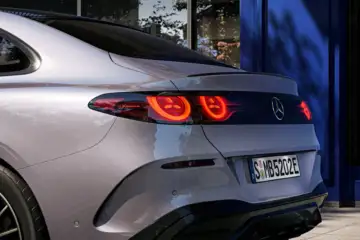
At the back, the tone shifts from sophistication to assertiveness. The GT rear, with four circular red elements in a star design, makes the car appear wider, more planted, and more emotional than one would normally expect from an efficiency-oriented electric sedan.
It is a C-Class that aims to seduce more through its design than through futuristic shock. And that is smart.
Aerodynamics: efficiency without sacrificing presence
Mercedes-Benz announces a drag coefficient starting from 0.22, a very strong figure for the segment. This is not a technical detail lost in the announcement: it is one of the foundations of the car’s character.
In an electric vehicle, aerodynamics serves not only to lower consumption. It serves to increase real range, reduce aerodynamic noise, and improve the feeling of fluidity on the highway. The brand reminds us that an improvement of just 0.01 in the coefficient can translate to an additional 2.5% range on long trips. This helps to understand why the design of the electric C-Class is so clean and so controlled.
From the almost completely closed base to the design of the wheels, through the mirrors, the lower areas of the body, and the shape of the trunk lid, everything has been refined to cut through the air with minimal resistance. And the good news is that the result does not seem like a cold wind tunnel exercise. It remains an elegant, desirable, and visually premium car.
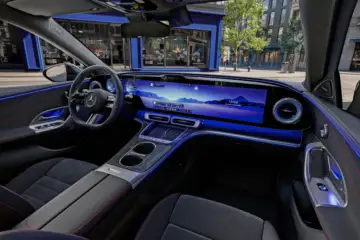
Cabin: the true selling point
If the new electric Classe C impresses on the outside, it is on the inside that Mercedes-Benz really wants to win over the customer. And, at least in theory, there are strong reasons to believe that it can.
The central concept remains “Welcome home,” a phrase that the brand has been using for years, but which takes on new weight here. The goal is not just to create a technological cockpit. It is to create a space where one wants to be. A refuge. A mobile sanctuary.
The entry into the car has been designed almost as a scenic experience. As the driver approaches, they are greeted by exterior animations on the grille and rear lights, ambient sounds, and a luminous and graphic response inside the cabin. It’s the kind of detail that may seem superfluous on paper, but in everyday life helps to build an emotional connection.
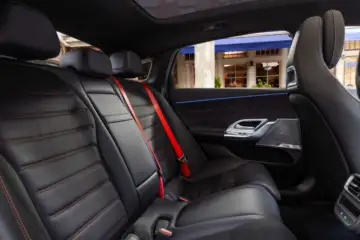
Then, there is the essential question: space. Thanks to the dedicated electric architecture, the new electric Classe C has a wheelbase of 2,962 mm, 97 mm more than the combustion version. This translates to more usable space, especially for front occupants, and also a better sense of openness. Headroom improves in both the front and back, largely thanks to the panoramic roof that comes standard.
Practically speaking, there are 470 liters of trunk space and, something rare in the segment, a truly usable 101-liter frunk. This gives it a versatility that many rivals still cannot offer. Add to that a towing capacity of up to 1.8 tons, and it becomes clear that Mercedes wanted to create more than just a stylish electric vehicle: it aimed to create a complete sedan.
Materials and environment: seriously premium, not just digital
The risk of modern interiors is becoming too dependent on the screen effect. Mercedes-Benz seems to have realized this and tried to compensate with well-crafted materials, textures, and details.
The new electric C-Class promises one of the most sophisticated interiors in its class. There is “Softtorino” synthetic leather, Nappa leather options with a “Twisted Diamond” pattern, specific stitching, open-pore woods, AMG carbon fiber, and even a fully vegan option certified by The Vegan Society. This is not just marketing: it shows a serious attempt to adapt luxury to different sensitivities and lifestyles without falling into simplism.
I particularly liked the attention given to small physical elements. The metallic-effect air vents with a light response to temperature regulation, the new rotary volume control, the well-integrated physical buttons, and the multifunction steering wheel with roller switch show that Mercedes has not completely fallen into the trap of everything-digital. There is still substance. There is still tactility. There is still a mechanical feel in everyday use.
In a segment where many interiors start to look like giant tablets on wheels, that means a lot.
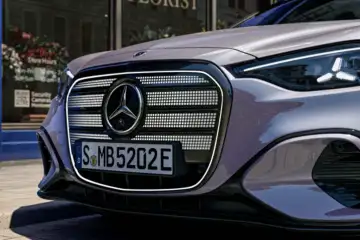
[1] The information is provisional. Neither confirmed values from an officially recognised testing organisation nor an EC type approval nor a certificate of conformity with official values are available to date. Deviations between the data and the official values are possible.
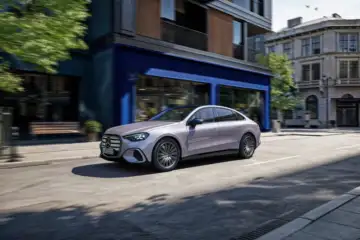
The all-new Mercedes-Benz C 400 4MATIC electric.
Energy consumption combined: 18.6-14.2 kWh/100 km | CO₂ emissions combined: 0 g/km | CO₂ class: A [1]
Exterior: AMG Line Plus; lavender silver
[1] The information is provisional. Neither confirmed values from an officially recognised testing organisation nor an EC type approval nor a certificate of conformity with official values are available to date. Deviations between the data and the official values are possible.
MBUX Hyperscreen: excess or genius?
The centerpiece of the cabin is, unsurprisingly, the new 39.1-inch MBUX Hyperscreen. It is the largest screen ever placed in a Class C and completely dominates the interior environment.
Is it spectacular? Yes. Is it impressive? Without a doubt. Is it necessary? The answer depends on the type of user.
For those who value digital immersion, personalization, entertainment, and a sense of cutting-edge, the Hyperscreen will seem like a masterpiece. It combines three visual areas under a continuous surface, with matrix backlighting, over 1,000 LEDs, and independent brightness levels. The integration is visually very successful and, unlike some rival solutions, it seems designed as a structural element of the interior, not as an accessory.
But the most important thing is that Mercedes promises this system is not only beautiful: it is also more intuitive. The new generation MBUX uses artificial intelligence, has a virtual assistant with memory, combines ChatGPT, Bing, and Google Gemini, allows for customized application folders, and receives OTA updates for virtually all the car’s software.
On paper, it is one of the most advanced systems on the market. In practice, its success will depend on one simple thing: speed, clarity, and absence of friction. If it works as well as it promises, it will be a benchmark. If it complicates basic tasks, all the technological apparatus could become counterproductive.
For now, the benefit of the doubt is on Mercedes’ side.
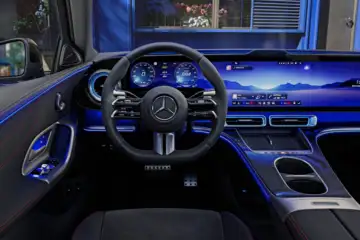
Comfort: this is where you want to be the best in class
The new electric C-Class does not want to be just fast or efficient. It wants to be the best place in the segment to spend time. And perhaps this is where Mercedes-Benz’s ambition becomes most serious.
The front seats seem particularly well thought out. In addition to full electric adjustment and memory, they offer electropneumatic lumbar support, massage, ventilation, and even 4D sound. This, combined with the ENERGIZING COMFORT system, transforms the car into almost a recovery lounge. For those who spend a lot of time behind the wheel, this type of equipment ceases to be a superficial luxury and becomes a real tool for well-being.
The brand also speaks of extremely effective climate control in cold weather, with the cabin heating twice as fast as in combustion models on 20-minute trips at -7 ºC, consuming about half the energy thanks to the new multi-source heat pump. If this is confirmed in real use, it is a very relevant advancement. In an electric vehicle, thermal comfort and efficiency are usually at odds. Here, the promise is to have both.
Sound insulation seems to have received almost obsessive attention. Laminated front windows, high structural rigidity, extensive insulation, new elastomeric supports, and attention to engine noise and the climate control system suggest that the silence on board will be one of the highlights. The brand even hints at a level of refinement close to that of an S-Class. It is a big promise. However, knowing Mercedes’ recent history in ride comfort, it does not seem unreasonable.