
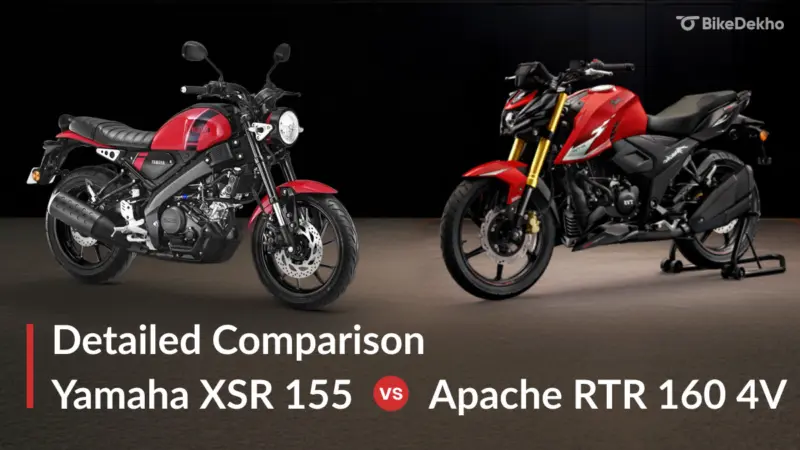

A neo-retro roadster versus a sporty naked: which one should you choose? Let's find out
The Yamaha XSR 155 and the TVS Apache RTR 160 4V both have sporty underpinnings, but they stem from two completely different design philosophies.
Interestingly, many end up comparing the two considering how close they are positioned in the displacement segments. Here's how they fare:
Prices & Variants
Yamaha XSR 155 | TVS Apache RTR 160 4V | ||
Variant | Ex-showroom Price | Variant | Ex-showroom Price |
Metallic Blue | Rs 1,49,990 | Single Disc - ABS | Rs 1.17 lakh |
Vivid Red | Rs 1,52,990 | Single Disc - ABS (Black Edition) | Rs 1.19 lakh |
Metallic Grey | Rs 1,56,990 | Dual Disc | Rs 1.20 lakh |
Greyish Green Metallic | Rs 1,58,990 | Dual Disc - ABS - Bluetooth | Rs 1.23 lakh |
Metallic Black | Rs 1,58,990 | Special Edition | Rs 1.25 lakh |
Dual Channel ABS | Rs 1.27 lakh | ||
Dual Channel ABS - USD Forks | Rs 1.30 lakh | ||
TFT Cluster | Rs 1.37 lakh | ||
Anniversary Special Limited Edition | Rs 1.39 lakh |
The XSR 155 is available in a single, fully-loaded variant (but in different colours at different price points). The company also offers two customisation kits: Scrambler accessory kit and Cafe Racer accessory kit as optional extras.
Meanwhile, the TVS Apache RTR 160 4V allows buyers to choose between eight variants so that customers can choose easily based on their budgets.
Even the top spec RTR 160 4V undercuts the XSR 155 in terms of pricing. However, the XSR justifies its cost with premium hardware and more importantly, a proper liquid-cooled engine.
Design & Dimensions
Specification | Yamaha XSR 155 | TVS Apache RTR 160 4V | Difference |
Wheelbase | 1,330mm | 1,357mm | -27mm |
Ground Clearance | 170mm | 180mm | -10mm |
Kerb Weight | 137kg | 144 kg | -10kg |
Seat Height | 810mm | 800mm | +10mm |
Fuel Tank Capacity | 10 litres | 12 litres | -2litres |
The Yamaha XSR 155 offers better agility and flickability, thanks to its shorter wheelbase and lighter kerb weight.
Despite offering a higher ground clearance, the RTR 160 4V should feel a bit more approachable to shorter riders due to its slightly lower seat height.
The modern-classic theme of the XSR 155 includes a round headlamp, sculpted teardrop tank, and a ribbed seat.
On the other hand, the RTR 160 4V has a muscular, aggressive, completely modern streetfighter appearance. It features a sharp headlamp, and a muscular fuel tank with extensions, along with a raised tail section and a stubby exhaust.
Ride & Handling
Specification | Yamaha XSR 155 | TVS Apache RTR 160 4V |
Frame Type | Deltabox | Double cradle Split Synchro Stiff Frame |
Front Suspension | Inverted fork | Telescopic fork / Upside down fork |
Rear Suspension | Link-type Monoshock | Monoshock |
Front Brake | 282mm Disc | 270mm Disc |
Rear Brake | 220mm Disc | • 240mm Disc ( dual-channel ABS variants) • 200mm Disc (single-channel ABS variants) • 130mm Drum (Base and Black Edition) |
Front Tyre | 100/80-17 | 90/90-17 (Tubeless) |
Rear Tyre | 140/70R-17 | • 130/70R-17 ( dual disc variants) • 110/80-17 (variants with front disc) |
The XSR 155 is based on a Deltabox frame and a cast-aluminium swingarm, offering high rigidity and sharp handling.
The lower variants of the RTR 160 4V come equipped with a telescopic fork, while its top-spec trims get an upside-down fork. Both have a monoshock, but the difference becomes prominent when you ride them one after the other. The suspension of the XSR 155 is tuned on the firmer side for handling, while that of the RTR 160 4V is for comfort.
The XSR 155 features slightly larger brakes with dual-channel ABS as standard, offering impressive stopping power. The RTR 160 4V, on the other hand, comes with varying front disc sizes, and also either a single-channel ABS or a dual-channel ABS. We recommend getting the one with dual-channel ABS as it offers much better safety while emergency braking.
Both motorcycles ride on 17-inch alloy wheels; however, the XSR 155 might deliver slightly better grip with its wider tyres.
Features & Tech
Features | Yamaha XSR 155 | TVS Apache RTR 160 4V |
Headlamp | LED | • LED • LED Projector (Top Variant Only) |
Instrument Cluster | Digital LCD Display | • TFT (Top Variant) • LCD (All Other Variants) |
Connectivity | Y-Connect (Bluetooth) | SmartXonnect (Bluetooth) |
Navigation | Not Available | Turn-by-Turn |
Traction Control | Standard | Only on Top Variant |
Riding Modes | Not Available | Sport, Urban, and Rain |
ABS | Dual-Channel (Standard) | • Dual-Channel (Mid to Top Variants) • Single Channel ABS (Below Mid Variant) |
Both offer all-LED lighting, however, the top-spec version of the TVS bike comes with a LED projector unit, offering better illumination.
A digital instrument cluster with Bluetooth connectivity is common to both. However, the RTR 160 4V gets voice assist and turn-by-turn navigation.
Both come with a slip-and-assist clutch, but the RTR 160 4V also offers adjustable brake and clutch levers on the higher-end variants.
Both the top variant of the RTR 160 4V and XSR 155 get traction control. TVS, however, offers an advanced system with three riding modes, so you can switch according to the riding conditions.
Engine & Performance
Specification | Yamaha XSR 155 | TVS Apache RTR 160 4V |
Engine | 155cc, Single-Cylinder, Liquid-cooled | 159.7cc, Single-Cylinder, Air/Oil-cooled |
Power | 18.4PS @ 10,000 rpm | 17.55PS @ 9,250 rpm |
Torque | 14.2Nm @ 7,500 rpm | 14.73Nm @ 7,500 rpm |
Gearbox | 6-Speed with slip-and-assist | 5-Speed with slip-and-assist |
The RTR 160 4V's engine is air-cooled with an oil-cooler. The radiator should keep the oil temperatures in check whereas the engine is cooled by passive air-flow. On the other hand, the liquid-cooled engine of the XSR 155 offers better heat management as the engine is cooled via a coolant fluid.
The XSR produces slightly more power, while the RTR delivers slightly better torque also at lower revs..
The XSR 155's engine uses Variable Valve Actuation (VVA) technology making it more rev-happy and offering a better top end, while also not compromising on low-end grunt. While that makes it a better, fun option on open roads, the RTR 160 is more usable in everyday conditions due to its stronger mid-range.
In terms of acceleration, the XSR 155 feels slightly faster and also has a higher top speed than the RTR 160 4V.
Both motorcycles deliver more or less similar mileage in most riding conditions.
Verdict
Despite sharing a sporty spirit, both have personalities that make them feel different. The Yamaha XSRc155 is for those who appreciate retro aesthetics with thoroughly modern underpinnings. It feels premium and is light, and is actually performance-oriented.
The TVS Apache RTR 160 4V, on the other hand, is a pretty straightforward motorcycle. It looks sharp and goes fast; you can feel its sporty intent in the design itself. It is for riders who prioritise everyday usability, and features - all wrapped in a value-for-money package.
It is not about which one is better, but more about which one suits your riding style and fits your requirements well.
Other Rivals
Despite the Hunter 350 having a much larger engine, the XSR 155 is quicker and livelier.
The MT-15 looks aggressive, while the XSR 155 is all about retro flair while also not compromising on performance.
With an upright seating posture, the XSR 155 is more comfortable than the R15.
The Honda CB150R is a better proportioned neo-retro roadster compared to the XSR 155
While the XSR 155 offers a great top-end punch, the Honda CB190SS delivers better low- to mid-range torque.