




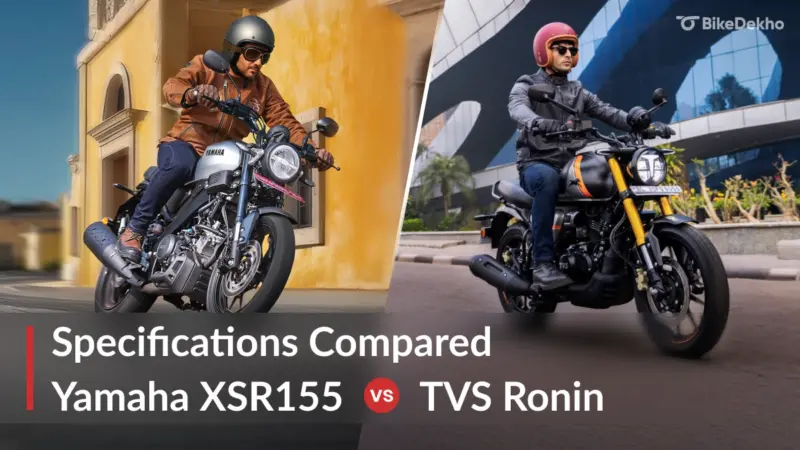

Two similarly powerful retro roadsters, and here's how their specs stack up against each other
The recently launched Yamaha XSR155 goes up against the TVS Ronin.
Both bikes are entry-level retro roadsters. In this specifications comparison, we will be taking the mid-variant of the TVS Ronin and comparing it with the Yamaha XSR155 to see which one wins.
Engine
Specifications | Yamaha XSR155 | TVS Ronin |
Engine | 155cc, liquid-cooled, single-cylinder | 225.9cc, air and oil-cooled, single-cylinder |
Power | 19.3PS @ 10,000rpm | 20.4PS @ 7,750rpm |
Torque | 14.2Nm @ 7,500rpm | 19.93Nm @ 3,750rpm |
Gearbox | 6-speed, slip and assist clutch | 5-speed, slip and assist clutch |
The Yamaha XSR155 is the more modern bike out of the two, with a liquid-cooled engine. The engine produces its peak power at the top-end of the rev range. This should make the bike a lot more fun in the twisties, where you can really push the engine to its limits.
The TVS Ronin, on the other hand, is a bit more old-school with its air-cooled engine. Also, it makes most torque quite early in the rev range. This should make the bike feel a lot more engaging in the city and also perfect for relaxed cruising on the highways.
Underpinnings
Specifications | Yamaha XSR155 | TVS Ronin |
Frame | Deltabox frame | Double Cradle Frame |
Front suspension | Inverted fork | Inverted fork |
Rear suspension | Monoshock | Monoshock (7-step adjustable) |
Front brake | 282mm disc | 300mm disc |
Rear brake | 220mm disc | 240mm disc |
Front tyre | 100-section | 110-section |
Rear Tyre | 140-section | 130-section |
Both models feature similar suspension setups, but the TVS Ronin has a 7-step preload-adjustable monoshock. This should make it easy for the rider to adjust the tuning to their liking.
However, while it seems like the Ronin would have a braking advantage because of bigger brake discs, they are so because of its heavier weight.
Dimensions
Specifications | Yamaha XSR155 | TVS Ronin |
Wheelbase | 1,325mm | 1,357mm |
Ground clearance | 170mm | 181mm |
Fuel tank capacity | 10 litres | 14 litres |
Seat height | 810mm | 795mm |
Kerb weight | 137kg | 160 kg |
On paper, the TVS Ronin is 23kg heavier than the Yamaha XSR155. This will be felt when moving the bike around in the parking lot. Another major difference between the two is the wheelbase. The Ronin has a longer wheelbase, which should make it a lot more stable when cruising down the highways.
The Yamaha XSR155's shorter wheelbase should result in more nimble handling, which will be quite useful when cutting through city traffic. Lastly, the TVS Ronin's larger 14-litre fuel tank will offer better touring range, while the XSR155's 10-litre tank is more suited to city commutes.
Features
Feature | Yamaha XSR155 | TVS Ronin |
Instrument Cluster | Fully digital LCD | LCD console |
Call/SMS Alerts | Yes | No |
Navigation | No | No |
ABS | Dual-Channel | Dual-Channel |
ABS Modes | No | Yes |
Both models are quite basic in terms of features, but the Ronin has the slight advantage with the ABS modes.
For a more detailed breakdown of the features, you can read our features comparison here.
Price & Verdict
Yamaha XSR155 | TVS Ronin Mid-variant | |
Price (ex-showroom, Delhi) | Rs 1,49,990 (introductory) | Rs 1,47,290 to Rs 1,48,590 (Depending on colour scheme) |
Both bikes are similarly priced, but are aimed at different kinds of riders. The Yamaha XSR155 is a simple, retro city bike which should be able to handle occasional weekend rides. The TVS Ronin is a more touring-friendly machine which can handle both city commutes and longer trips.
The Yamaha XSR155 also goes up against the Royal Enfield Hunter 350 in the retro-roadster segment. We had done a similar comparison earlier between the two to see which one wins.