
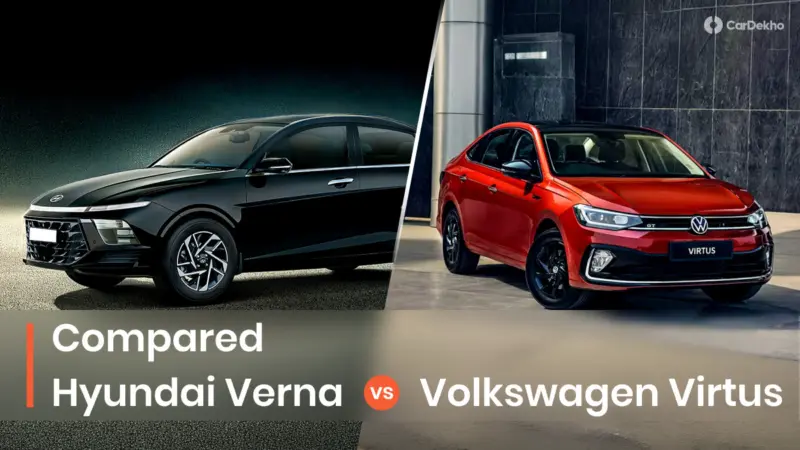

Hyundai recently launched the facelifted Verna, which gets slightly updated exterior elements and an upgraded interior with more features. After the upgrades, the Verna now gives a tougher fight to its competition, which includes sedans that are due for an upgrade.
One such sedan is the Volkswagen Virtus, which has been ruling the sedan segment since its launch.
While both cater to buyers looking for a practical family sedan that offers space, features and powerful engine options, they differ in styling, features, and powertrain. So in this report, we take you through a detailed comparison between these two sedans, comparing their prices, dimensions, features and powertrain options:
Price
Model | Hyundai Verna | VW Virtus |
Price (ex-showroom) | Rs 10.98 lakh to Rs 18.25 lakh | Rs 10.5 lakh to Rs 19 lakh |
There is a price difference of around Rs 50,000 for the entry-level variants.
Top-spec variants of the VW Virtus are more expensive by around Rs 75,000.
Overall, the pricing of both these sedans is similar, and it would mostly come down to the discounts and offers that VW and Hyundai are offering.
There are higher chances of getting a better deal and good discounts on the Virtus, because of the fact that it is an older car when compared to the Verna facelift.
Let's find out what you get for similar money:
Dimensions
Parameter | Hyundai Verna | Volkswagen Virtus | Difference |
Length | 4565 mm | 4561 mm | (+4 mm) |
Width | 1765 mm | 1752 mm | (+13 mm) |
Height | 1475 mm | 1507 mm | (- 32mm) |
Wheelbase | 2670 mm | 2651 mm | (+19 mm) |
Both Virtus and Verna are nearly identical in size.
The Verna is marginally longer and wider, and also has a larger wheelbase.
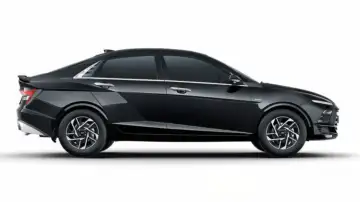
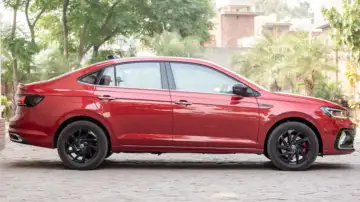
The Virtus, on the other hand, is fairly taller than the Hyundai sedan.
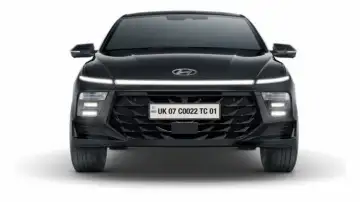
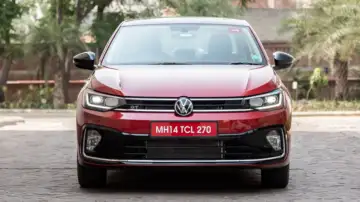
We expect the Verna to offer slightly more cabin space, mainly due to the extra width and wheelbase.
Powertrain
When it comes to powertrain options, both Virtus and Verna only get petrol options. The Verna's entry-level engine is a 1.5-litre NA petrol unit, while that of the Virtus is a 1-litre turbo-petrol engine. Here's a quick look at all the powertrain options in detail:
Let's take a look at the specifications:
Model | Hyundai Verna | Volkswagen Virtus | ||
Engine | 1.5-litre NA petrol engine | 1.5-litre turbo-petrol | 1-litre turbo-petrol | 1.5-litre turbo-petrol |
Power | 115 PS | 160 PS | 115 PS | 150 PS |
Torque | 144 Nm | 253 Nm | 178 Nm | 250 Nm |
Transmission | 6-speed MT, CVT | 6-speed MT, 7-speed DCT | 6-speed MT, 6-speed AT | 7-speed DCT |
MT- Manual Transmission, DCT- Dual Clutch Transmission (automatic)
AT- Automatic Transmission (torque converter), CVT- Continuously Variable Transmission (automatic)
As seen above, both Verna and Virtus come with 1.5-litre turbo-petrol engines, catering to those who seek performance and drive more on the highways.
The Verna's turbo-petrol mill offers more power, but the difference is not a lot.
In terms of automatic transmission as well, both come with a 7-speed DCT for the top-spec turbo-petrol engines.
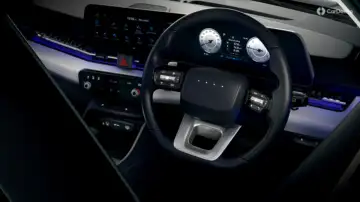
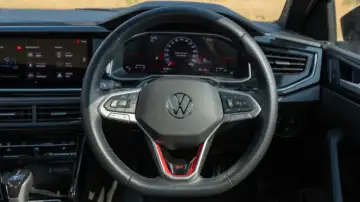
Hyundai offers a CVT with the NA petrol engine, and VW offers a torque converter with its 1-litre engine.
You miss out on a manual transmission with the Virtus' 1.5-litre turbo-petrol engine. So, if you want a powerful engine with the control that you get with a manual, you would have to opt for the Verna.
Features
Feature | Hyundai Verna | VW Virtus |
Auto Headlamps | ✅ | ✅ |
Foglamps | LED | Halogen |
LED Taillamps | ✅ | ✅ |
Wheels | 16-inch alloy wheels | 16-inch alloy wheels |
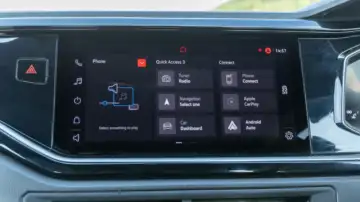
Infotainment | 10.25-inch touchscreen | 10-inch touchscreen |
Wireless Apple CarPlay/Android Auto | ✅ (via wired-to-wireless adapter) | ✅ |
Instrument Cluster | 10.25-inch digital display | 8-inch display |
Height-adjustable Driver Seat | ✅ | ✅ |
Wireless Phone Charger | ✅ | ✅ |
Sound system | 8-speaker Bose sound system | 8-speaker sound system |
Push-button start/stop | ✅ | ✅ |
Ventilated front seats | ✅ | ✅ |
Powered seats | ✅(6-way driver/4-way co-driver) | ✅(6-way) |
Memory function for the driver's seat | ✅ | ❌ |
Ambient lighting | ✅ | ✅ |
Paddle shifters | ✅ | ✅ |
Powered tailgate | ✅ | ❌ |
Cooled Glovebox | ✅ | ✅ |
Connected Car Tech | ✅ | ✅ |
Cruise Control | ✅ | ✅ |
Climate Control (AC) | Automatic | Automatic |
Keyless entry | ✅ | ✅ |
Airbags | 7 | 6 |
Parking sensors | Front and rear | Rear |
ISOFIX child seat mounts | ✅ | ✅ |
Electronic parking brake with auto hold | ✅ | ❌ |
360-degree camera | ✅ | ❌ |
Rear defogger | ✅ | ✅ |
TPMS (Tyre Pressure Monitoring System) | ✅ | ✅ |
ADAS | ✅ | ❌ |
As seen above, the Verna clearly offers more in the features department. It comes with extras such as larger displays, a branded audio system, memory function for the driver side seat, and even a powered tailgate.
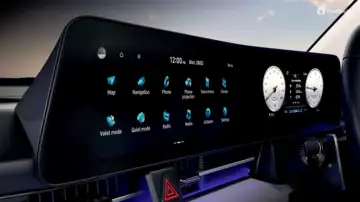
The Verna also gets better safety equipment with features like a side centre airbag, front parking sensors, a 360-degree camera, and even level-2 ADAS.
Both sedans have secured 5-star ratings in Global NCAP crash tests.
Overall, it is the Verna that will give you a more premium cabin due to its extra features over the VW Virtus.
CarDekho Says
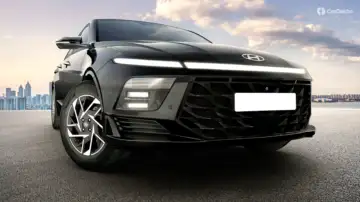
Both the Hyundai Verna and the Volkswagen Virtus bring a strong case to the midsize sedan segment, but they appeal to slightly different kinds of buyers. The Verna stands out with its feature-rich cabin, more modern technology, including ADAS, and a slightly more powerful turbo-petrol engine. It also offers a wider range of convenience features that make daily driving and long journeys more comfortable.
The Virtus, on the other hand, continues to appeal to enthusiasts and those who prioritise driving dynamics, build quality, and a traditional European driving feel. While it may not match the Verna feature-for-feature, it still delivers where it matters with solid performance and a well-balanced ride. With the Virtus, you can also get VW's GT lineup which comes with sporty styling and a reputation among enthusiasts.
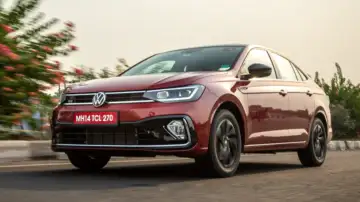
If you want the most tech-loaded and feature-packed sedan in this price bracket, the Verna is likely to be the better pick. But if your priority is driving dynamics, and want a sportier looking car with a decent set of features, the Virtus remains a very compelling option. Ultimately, the choice between the two will depend on your taste and preferences, and we recommend you to take a proper test drive of both these cars with your family to understand them better.
If you want to take a closer look at the Verna facelift, you can check out this story. Those who want to know the differences between the Verna facelift and pre-facelift can head over to this report.
Which sedan would you choose? Let us know in the comments below.