




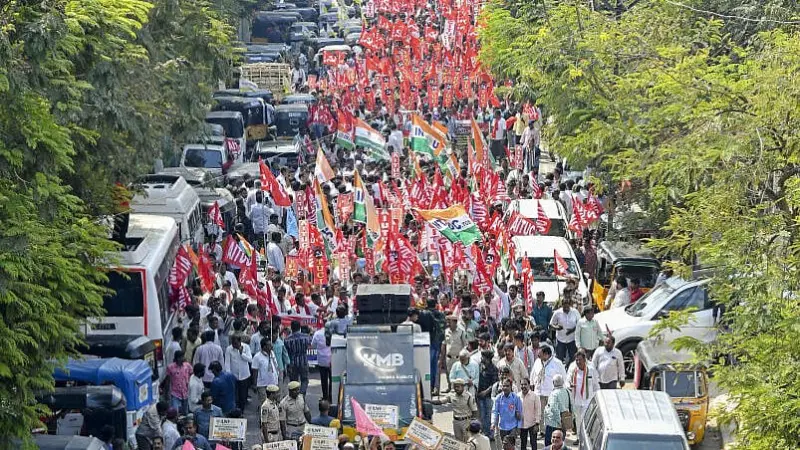

The May 9 evening saw workers rising in unison to burn copies of rules on four Labour Codes across the country. Only hours before, the rules and 29 related notifications were published in the gazette, setting in motion the full operationalisation of the contentious Codes.
The Code on Wages, 2019, the Industrial Relations Code, 2020, the Code on Social Security, 2020 and the Occupational Safety, Health and Working Conditions Code, 2020 had a tumultuous run, with the last three being passed amid an Opposition boycott of parliamentary proceedings in September 2020.
The operationalisation of the contentious Codes, which the Opposition and 10 central trade unions oppose, was dependent on the union government notifying the rules, and it came a few days ago, after the results of the latest round of Assembly elections. The draft rules were notified on December 31 last year.
As soon as the rules notified on May 8 were publicised in the gazette the next day, Opposition-linked trade unions were up in arms, especially highlighting certain omissions, like criteria for calculating minimum wages, which in the draft had included the well-established formula.
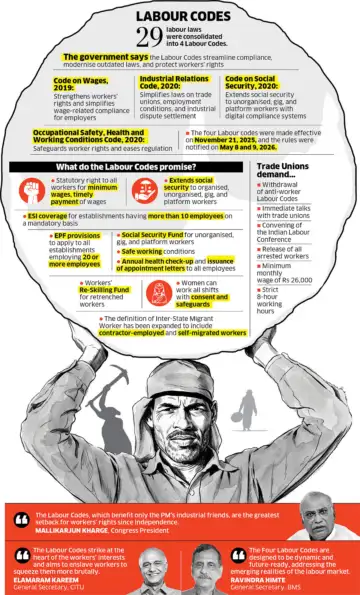
The formula for fixing minimum wage suggested in the draft was linked to the net intake of 2,700 calories per day per consumption unit and 66 metres of clothing per year per standard working-class family, among other things. But it was missing the final rules, which said it shall be fixed on a day-to-day basis, keeping in view the criteria which shall be "separately specified by the Central Government by special or general order".
A national floor wage, which acts as a mandatory baseline that prohibits any state from setting minimum wages lower, will be decided by the Centre in consultation with an advisory board and states. A normal working day will be of eight hours, having a weekly cap of 48 hours, and a social security fund will be established for the unorganised sector and gig workers, the rules noted.
Greatest setback for workers' rights since Independence: Congress on new labour codesCongress president Mallikarjun Kharge, a former Labour Minister in the UPA government, was among those who highlighted the dropping of the "specific criteria" for calculating minimum wages using calorie intake, clothing needs, rent and fuel costs, among others. He warned that the minimum wages would be set, not according to a set of guidelines and norms, but according to the arbitrary whims of the Modi government, resulting in lower minimum wages.
Labour Minister Mansukh Mandaviya defended the Codes, saying the new legal framework provides equal wages for equal work to both men and women. Employment will be generated only when industrialists create wealth and pay taxes, he adds.
Concerns were also raised by several sections about the new salary structure, where basic salary must be 50% or more of the total remuneration, creating trouble for Micro, Small and Medium Enterprises (MSMEs). The insistence on digital compliance could squeeze MSMEs, some argued.
The CPI(M)-affiliated Centre of Indian Trade Unions (CITU) argues that the Codes would snatch almost all rights and entitlements of workers. It claimed that basic rights related to defined working conditions, including working hours, minimum wages and any form of collective expressions of protests like strikes, are being "snatched away together with atrocious and vindictive punitive measures against any collective dissent by the workers".
"In essence, the Labour Codes are a blueprint to impose conditions of virtual slavery on the working people in the interests of the corporate or employers' class," the CITU said.
The trade unions point to the recent crackdown on workers in Noida in the Delhi-NCR. The workers were protesting against low pay and demanding better working conditions while opposing the Codes.
The protests by the workers were also reported from Lucknow and Mathura in Uttar Pradesh, Manesar, Faridabad and Sonipat in Haryana, Alwar and Bharatpur in Rajasthan, Rudrapur, Haridwar and Haldwani in Uttarakhand, Pithampur in Madhya Pradesh and Bhatinda and Mandi Gobindgarh in Punjab since April.
Protesting workers and their leaders face the "anti-national" tag and stringent laws, while the West Asia war has triggered a fuel crisis, prompting migrant workers, especially, to leave cities for their villages. With miseries adding to their lives, workers are restless, with trade unions warning that they will implode.