





The Government of India has notified the Rules to implement the four labour codes, which were enacted in 2019 and 2020. The rules will make the implementation of the codes possible in practice.
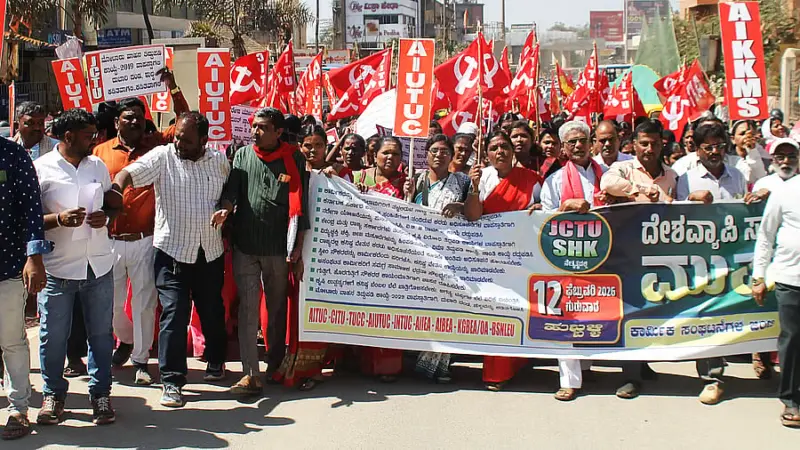
The enactment of the four labour codes will not fundamentally change labour law administration. The four labour codes amalgamate 29 existing labour laws. The majority of provisions in the existing laws were retained, and certain provisions were modernised and updated. In certain cases, the safeguards protecting the interests of the working class were lowered in the new codes. Trade unions and scholars ventilated their grievances, and workers protested. One expectation was that certain regressive elements would be addressed by the rules.
The rules to implement the Code on Wages have given a vague definition of 'floor wage' and have not clarified how it differs from minimum wage. Also, they did not lay down the ground rules for setting minimum wages. The present convention of taking three units for a four-member family is likely to continue. This implies the continuation of gender discrimination, as female members are given 0.8 weightage vis-à-vis one for male members.

Authors Kingshuk Sarkar (left); Sanjay Mehrotra (right).
Further, the rules provide that the hourly wage would be determined by dividing the daily wage by eight. Conceptually, this is a flawed approach because, in our informal economy, workers often work part-time. The hourly wage should be determined based on the 8-hour time rate, as the worker might not find work in the remaining hours. Internationally, the hourly minimum wage is computed independently of the daily wage. This becomes important because of the millions of domestic and gig or platform workers.
The Social Security Code Central Rules do not make any attempt to demystify the employer-employee relationship in gig work. Gig and platform workers remain self-employed and part of the unorganised labour force. The rules are silent about the mandatory insurance for gratuity payment mentioned in the code. Insurance could be a safeguard for workers suffering from non-payment of gratuity. The modalities for such insurance should be clearly laid out in the rules, but that is absent. The absence of social security defines informality globally; 90% of Indian workers are informal.
The Industrial Relations Code Central Rules say that, in the case of a single registered trade union, a minimum 30% membership is required for recognition. So, in a large establishment, smaller registered trade unions cannot be recognised. This makes it impossible for a small or new trade union to emerge. The bargaining power of trade unions has been in decline over the past four decades. The rules also fail to clarify the engagement of fixed-term employees. They do not specify the exact duration required to qualify for FTE status, leaving the provision vulnerable to exploitation.
The rules for the Occupational Safety and Health Working Conditions Code provide for safety and welfare provisions for occupations listed in the code. However, welfare provisions are missing (e.g. medical/housing facilities for plantation workers). The rules do not specify the activities in which contract labour can be engaged. This is significant because India has witnessed increasing use of contract labour in core activities, too, which is prohibited. There is still no clarity on what constitutes a core activity.
The notification of the rules heralds the implementation of the Labour Codes almost six years after they were enacted. But they belie any hope of mitigating the adverse impact of certain regressive aspects of the codes.
(Kingshuk Sarkar is Professor of Economics and Public Policy at the Goa Institute of Management, Goa, and Santosh Mehrotra is ex-Professor, JNU, and Visiting Professor, Centre for Development Studies, University of Bath, UK)