
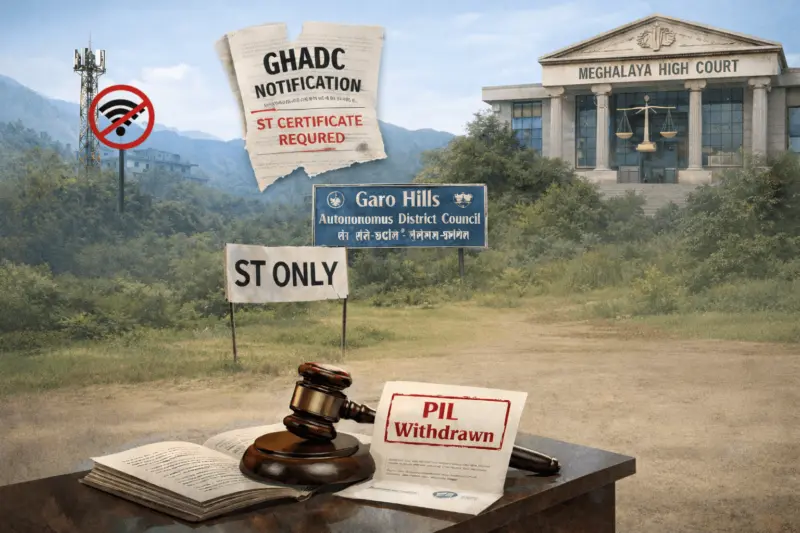

The High Court of Meghalaya on March 9 allowed petitioner Niksrang Ch Marak to withdraw a Public Interest Litigation (PIL) that had challenged the participation of non-tribals in the upcoming Garo Hills Autonomous District Council (GHADC) elections.
The petition had raised questions over whether non-tribal candidates should be allowed to contest the elections scheduled for April 10.
The Division Bench comprising Chief Justice Revati Mohite Dere and Justice W Diengdoh permitted the withdrawal after the petitioner's counsel sought leave to withdraw the case. The court clarified that it had not examined the merits of the petition and that all contentions by the parties remain open.
The withdrawal of the PIL has not ended the controversy surrounding the GHADC elections.
Instead, it has come amid escalating tensions in West Garo Hills following protests, violence and administrative restrictions triggered by a broader dispute over a GHADC notification requiring candidates to possess Scheduled Tribe (ST) certificates to contest the polls.
The root of the unrest
The root of the controversy lies in a notification issued by the Garo Hills Autonomous District Council on February 17 mandating that candidates contesting the GHADC elections must produce a Scheduled Tribe certificate issued by the Meghalaya government.
The council argued that the requirement is necessary to safeguard the customary laws, traditions and socio-political identity of the indigenous tribal communities of the Garo Hills under the Sixth Schedule of the Constitution.
Under the notification, Returning Officers and Assistant Returning Officers have been directed to verify ST certificates during scrutiny of nomination papers. Failure to produce a valid ST certificate will be treated as a defect of substantial character and will result in rejection of the nomination.
The move effectively bars non-tribal individuals from contesting seats in the council. While several tribal organisations have defended the mandate as a step necessary to protect indigenous identity and customary governance, non-tribal leaders have criticised the order as unconstitutional.
Critics argue that only Parliament has the authority to amend provisions under the Sixth Schedule and that the council's decision restricts democratic participation in local governance.
The notification has triggered intense political debate across Meghalaya, particularly in the Garo Hills region where the GHADC plays an important role in administering tribal land, customary institutions and local governance under the Sixth Schedule framework.
The council has also issued another directive invoking its constitutional powers to restrict non-tribals from acquiring or claiming land in the five Garo Hills districts. According to the notification, non-tribal persons cannot acquire, purchase, possess, inherit, lease or claim rights over land in the region.
Officials said the measure was intended to prevent alienation of tribal land and protect traditional ownership patterns. The council clarified that the order would not affect non-tribals who had legally inherited or acquired property prior to existing land transfer regulations.
What have the politicians said?
The GHADC notification has drawn reactions from political leaders across party lines, reflecting the complexity of the issue.
Meghalaya Pradesh Congress Committee chief Vincent H Pala said that the notification would remain valid unless it is legally challenged and overturned by the courts.
He stated that until a legal challenge succeeds, the order will continue to remain in force.
Leader of Opposition Mukul M Sangma also called on the state government to provide clarity on whether the ST certificate requirement will be enforced in the upcoming elections.
He said the government must remove any ambiguity in order to prevent confusion during the election process.
Sangma emphasised that elections to the district council are an important democratic exercise linked to the constitutional mandate of the Sixth Schedule, which was designed to safeguard the identity and governance systems of tribal communities.
Meanwhile, internal differences have emerged within political parties as well.
Trinamool Congress MLA Rupa M Marak clarified that a move by party legislator Dr Md Mizanur Rahman Kazi to meet Meghalaya Governor CH Vijayashankar regarding the issue was taken in his personal capacity.
Kazi had urged the Governor not to give assent to the GHADC notification mandating ST certificates for candidates.
Marak said the meeting had not been authorised by the party leadership and that the TMC would seek an explanation from the legislator. She added that the party supports the GHADC notification but urged the state government to clarify whether the rule would apply in the upcoming elections.
On the other hand, BJP leader and Tura MDC Bernard N Marak defended the notification and urged the Governor to protect the definition of "permanent resident" under the rules governing the GHADC.
He argued that existing rules under the Assam and Meghalaya Autonomous Districts (Constitution of District Councils) Rules, 1951 distinguish between permanent and temporary residents.
According to him, individuals who are not members of recognised Scheduled Tribes may only participate in the electoral process if they qualify as permanent residents. Temporary residents holding short-term lease pattas should not be able to claim such rights.
He urged authorities to uphold the Sixth Schedule framework to ensure that the rights of indigenous communities are not diluted.
Violence and tensions on the ground
The political and legal debate escalated into violence in West Garo Hills when former MLA SG Esmatur Mominin attempted to challenge the ST certificate requirement.
Mominin arrived at the Deputy Commissioner's office in Tura to file nomination papers for the GHADC elections despite the new rule mandating ST certificates.
He and his supporters were reportedly assaulted by unidentified miscreants while attempting to file the nomination.
Another group of his supporters was reportedly attacked near Hawakhana later in the day. While officials have not confirmed the extent of injuries, local reports suggested that one person was seriously hurt.
Following the attack, Mominin withdrew his nomination attempt and indicated that he may approach the High Court of Meghalaya seeking legal remedy.
The incident triggered tension across Tura, with a shutdown reportedly called by an unidentified group. Volunteers also gathered outside the Deputy Commissioner's office to prevent non-tribal candidates from filing nominations.
In a suspected retaliatory incident, the office of the Garo Students' Union in Chibinang was set on fire by unidentified miscreants.
Authorities said the situation in parts of the plain belt remained tense following the clashes.
Actions taken by authorities
In response to the escalating tensions, the West Garo Hills district administration imposed several restrictions to prevent further unrest.
Deputy Commissioner Vibhor Aggarwal issued an order under Section 163 of the Bharatiya Nagarik Suraksha Sanhita imposing a night curfew in sensitive areas of the district.
The curfew applies from 6 pm to 6 am in areas under the Phulbari, Rajabala, Hallidayganj and Tikrikilla police stations.
The order prohibits unauthorised processions, unlawful assemblies of five or more persons and the carrying of weapons such as sticks and stones.
Authorities said the decision was taken after recent incidents raised concerns about possible communal tension and a breach of peace between different community groups.
The Meghalaya government also ordered a 48-hour suspension of internet services across West Garo Hills district starting midnight on March 10.
The order was issued by Secretary to the Government FR Kharkongor under provisions of the Indian Telegraph Act and the Temporary Suspension of Telecom Services Rules.
Officials said the decision followed reports from the Deputy Commissioner and district police about physical assaults, large gatherings and the spread of misinformation through social media platforms such as WhatsApp, Facebook, X and Instagram.
Authorities said the suspension was necessary to prevent the misuse of social media that could further incite unrest or spread rumours.
As the nomination process for the GHADC elections continues until March 16, the administration has said it is closely monitoring the situation and undertaking mediation efforts to restore peace in the region.