

In a hill state where food supplies have long depended on winding mountain roads and weather-beaten highways, the arrival of a freight train carrying rice from the plains of Punjab marked more than a routine delivery.
It was, in many ways, the arrival of a new supply chain.
A 42-wagon cargo train rolled into Sairang railway station carrying about 25,900 quintals of rice for the Food Corporation of India (FCI). For Mizoram, the event was historic: the first-ever foodgrain cargo rake delivered to the state by rail.
As workers began unloading sacks of rice at the modest but fast-evolving terminal, officials described the moment as a turning point in the region's logistics network - one that could transform how essential commodities reach the state.
For decades, Mizoram's supply lines depended overwhelmingly on trucks navigating narrow hill roads from Assam. The new rail connection offers a far more stable route for bulk goods, potentially reducing transportation costs, travel time and supply disruptions.
A Rail Line Years in the Making
The breakthrough was made possible by the 51.38-km Bairabi-Sairang railway line, inaugurated in September 2025. The line effectively brought the state capital Aizawl - located about 20 km from Sairang - onto India's railway map for the first time.
Built through rugged terrain marked by steep slopes and fragile geology, the project required numerous tunnels and bridges, making it one of the most challenging railway constructions in India's Northeast.
Its strategic significance is now beginning to show.
The arrival of the FCI rice cargo demonstrates that the line is not merely symbolic connectivity but an operational freight corridor capable of handling bulk food supplies.
Officials say the development could improve the reliability of the Public Distribution System (PDS) in Mizoram, which serves a large section of the population.
"Railways allow us to move essential commodities in bulk more efficiently," a railway official involved in freight operations said. "For a remote hill state like Mizoram, this changes the logistics equation."
Freight Operations Begin to Expand
Since the line became operational, freight traffic has been gradually increasing.
Between April 2025 and March 2026, the Sairang terminal handled more than 30 freight rakes, indicating a steady rise in rail-based cargo movement into the state.
Much of the cargo so far has supported construction and infrastructure activity. According to railway data, the terminal has already handled around 20.5 rakes of stone chips, four rakes of sand, 3.5 rakes of cement, two rakes of automobiles and half a rake of fertilisers.
The diversity of cargo is significant. It signals that the railway is evolving into a multi-commodity logistics hub, helping supply materials needed for infrastructure development across Mizoram.
In December 2025, the station also handled its first automobile rake carrying 119 passenger vehicles, demonstrating the line's ability to transport higher-value consignments.
Railway officials say additional logistics services are also being planned, including refrigerated parcel vans that could allow farmers to ship fruits, vegetables and other perishables to markets outside the state.
For a region known for horticulture - particularly oranges, passion fruit and spices - such services could open new market access.
Tourism Finds a New Route
The railway's impact is also being felt beyond freight yards.
Improved connectivity has begun to draw tourists to a state long considered one of India's most remote destinations.
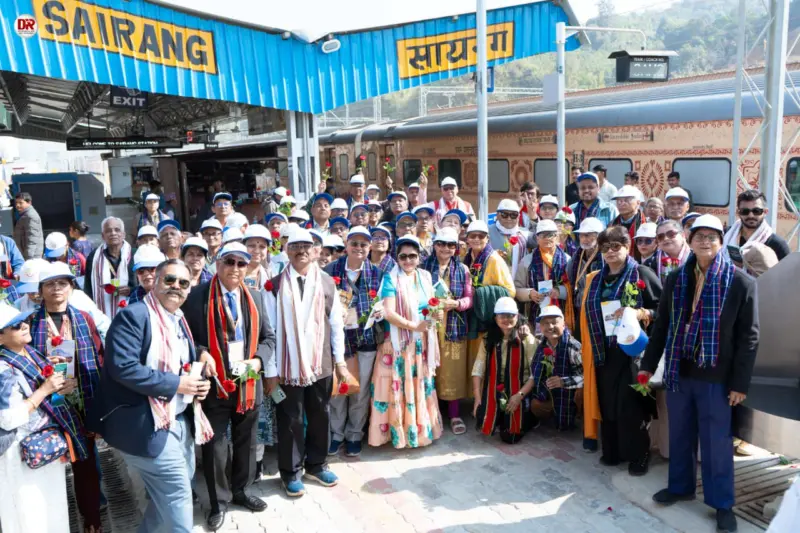
In February, Sairang station welcomed the Bharat Gaurav Deluxe AC Tourist Train for the first time under the "North East Discovery" circuit. The train carried 81 tourists, including visitors from across India as well as from countries such as the United States and Nepal.
Tourism officials say easier rail access is slowly raising Mizoram's profile among travellers seeking eco-tourism, culture and relatively unexplored landscapes.
Local hospitality operators report that visitor numbers have been steadily rising over the past six months, creating new employment opportunities in hotels, homestays and tour services.
Passenger Demand Surges
Passenger traffic on the new railway route has also exceeded expectations.
The Sairang-Anand Vihar Rajdhani Express, which connects the state to Delhi, has reportedly been running with occupancy levels exceeding 150 per cent in both directions.
Other services have seen similarly strong demand.
The Sairang-Guwahati Express and the Sairang-Kolkata Express are regularly recording full or near-full occupancy, reflecting how quickly residents have embraced rail travel.
Earlier this year, another link was added when a Sairang-Silchar train service was launched in February. The route connects Mizoram with the Barak Valley in Assam - a key regional centre for education, healthcare and commerce.
A Turning Point for a Hill State
For many residents, the railway represents more than convenience. It represents inclusion.
Mizoram was one of the last states in India to be connected to the national rail network, largely due to its mountainous geography and relatively small population.
The new line is therefore seen as a major step towards integrating the state with national markets.
Economists say the long-term impact could be significant: lower logistics costs, more reliable supply chains, new tourism flows and expanded market access for local produce.
The arrival of a trainload of rice from Punjab may seem routine elsewhere in India. But in Mizoram, it signals the start of a logistical transformation - one wagon at a time.