
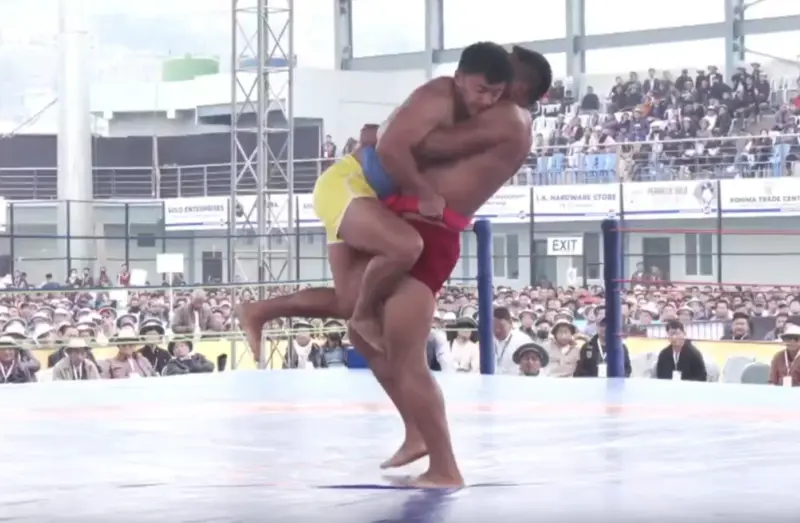

Kohima: Deeply rooted in culture, Naga traditional wrestling has evolved from a centuries-old community practice into Nagaland's only indigenous sport played professionally.
Once used by villages to settle disputes and strengthen bonds, the sport now attracts major crowds to organised championships statewide.
With structured tournaments, growing prize money and institutional support from the Nagaland Wrestling Association (NWA), the traditional grappling sport has steadily moved beyond its village origins while retaining its cultural significance.
The recently held 30th NWA Naga Traditional Wrestling Championship and the first Wrestling Festival in Kohima once again highlighted how the sport continues to bridge tradition and modern competition, serving as a powerful symbol of identity, pride and unity for the Naga people.
Naga wrestling, played professionally at the state level, continues to draw thousands to major championships organised by the Nagaland Wrestling Association (NWA).
The sport's enduring relevance was on display when more than 15,000 people gathered at the remodelled Khuochiezhie (Kohima Local Ground) to witness the 30th Naga Traditional Wrestling Championship organised by the Nagaland Wrestling Association (NWA).
Held alongside the state's first Naga Wrestling Festival on March 6 and 7, organised by the NWA in collaboration with the Department of Tourism and Ministry of Tourism, the event highlighted how the sport continues to bridge tradition and modern competition, preserving its cultural roots while gradually expanding its reach.
The sport has also produced several celebrated wrestlers whose achievements have earned them widespread recognition across Nagaland.
Prominent names such as Venuzo Dawhuo, Kezhaseluo-o Pienyü, Menuosetuo Yiese, Venu Vadeo, and so on, are widely regarded as among the sport's leading figures today.
But within Naga society, the sport represents far more than physical prowess.
Wrestlers often refer to their opponent as "khrietho-u", a word in the Tenyidie language meaning beloved friend, reflecting the deep respect and brotherhood embedded within the tradition.
Growing professional platform
Today, Naga wrestling has grown into a structured competitive sport with organised tournaments and professional recognition.
The Nagaland Wrestling Association conducts two major tournaments in alternate years: the Naga Wrestling Championship, which is restricted to the three traditional wrestling tribes, and the Open Naga Wrestling Championship, allowing participation from other tribes and athletes from outside the state.
The annual Hornbill Festival also hosts the Hornbill International Naga Wrestling Championship, which has helped expand the sport's visibility and attract competitors from across India.
Prize money has also increased significantly over the years, with champions receiving substantial financial rewards and, in some cases, plots of land donated by supporters, a symbol of the high regard the community holds for its wrestlers.
This year's championship featured 54 wrestlers: 18 each from the Angami Sports Association, Chakhesang Wrestling Association and Zeliang Wrestling Association.
Defending champion Kezhaseluo-o Pienyü retained his title, receiving a 100 ft × 100 ft plot of land in Chümoukedima, donated by Puleho Pusa, along with a cash prize of Rs 6 lakh, a medal and a citation.
Menuosetuo Yiese finished as runner-up and was awarded Rs 3 lakh. Venuzo Dawhuo and Venu Vadeo secured third and fourth positions, respectively, receiving Rs 2 lakh and Rs 1.5 lakh.
All quarter-finalists were awarded Rs 20,000 each, while every participant in the championship received Rs 10,000 as a participation award.
In the team category, the Chakhesang Wrestling Association was declared the group champion and received a cash prize of Rs 60,000.
New categories of the sport
Historically practised by the Angami, Chakhesang and Zeliang tribes, the sport originated as a way for villages to settle disputes peacefully while strengthening communal ties. Over time, many other communities introduced the grappling sport.
The 2026 championship also marked a significant expansion in the competition structure with the introduction of the Provisional Category, held for the first time in the tournament's history.
Six provisional units of the NWA took part in the new provisional category, signalling growing interest in Naga wrestling beyond its traditional base. Representing the Sumi Wrestling Association, Pukiye Shohe emerged as champion and received a cash prize of Rs 2 lakh.
Yankithung Shitiri of the Lotha Wrestling Association finished as runner-up, earning Rs 1 lakh. Third place went to Lumthsa Sangtam, while Jochuhyu Semy of the Rengma Wrestling Association secured fourth place. They received prize money of Rs 80,000 and Rs 60,000 respectively.
The Provisional Championship featured eight wrestlers, each from six provisional NWA units: the Lotha, Sumi, Pochury, Rengma, Chang and Sangtam wrestling associations.
The championship also introduced the first NWA Under-15 category, offering a platform for young athletes to showcase their talent. Menuokhriezo Metha of the Angami community emerged as champion and received Rs 1 lakh in prize money. Mudoto Dozo from the Chakhesang community finished as runner-up, taking home Rs 80,000. Third place went to Kütho Puro, while Chüre Pohena secured fourth position. They received prize money of Rs 60,000 and Rs 40,000 respectively.
Celebrating heritage
Addressing the gathering on March 7, Nagaland Chief Minister Neiphiu Rio described Naga traditional wrestling as a celebration of the Naga people's identity, heritage, and indomitable spirit. Calling the sport a "living heritage" passed down from forefathers, Rio said it represents not only physical strength but also character and integrity.
He noted that the championship and festival had brought people together through culture, sports and a shared sense of belonging.
The chief minister also appreciated the efforts of the Nagaland Wrestling Association for preserving and promoting the indigenous sport while safeguarding its traditional essence. He expressed satisfaction that the sport, once largely confined to the Tenyimia region, has now spread to other parts of the state.
Calling wrestlers ambassadors of Naga culture, Rio encouraged them to push beyond their personal limits and continue improving. On the occasion of the 30th championship, he urged the public to renew its commitment to preserving traditions while embracing progress.
He also reaffirmed that the state government remains committed to promoting sports infrastructure and supporting indigenous games alongside modern sporting disciplines, creating opportunities for young athletes to compete at regional, national and international levels.
As part of the event, Rio distributed financial assistance of Rs 1,00,000 each from the Chief Minister's Sports Fund to the six provisional wrestling bodies.
National support for indigenous sport
President of the Wrestling Federation of India, Sanjay Kumar Singh, attended the event as the honoured guest.
Singh congratulated organisers on the championship reaching its 30th edition, describing it as a significant milestone in the promotion of traditional wrestling in the region. He also announced financial assistance for the procurement of equipment and assured that proposals related to the development and promotion of wrestling would be approved in the coming financial year.
Emphasising the importance of expanding the sport beyond the state, he said efforts would be made to introduce Naga traditional wrestling at the national level.
In his presidential address, NWA president Vivolie Kezo urged the public to support wrestlers beyond the arena, stressing the need to make it a sustainable sport.
Tradition adapting to change
Despite its deep-rooted history, the sport has gradually adapted to changing social norms.
In earlier times, wrestlers competed wearing traditional loincloths, and strict customs governed the arena. Women were not allowed to watch matches or enter the wrestling ground.
Over the years, these restrictions have eased. Wrestlers now compete wearing half-pants, standardised rules have been introduced, and women are regular spectators at major wrestling events.
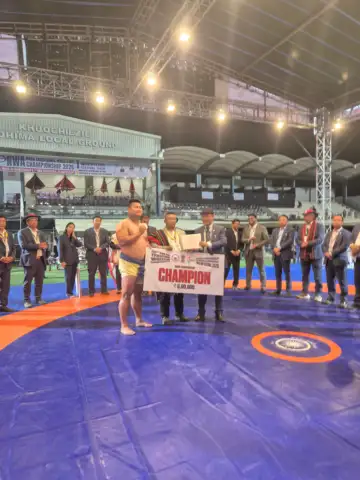
A significant milestone came in 2025 when 29 women participated in the Open Naga Wrestling Championship in Kohima for the first time. The move sparked both celebration and debate, with some praising the step toward inclusivity while others voiced concerns about preserving the sport's traditional character.
Wrestlers from outside the state and even other countries have also participated in open championships organised by the Nagaland Wrestling Association and its federating units over the years, reflecting the sport's gradual expansion beyond its traditional base.