
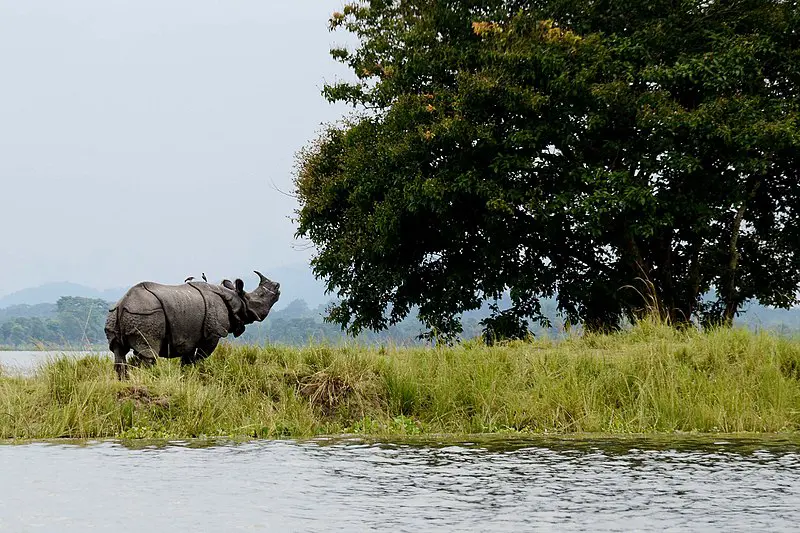

Guwahati: Kaziranga's sweeping grasslands and thriving rhino population may look timeless today, but new research shows the park's landscape has been continually reshaped by climate shifts, forests, and large animals over thousands of years.
A study published in
The findings challenge the idea that Kaziranga has always been an open grassland system and instead point to a far more dynamic ecological past.
According to the researchers, the earliest phase, between 3,290 and 1,700 years ago, paints a very different picture of Kaziranga.
"Our data show that between about 3,300 and 1,700 years ago, Kaziranga was dominated by a dense tropical mixed forest under warm and humid climatic conditions, with comparatively lower wildlife activity than at present," the authors note.
Tree species such as Mesua, Cinnamomum, and Duabanga were widespread, while grasslands were limited. The study suggests that large herbivores were present but far less abundant than they are today.
A major ecological shift began around 1,700 years ago. Evergreen forests started to decline, deciduous trees expanded, and grasslands spread across the floodplain.
This transformation coincided with a steady rise in coprophilous fungal spores-microscopic fungi that grow on animal dung and serve as a reliable indicator of herbivore presence.
"A gradual decline of evergreen forest taxa and an expansion of grasslands coincide with a steady rise in coprophilous fungal spores, indicating increasing herbivore presence in the landscape," the researchers write.
This period also marks the appearance of Mimosa, an invasive plant species that the study flags as ecologically detrimental-an issue that continues to concern park managers today.
The most dramatic change occurred over the last 640 years, when the evidence points to a sharp rise in large herbivore populations.
"The significant increase in coprophilous fungal spores after about 640 years BP implies a sharp rise in large herbivore populations, suggesting that herbivores played a key role in driving vegetation dynamics in Kaziranga," the authors observe.
Rather than forests naturally giving way to grasslands, the study suggests that grazing, trampling, and movement by animals-especially rhinoceros-helped maintain open landscapes, preventing dense forest regrowth.
The researchers also offer a broader explanation for why Kaziranga became a stronghold for megafauna.
"We propose that megaherbivores, particularly rhinoceros, migrated from the western and northern regions into the north-eastern part of the Indian subcontinent in response to climatic amelioration and increasing human activities during the late Holocene," the study states.
This migration, combined with favourable floodplain conditions along the Brahmaputra, likely helped establish Kaziranga as one of the last major refuges for the one-horned rhinoceros.
"This study will be helpful in providing a better understanding of the palaeoecological and palaeo-herbivory history of this region and can provide greater insight into the causes of migration and subsequent extirpation of wildlife," the authors say.
Kaziranga's famous grasslands, the research shows, are not just scenery-they are the living outcome of a long and ongoing conversation between land, water, and wildlife.
Arunachal's edible insects emerge as rich sources of healthy fats, B vitamins