




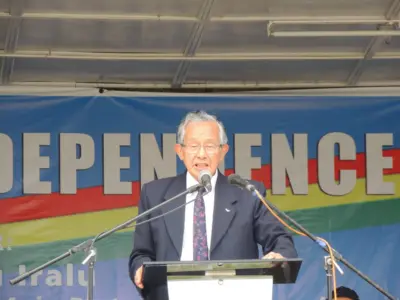

Kohima: In a land shaped by conflict, few people spent as much of their lives trying to understand what divides people - and what might bring them back together - as Niketu Iralu.
For more than six decades, Iralu worked for peace, reconciliation and understanding in Nagaland and the wider Northeast. He encouraged people to listen to one another, speak the truth and find ways to heal divisions that had hardened over generations.
Iralu, one of Nagaland's best-known peace activists, died in New Delhi on August 18, 2026, at the age of 91.
His death has been widely mourned across Nagaland and beyond. Political leaders, tribal bodies, civil society organisations, churches and community groups have remembered him as a man who devoted his life to peace and to the Naga people.
But perhaps the most revealing tribute to the man he was is not an award, an official title or a description of his work. It is the name by which generations of Nagas knew him: "Uncle Niketu".
The man behind the title
For many Nagas, he was not simply Niketu Iralu. He was "Uncle Niketu".
The name was more than a term of affection. It reflected the relationship he built with people across generations and communities. Young people, community leaders, church workers, political actors, social workers and ordinary citizens could find a listening ear in him.
"Though many might have addressed him as Grandpa, or more suitably, 'Sir', we all called him 'Uncle' Niketu. He earned that title because we loved him dearly and appreciated him for who he was. He was 'Uncle' because he was approachable, because he was a gentle soul," a Naga youth remembering Niketu Iralu shared.
"He was 'Uncle' because, though he was a towering figure, there was something childlike about him. He was 'Uncle' because he welcomed everyone into his home with open arms. And he was 'Uncle' because every time we said goodbye, he expected us to meet again," the person added.
His home, Kerünyü Ki - meaning "House of Listening" - at Sechü Zubza became an extension of that philosophy.
Iralu lived there with his wife, Christine, and their children. Over the years, people from different communities, churches, political backgrounds and generations came to the house to speak with him, seek advice or simply have a conversation.
The name of the house was fitting. Iralu's contribution to public life was often less about providing answers than creating a space in which people could speak, listen and perhaps begin to understand one another.
The North East India Christian Council, in its tribute, remembered Iralu as a thinker, social scientist and peacebuilder who was trusted by people from different sections of society. It remembered him as someone who listened carefully before giving his views.
A life shaped by reconciliation
Born in 1935 to Dr Sevilie Iralu, the third Naga to become a doctor, and Vituno Iralu, elder sister of Naga leader A Z Phizo, Niketu was one of 13 children.
After completing his Pre-University studies in Shillong, he joined Madras Christian College. It was during his time there that he came across Moral Re-Armament (MRA), now known as Initiatives of Change (IofC).
His association with the organisation would shape much of his life. He worked in India and different parts of the world and later served as director of Asia Plateau, the IofC centre in Panchgani, Maharashtra.
His work centred on trust-building, personal change and reconciliation.
But however far his work took him, Nagaland remained at the centre of his life.
He continued to speak about peace and healing among the Naga people, particularly at times when political and social divisions threatened to deepen.
In 2004, the Naga Hoho and the Nagaland Christian Forum appointed a seven-member Naga National Reconciliation Commission, with Iralu as its chairman. The commission was formed at a time when differences among Naga political groups remained deep.
He later became closely associated with the Forum for Naga Reconciliation (FNR), which worked to encourage dialogue among divided Naga political groups.
For Iralu, reconciliation was not an abstract ideal. It was a daily discipline - one that required people to confront hurt, acknowledge differences and still find the courage to sit across the table from one another.
Beyond the peace process
His work also extended beyond the political conflict.
Iralu was involved in efforts to address drug addiction and other social problems in Nagaland. Kripa Foundation Nagaland recalled his role in bringing together the Naga Mothers Association and Kripa Foundation in 1989, when he was director of Moral Re-Armament at Asia Plateau.
The partnership eventually led to the establishment of the NMA-Kripa "Mount Gilead Home" Rehabilitation Centre at Zubza.
At a time when drug addiction was a major problem and carried heavy social stigma, the initiative helped create greater awareness about treatment and rehabilitation.
Kripa Foundation remembered Iralu as a peace activist, social worker and elder statesman who worked quietly to help people facing difficult circumstances.
This was perhaps characteristic of his public life. His understanding of peace extended beyond negotiations between political groups. It encompassed the dignity of individuals, the healing of communities and the responsibility of society towards those pushed to its margins.
A lifetime of recognition
Iralu received several awards for his work in peace and reconciliation.
These included the Lokapriya Gopinath Bordoloi Award for National Integration in 2005, the UN Brahma Foundation's "Soldier of Humanity" Award in 2011, the Rotary Peace Award from the Rotary Club of Kohima in 2018 and the Bhupen Hazarika Integration Award for 2023.
In 2025, Initiatives of Change International honoured him with its Lifetime Achievement Award for his work in trust-building in Northeast India.
Yet those who knew him often remembered something that no award could quite capture: his manner.
He was soft-spoken, humble and approachable. He did not appear to need the distance that often accompanies public stature. People could walk into his home, sit with him and talk.
That is why "Uncle Niketu" endured.
A voice of reason in difficult times
Following his death, tributes came from across Nagaland and the Northeast.
Nagaland Governor Nand Kishore Yadav remembered Iralu as a respected Naga pacifist and peace activist who spent decades working for non-violence, dialogue and reconciliation.
Deputy Chief Minister Yanthungo Patton described him as a respected peace activist, pacifist and social reformer who worked to bring people together.
Nagaland Legislative Assembly Speaker Sharingain Longkumer remembered his commitment to truth, forgiveness and reconciliation.
The Angami Public Organization (APO) described Iralu as a "luminous son" of the Angami people and a towering voice for peace, reconciliation and humanity.
The APO said Iralu devoted more than six decades to healing a conflict-affected land, working through Initiatives of Change, the Forum for Naga Reconciliation and various community dialogues. It described him as a man of integrity whose leadership was rooted in humility, forgiveness and truth.
Calling him a source of pride for the Angami community and Nagaland, the organisation said Iralu carried the Naga name with dignity and became a voice of reason during times of division and a voice of hope during despair.
The APO said his death had left an "irreplaceable void", with Nagaland losing a father, guide, teacher and bridge between generations. It pledged to uphold his legacy by choosing dialogue over discord, reconciliation over revenge and truth over bitterness.
The organisation also expressed gratitude for Iralu's lifelong commitment to global peace, Naga unity and moral renewal, and conveyed its condolences to his family.
The Yimkhiung Tribal Council remembered him as "Uncle Niketu", a household name and a keeper of conscience. It described him as a man who sought neither recognition nor position, but dedicated his life to serving his people and their aspirations.
The Naga Students' Federation described Iralu as a visionary and steadfast leader who dedicated his life to peace, justice and the dignity of the Naga people.
The Naga People's Front called him a "towering figure" and a voice of reason who worked to build trust among the Nagas.
The Western Chakhesang Hoho remembered him as an elder, scholar, thinker and writer who spent his life building bridges between divided people.
The Nagaland Gorkha Association also remembered his work for dialogue and harmony between Naga and non-Naga communities.
The United Christian Forum of North East India remembered him as "Uncle Niketu" and highlighted his work for peace across communities and churches.
What remains after him
Niketu Iralu's death comes while the Naga peace process remains unfinished.
For decades, he worked in the space between politics and society, reminding people that peace could not come only through political agreements. It had to be built in homes, churches, communities and relationships.
His life offered another understanding of leadership - one based not on power, but on service; not on speaking the loudest, but on listening; not on victory over another, but on finding a way to live together.
That may be the most enduring meaning of "Uncle Niketu".
He leaves behind a body of work, institutions and conversations. But he also leaves behind something less tangible: generations of people who experienced the possibility of being heard.
His body is scheduled to arrive at Dimapur airport from Delhi on August 19. A short reception will be held at the airport before his body is taken to his home, Kerünyü Ki at Sechü Zubza, where he will be laid to rest.
The funeral service is scheduled to be held on August 20.
For a man who spent his life asking people to listen to one another, it is perhaps fitting that his final journey returns to the "House of Listening".
Nagaland has lost a peace activist, a thinker and a bridge between generations. But for those who called him "Uncle", the loss is more intimate.
They have lost someone who always expected there would be another meeting, another conversation, another chance to say hello.
And perhaps that is where his legacy will live on - in the continuing decision to meet again, to listen again and, despite everything, to choose peace.
Western Himalaya warming faster, faces steepest snow loss: Study