
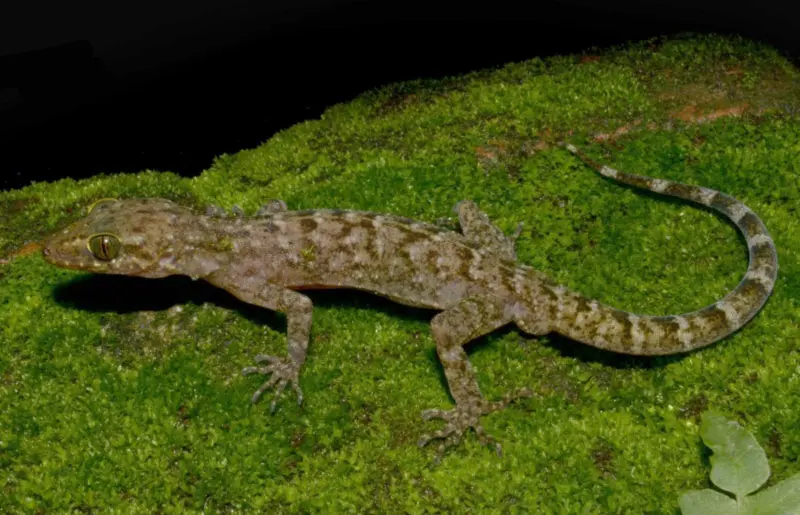

Guwahati: In a degraded forest patch on the fringes of Raimona National Park, Assam, researchers have discovered a gecko species previously unknown to science-underscoring the region's untapped biodiversity.
The species, named Cyrtodactylus raimonaensis, was recorded from Kachugaon in Kokrajhar district. The discovery, documented by researchers from Cotton University and the Wildlife Trust of India, adds to the rapidly growing list of reptile species from Northeast India.
Notably, while the study was based on specimens collected from outside the park, individuals of the species were also encountered within Raimona National Park-highlighting its wider ecological presence.
The discovery is significant as it marks the first species described after the declaration of Raimona National Park and the first to be named after the park.
What makes this gecko unique
Belonging to the Cyrtodactylus khasiensis group, the new species is genetically distinct and forms a sister lineage to Cyrtodactylus septentrionalis. It grows up to 71 mm in length and is characterised by conical dorsal tubercles.
The species also displays distinct banded patterns on the body and tail, along with unique scale and pore structures that set it apart from closely related species.
What stands out is where it was first documented-not inside a protected forest, but in a degraded patch near Raimona.
Researchers say this reinforces the ecological value of such overlooked landscapes, which can still support significant biodiversity.
Field observations suggest the gecko is nocturnal, becoming active a few hours after sunset. It was found on tree trunks, forest floors, and near moist, streamside habitats.
"Western Assam remains relatively underexplored, and discoveries like this indicate there may be more undocumented species in these landscapes," the researchers noted.
Emphasising the broader conservation significance, Bijay Basfore, one of the study's authors, said:
"Assam is not defined by a single protected area, and conservation efforts should extend beyond an exclusive focus on Kaziranga National Park. Equal attention must be directed towards other protected landscapes that hold significant ecological value.
Raimona National Park is strategically located, forming a transboundary ecological continuum with Phibsoo Wildlife Sanctuary and contributing to the unique Raimona-Sikhna Jwhwlao-Manas National Park tri-junction landscape. This connectivity enhances its conservation importance.
Furthermore, the recent description of a new species from the fringes of Raimona provides compelling evidence of the park's immense potential to harbour undocumented and undescribed taxa, underscoring the need for intensified research and conservation attention in this region."
Very little is known about the species so far, and it has been recommended for a 'Data Deficient' status under the IUCN criteria.
Scientists warn that many species in this group have limited ranges and may be vulnerable to habitat disturbance-making even small forest fragments critical for conservation.
Located at the intersection of the Indo-Burma and Eastern Himalayan biodiversity hotspots, Northeast India continues to yield new species. Yet, as this discovery shows, significant gaps remain-especially in lesser-studied landscapes like western Assam.
Assam's centuries-old Putola Naas is running out of artistes