
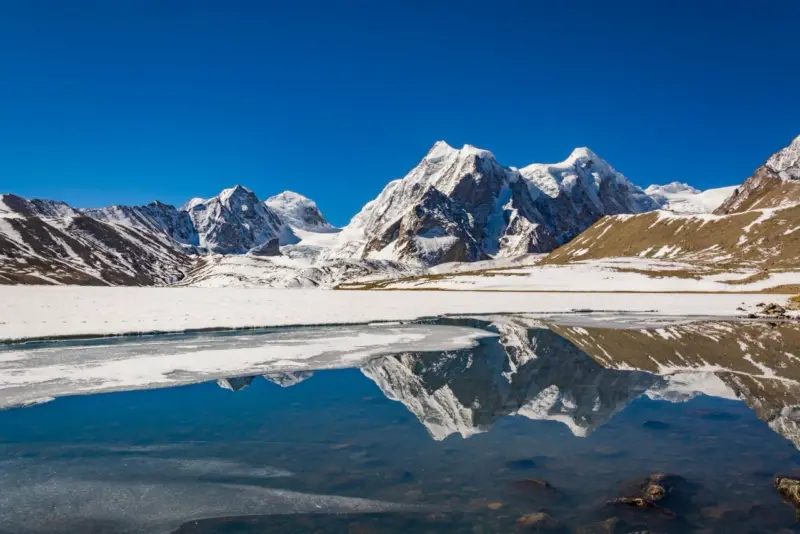

Tourism to the high-altitude Gurudongmar Lake in North Sikkim has begun to revive after more than two years of disruption following the devastating South Lhonak Lake GLOF of October 2023, which severely damaged road infrastructure and cut off access to the region.
With the reopening of the Chungthang-Lachen road following the inauguration of the newly constructed 400-foot Taram Chu bridge, authorities have started issuing tourist permits again, allowing visitors to travel towards Lachen - the primary base for tourists heading to Gurudongmar Lake.
Situated at an altitude of nearly 17,000 feet near the India-China border, Gurudongmar Lake is among the highest lakes in India and one of the most sought-after destinations in North Sikkim. The lake draws thousands of visitors every year, many of whom travel via Lachen before proceeding further to the high-altitude site.
The GLOF disaster had washed away multiple bridges and damaged long stretches of road along the route, bringing tourism activity in the Lachen belt to a near standstill.
District Magistrate of North Sikkim district Anant Jain said the route towards Lachen had remained closed earlier because the final bridge along the stretch was under construction.
"The newly constructed 400-foot bridge was inaugurated last week, after which vehicular movement resumed," he said.
Jain added that authorities have issued advisories to ensure safe passage across the newly restored bridges along the route.
"Only one vehicle is allowed to cross the bridge at a time as the width permits single-lane movement. Allowing two vehicles simultaneously would be risky from both safety and engineering perspectives," he said.
He further said drivers must adhere to load capacity limits and maintain a time gap while crossing bridges.
The advisory has been circulated to the Tourism Department and checkposts, including the Third Mile office from where most tourist permits are issued online.
Jain confirmed that there are currently no restrictions on tourist movement.
"Permits are now being issued as the road from Chungthang to Lachen and Lachung is open and in good condition," he said.
The reopening has brought renewed optimism among tourism stakeholders in Lachen, where the local economy depends heavily on visitors travelling to Gurudongmar Lake.
Dathup Lachenpa, president of the Lachen Hotels and Homestay Association, said the restoration of connectivity has sent a positive signal to the tourism sector.
"The opening of the Taram Chu Bridge has sent a very positive message to tourism stakeholders in Lachen," he said.
Tourism operators in the region are now preparing for the return of visitors as permits begin to be issued again.
"We are hoping the Tourism Department will start issuing permits soon. The weather is favourable right now and we are ready to welcome tourists," he said.
Dathup noted that Gurudongmar Lake continues to be the biggest attraction for travellers visiting North Sikkim. "Most tourists coming to North Sikkim want to visit Gurudongmar Lake, so Lachen naturally becomes their base," he said.
At the same time, he acknowledged that the region remains vulnerable following recent natural disasters. "The entire belt has become fragile after the GLOF and heavy rains. Infrastructure damage, especially to roads and bridges, has been a major challenge," he said. Local tourism stakeholder Pepe Lachenpa said the restoration of connectivity is crucial not only for tourism but also for the daily lives of residents.
Dear Reader,
Every day, our team at EastMojo travels through rain, rough roads, and remote hills to bring you stories that matter - stories from your town, your people, your Northeast.
We do this because we believe in truthful, independent journalism. No big corporate backing, no government pressure - just honest reporting by local journalists who live and breathe the same air you do.
But to keep doing this work, we need you. Your small contribution helps us pay our reporters fairly, reach places others ignore, and keep asking the tough questions.
If you believe the Northeast deserves its own fearless voice, stand with us.
Support independent journalism. Be a Member.
Thank you,
Karma Paljor
Editor-in-Chief, eastmojo.com
"For a long time the entire Lachen belt was cut off from communication and transportation. People survived on essential materials that had to be carried manually from lower areas," he said.
He said residents were able to manage during the prolonged disruption because families traditionally store food grains and essential supplies for several months. "Because of this habit of storing supplies, we were able to manage even when rations and essential commodities could not reach us for several months," he said. However, Pepe cautioned that the terrain remains fragile, particularly along sections of the route leading towards Gurudongmar.
"The entire belt is very vulnerable. Even newly constructed roads may not sustain for long because of the nature of the terrain," he said.
Also Read | How rail link is transforming Mizoram's economy