




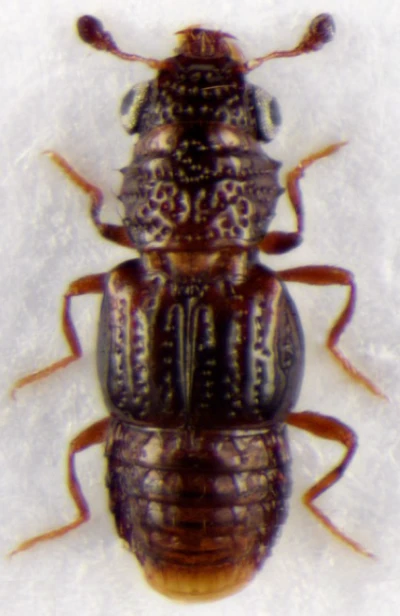

Hidden in the damp leaf litter and decaying wood of Arunachal Pradesh's forests, scientists have uncovered a discovery that is small in size but big in significance-three new species of rove beetles, a group of insects that quietly sustain forest ecosystems.
The study, led by Tobias Mainda along with Hiren Gogoi, Tagam Dobiam, Sonu Singh, and Oliver Betz, documents five species of the genus Megalopinus, including three species new to science.
The study was the result of an MoU between Rajiv Gandhi University and the University of Tübingen, Germany, followed by an MoU with the National Biodiversity Authority, India, and permission from the PCCF, Arunachal Pradesh. The German Science Foundation had given the grant.
Rove beetles, belonging to the family Staphylinidae, are among the most diverse insects on Earth, easily recognised by their short wing covers and exposed abdomen.
Despite their tiny size, they play an outsized role as predators and decomposers, helping recycle nutrients and maintain the health of forest ecosystems.
Collected from fungal leaf litter and decaying wood in tropical evergreen forests, these beetles underline just how rich-and understudied-Northeast India's microhabitats remain.
Among the discoveries is Megalopinus arunachalensis, found near streamside forest slopes and currently known only from Arunachal Pradesh, adding to the region's growing list of endemic insects.
Another, Megalopinus mithun, named after the culturally significant mithun, was recorded from multiple forest sites, including Eaglenest Wildlife Sanctuary, reflecting both ecological richness and cultural context.
The third, Megalopinus micros, measuring just 1.9 mm, is among the smallest known species of its genus globally and was also discovered in Eaglenest, highlighting how even the tiniest forest niches can harbour new life.
This is the first focused account of Megalopinus beetles in Arunachal Pradesh, and researchers believe many more species remain undiscovered. With vast forest cover and limited exploration, the Eastern Himalayas are increasingly emerging as a frontier for biodiversity research, particularly for lesser-known insect groups.
As the authors note, tropical regions like Northeast India remain underrepresented in scientific records, making such findings crucial for conservation and ecological understanding.
The discovery is a reminder that even today, new species are still being found in overlooked corners of the natural world.
In Arunachal Pradesh, the forest floor itself-quiet, damp, and teeming with unseen life-continues to tell stories that science is only just beginning to hear.
How Jessami village became the poster child of conservation in Manipur