
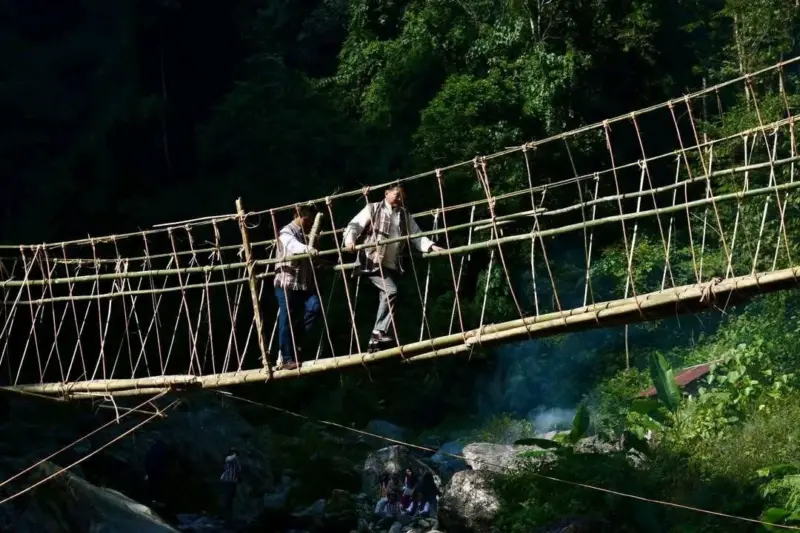

Guwahati: When modern bridges collapsed under the force of glacial floods and cloudbursts in North Sikkim, it was an ancient indigenous technology that restored access to isolated Himalayan villages.
A new study by Lepcha scholar and senior district official Sonam R. Lepcha documents how traditional cane suspension bridges-known as Ru-Soam-became lifelines for the Dzongu region following recent climate disasters.
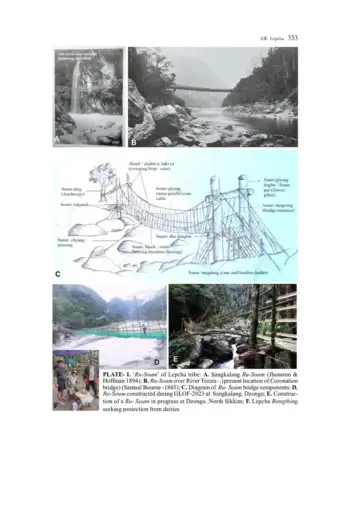
In the Lepcha language, 'Ru' means cane or rattan, while 'Soam' refers to a bridge. Historically, the structure was also known as Soam-pu or Jholungey pool (in Nepali). More than a functional crossing, the Ru-Soam embodies the Lepcha community's sustainable engineering traditions, cultural identity, and deep-rooted relationship with nature. It stands as a living example of human resilience and ecological harmony.
Renowned British botanist Joseph Dalton Hooker once described Lepcha cane bridges as true "works of art." In terrain marked by steep gorges where descending and ascending are nearly impossible, the Ru-Soam represents an ingenious, time-saving adaptation to the rugged Himalayan landscape.
The Lepchas are widely recognised as custodians of rich traditional knowledge, cultural heritage, and nature-based belief systems.
Authored by Sonam R. Lepcha of the Office of the Additional District Collector (Development), Mangan, the research highlights how Lepcha communities rebuilt vital connectivity after the 2023 South Lhonak Lake glacial lake outburst flood (GLOF) and the devastating cloudburst of 2024, both of which washed away several modern bridges in North Sikkim.
According to the study, published in the journal Pleione, the destruction of conventional infrastructure left large parts of the Dzongu Tribal Lepcha Reserve Area cut off for weeks.
With roads severed and heavy construction equipment unable to reach remote valleys, villagers turned to their own traditional engineering knowledge-constructing Ru-Soam bridges entirely from locally sourced cane and bamboo.
"Ru-Soam is not merely a bridge; it is a living symbol of Lepcha resilience, collective labour, and harmony with nature," Lepcha notes in the paper. Built through community effort under the guidance of master craftsmen (Soam-nokbu) and ritual specialists (Bongthing), the bridges were erected swiftly, restoring foot access for residents, relief supplies, and emergency movement.
The study traces the Ru-Soam tradition back several centuries, describing it as one of the oldest forms of suspension bridge engineering in the Eastern Himalaya. Historical records and 19th-century photographs show cane bridges spanning major rivers such as the Teesta and Rangit, long before the advent of steel or concrete structures.
Structurally, the bridges are deceptively sophisticated. A typical Ru-Soam can span over 100 metres, hang more than 30 metres above turbulent rivers, and support multiple people at a time. Their key strength lies in flexibility-unlike rigid modern bridges, cane structures sway and absorb force, making them more adaptable during floods and landslides.
Lepcha argues that the revival of Ru-Soam construction offers critical lessons for disaster-resilient infrastructure in fragile mountain ecosystems increasingly affected by climate change. The bridges are low-cost, rapidly deployable, repairable using forest materials, and environmentally sustainable-qualities often missing from conventional infrastructure.
"Over time, Lepcha footbridges have undergone significant evolution in both structural design and functional relevance. These bridges, extending up to 141 metres and rising nearly 20 metres above riverbeds, have demonstrated remarkable resilience under dynamic environmental conditions," Lepcha writes.
In contemporary contexts, they are valued not only for their utility during floods and landslides but also as vital expressions of the region's intangible cultural heritage. The master artisans who preserve and transmit this indigenous knowledge occupy positions of high respect within the Lepcha community.
The paper also notes growing institutional interest in preserving the Ru-Soam tradition. The Department of Science and Technology, Government of Sikkim, in collaboration with UNESCO-linked initiatives, has begun documenting the practice as part of broader efforts to safeguard indigenous knowledge systems.
As extreme weather events intensify across the Himalaya, the study suggests that pathways to future resilience may lie as much in ancestral wisdom as in modern engineering-woven, quite literally, from cane, bamboo, and community solidarity.
Kaziranga's grasslands not ancient: Science traces 3,000-year eco shift