





Aizawl Coffee House, a popular café tucked away in Ngaizel with sweeping views of the city, has long been a favourite hangout for the youth of Mizoram's capital.
Known for its handcrafted artisan coffee and fresh sourdough bread, the café recently found itself at the centre of a wider conversation on tourism and cultural respect in the state.
Last Wednesday, the café posted an unusual advisory on its Instagram page, typically reserved for menus and photographs of its culinary offerings. While welcoming tourists, the post urged visitors to respect the establishment and its staff.
The owner cited experiences that were previously unheard of at the café, including spitting on the floor, bargaining over cappuccino prices, demanding free food, and other forms of behaviour described as "new to them."
Mizoram, despite infrastructural challenges such as narrow roads and a high cost of living, is widely known for the politeness and goodwill of its people. Practices common in other parts of the country are generally absent here, a factor that has contributed to the state's growing appeal among tourists.
However, the recent surge in visitors has raised concerns about whether this peaceful social fabric can be sustained.
Speaking to EastMojo, noted activist Vanramchhuangi said the tourism boom was less a result of deliberate policy success and more a consequence of increased connectivity. "The sudden rise in tourism is largely because the railway has reached Mizoram, making budget travel easier. Travel vlogging has also played a major role," she said.
The first Mizoram railway project connecting the capital, Aizawl, to the rest of the country-the Bairabi-Sairang line-was officially inaugurated by Prime Minister Narendra Modi in September 2025.
This has led to an increase in tourists visiting the state. Since the opening of the Bairabi-Sairang railway line in September 2025, Mizoram has issued a total of 22,431 Inner Line Permits (ILPs) to visitors arriving at Sairang railway station, according to police officials.
The ILP, required under the Bengal Eastern Frontier Regulation of 1873, permits Indian citizens to enter protected areas, such as Mizoram. Between September 13 and the end of 2025, 20,914 permits were issued to tourists, traders, and migrant workers, with an additional 1,517 issued in the first week of January 2026.
Warning against the unchecked growth of mass tourism, she added, "Society and the government must be prepared not just for the profits, but also for the unintended consequences. Mass tourism can be dangerous for a community if it is not managed properly. There will always be both positive and negative impacts."
Vanramchhuangi also expressed concern over the cultural implications of unregulated content creation. "Across the world, tourism has the potential to negatively impact the social fabric of communities. Our churches, culture, and traditions are particularly vulnerable. There should be limits on what can be vlogged inside churches," she said, referring to tourists who film church services and feast celebrations for social media.
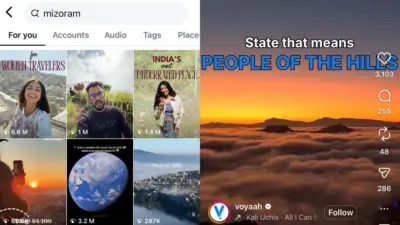
Adding to the discontent is the growing trend of exoticised portrayals of Mizoram on platforms like Instagram.
A recent reel by Voyaah, a travel agency with over 60,000 followers, described Mizoram as a place with no honking, no scams, no trash, no curse words, and spotless streets-claims that many locals say oversimplify and distort reality.
Local content creator Duhawmi Rokhum, who runs the page huesofwhatifs, criticised such portrayals, stating, "Even when presented as harmless, misinformation remains misinformation, regardless of whether it casts the state in a positive light. Mizoram does not need exaggeration, sensationalisation, or infantilisation by outsiders to be appreciated. Admiration rooted in falsehoods is neither meaningful nor respectful."
Another viral reel about Mizoram by Aakanksha Monga, which has over six million views, portrays Mizoram as a state that is safe for women and a state where men are taught how to cook, how to clean, and how to share equal responsibility.
"I'm glad she had a positive experience, but seeing videos like these almost feels comical because it's so far from our everyday reality," said Rokhum.
According to a study by Janet C. Lalhmingpuii and Vijanti Namchoom, Mizo society is traditionally patriarchal and patrilineal, with authority firmly vested in men and women historically excluded from decision-making within the family.
The study notes that women continue to occupy a marginal position in the workforce, largely confined to home-based activities and traditional production, and even after decades of development, most remain in low-skilled, low-wage occupations.
"There are positive and negative sides to the boom in tourism in the state," said Caroline Lalrosangi, a journalist based in Aizawl. On one hand, the reels and vlogs act as free advertisements for Mizoram. But over-exaggeration may lead to tourists being disappointed when they visit. There is also the concern that our lives may be disrupted. Are we ready for such a mass inflow of tourists? Our people still live in a close-knit society, and we must consider how this will impact our social fabric and law and order," she added.