




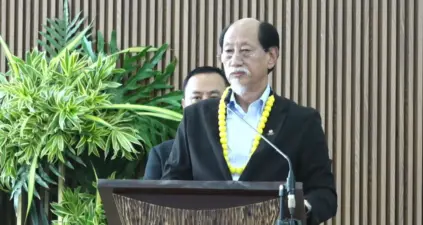

Kohima: Nagaland Chief Minister Dr. Neiphiu Rio, on Friday defended the state's indigenous protection mechanisms while explaining who qualifies as an indigenous inhabitant of Nagaland.
Stressing the need for the Register of Indigenous Inhabitants of Nagaland (RIIN), Rio said the exercise would distinguish indigenous Nagas from other residents and safeguard the state's identity, customary laws and traditional institutions.
Addressing a gathering during the inauguration of the Kohima Village Multipurpose Building at Ziekezou, Rio said the RIIN would help distinguish indigenous Nagas from other residents and protect the state's identity, customary laws and traditional institutions.
Kohima: Rooted in indigeneity
Rio said Kohima had earned recognition as one of Asia's largest villages because of its inclusive nature while retaining its traditional land ownership and community institutions.
He lauded natives of Kohima Village for welcoming people from across Nagalaand who wanted to settle in present day Kohima, while the village continues to preserving its customary institutions. "That is how the community grew from strength to strength," he said, adding that it remained one of the largest indigenous villages.
He contrasted Kohima with many large urban settlements elsewhere, saying the village had expanded through its indigenous community system rather than through refugee settlements.
The Chief Minister said the British administration had recognised the distinct identity of the Nagas because of their rich culture, customary laws and village-based self-governance.
Consititutional protection:
According to Rio, this recognition led the Parliament in London to enact the Bengal Eastern Frontier Regulation (BEFR) Act, 1873, which introduced the Inner Line Permit system to protect tribal communities in the eastern region.
Rio said the British legacy of the Bengal Eastern Frontier Regulation (BEFR), 1873, had continued even after Nagaland became part of the Indian Union. He said the protections were further strengthened after Independence through Article 371A of the Constitution, which safeguards Naga customary laws, social practices, and ownership of land and resources.
He said these constitutional safeguards had ensured the continuation of the Inner Line Permit (ILP) system in the state and helped preserve Naga tribal identity, festivals, songs, dances, handloom, handicrafts, and customary institutions.
"And so, our customary law and identity should be protected. All this history happened because the host, the headquarter from Kohima had been established, and they had been nurturing all the Nagas," Rio said.
Rio also referred to the legal challenge against the state's decision to extend the Inner Line Permit regime to Dimapur, Chümoukedima and Niuland districts.
He said three petitions had questioned the legality of the extension, but the state government defended its decision in court and the petitions were eventually dismissed.
"What the British gave us and what the Constitution protects continue to remain intact," he said.
Calling for public cooperation, Rio said all landlords should ensure their tenants possess valid ILPs wherever required, while village councils should certify non-Naga workers residing in villages.
"Everyone coming to Nagaland must comply with the regulations," he said.
The Chief Minister also defended Nagaland's exemption from the 73rd Constitutional Amendment relating to the Panchayati Raj system.
He said Naga villages traditionally followed a system of consensus and selection rather than competitive elections.
Even where more than one person sought a position, he said decisions were made transparently through head counts, majority opinion and consensus.
"If we move to an election system, there will be ruling and opposition groups, which may eventually lead to corruption. Our traditional system must be preserved and protected," Rio said.
Who is indigenous?
Explaining the need for the Register of Indigenous Inhabitants of Nagaland (RIIN), Rio said the exercise was intended to distinguish indigenous Nagas from other Indian citizens residing in the state.
He also informed how, over the past years, some administrative officers had issued indigenous certificates to non-Nagas.
"They can be citizens of India and they can live here, but they cannot become indigenous Nagas," he clarified. Rio said indigenous status was different from Indian citizenship.
According to him, Indian citizens who settled in Nagaland before the prescribed cut-off year (1963) could be recognised as permanent residents, while those arriving after the cut-off would continue to remain temporary residents under existing regulations.
He further said native Naga villages had existed "since time immemorial" and their indigenous status did not require fresh government recognition.
The Chief Minister also clarified that indigenous status under RIIN would be specific to Nagaland.
Referring to the Garo, Kuki, Kachari and Karbi (Mikir) communities, Rio said the government had asked them to undergo enumeration to determine who had settled in Nagaland before 1963 and who had arrived later. However, he said that they had instead approached the court seeking indigenous status which the court later dismissed. He maintained that the four communities were 'migrants'.
Likewise, he said, Nagas living outside Nagaland are indigenous to their respective ancestral areas. "We are talking only about Nagas of Nagaland, we are indigenous. Nagas outside Nagaland, they are indigenous in their own area," he said.
He cautioned village councils against issuing incorrect indigenous recommendations. Rio also said the government will soon be finalising procedures after consultations, including with stakeholders from the Dimapur area.
Unity essential for Nagaland's future
Rio appealed for unity among Nagas, saying internal divisions should not undermine the state's future. He said that Nagas must unite to progress.
The Chief Minister also said Nagaland should also participate in India's broader development journey as the nation is progressing towards Viksit Bharat.
Highlighting welfare initiatives, Rio said the Chief Minister's Health Insurance Scheme (CMHIS) had already benefited thousands of families. He said government employees contributed to the scheme through salary deductions while the public received insurance coverage without direct premium payments.
According to Rio, around 1.17 lakh beneficiaries have been registered under CMHIS, while the government has spent over Rs 228.87 crore under the scheme's cashless treatment component.
He also encouraged the local youth to utilise schemes such as the Chief Minister's Micro Finance Scheme, under which the state subsidises loan interest to encourage entrepreneurship.