
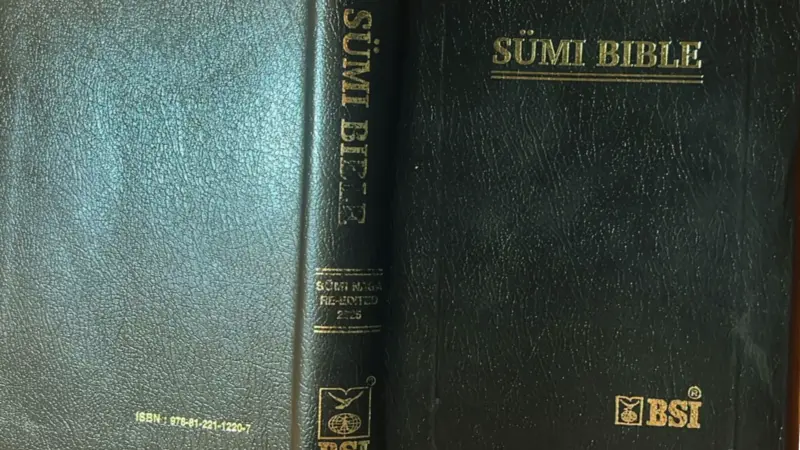

In the Christian-majority state of Nagaland, the Bible has long been more than a religious text for the faithful. For generations, it has shaped prayer, guided worship through hymns, and helped preserve the community's language and identity.
Today, however, a newly revised Sümi-language Bible has become the centre of a growing controversy.
The tension reached a turning point when a forum of Sümi leaders, retired pastors, and language representatives publicly demanded that the Bible Society of India (BSI) recall all copies of the revised edition.
The controversy deepened on April 9, 2026, when a forum identifying itself as the Society for the Preservation of Sümi Language stepped forward with a strong appeal to suspend the circulation of the newly revised Sümi Bible translation, and even called for refunds to buyers.
Work of the devil?
For retired pastor Rev. Heniji Zhimomi, the controversy surrounding the revised Sümi Bible translation goes far beyond vocabulary or grammar.
At a press conference, he narrated how the journey of translating the Bible into the Sümi language began nearly a century ago, with the Gospel of Mark completed in 1928. Since then, the text has been revised more than ten times.
However, Zhimomi believes the latest version is unlike any revision the community has seen before. He described the changes in unusually strong terms, even calling them the "work of Satan (devil)".
"The word of God must remain untouched and translated as it is," Rev. Zhimomi said, alleging that portions of the scripture had been removed while others had been added.
According to him, concerns about translation errors were formally raised, and on July 12, 2024, the Sümi Hoho, the apex tribal body of the community, adopted a resolution along with various frontal organisations and committees, including the Sümi Hoho, Sümi Totimi Hoho, the Sümi Literature Board, and the Sümi Bible Editorial Board, to review the text.
At the time, he said, assurances were given that corrections would be made before publication. However, he alleged that the revised Bible was released without incorporating those agreed changes.
Expressing the sentiment of the community, Zhimomi also made it clear that acceptance of the revised text remained uncertain. "The revised translation of the Bible cannot be used officially," he said.
Words that changed meaning
Convenor of the forum, Aqheto Chishi, explained how deeply the changes in the revised translation have affected readers within the community.
He said that since 2024, several letters had been submitted to the concerned authorities urging that key terms, especially traditional names used in scripture, should not be altered, stressing that the originality of the words must be preserved.
According to him, parts of the revised text now feel unfamiliar to many readers and appear linguistically inconsistent with earlier versions. He alleged that some passages reflected troubling substitutions in translation, for instance, where "gold" reportedly appeared as "iron", "fox" as "dog", and "fig" was replaced with "sycamore".
Raising legal concerns, he alleged that the translation violated provisions under Section 298 of the Bharatiya Nyaya Sanhita relating to defiling a sacred object, Article 29(1) of the Constitution concerning the right to conserve language and culture, and consumer protection laws by selling what he described as a defective product without offering replacements.