

HYDERABAD:
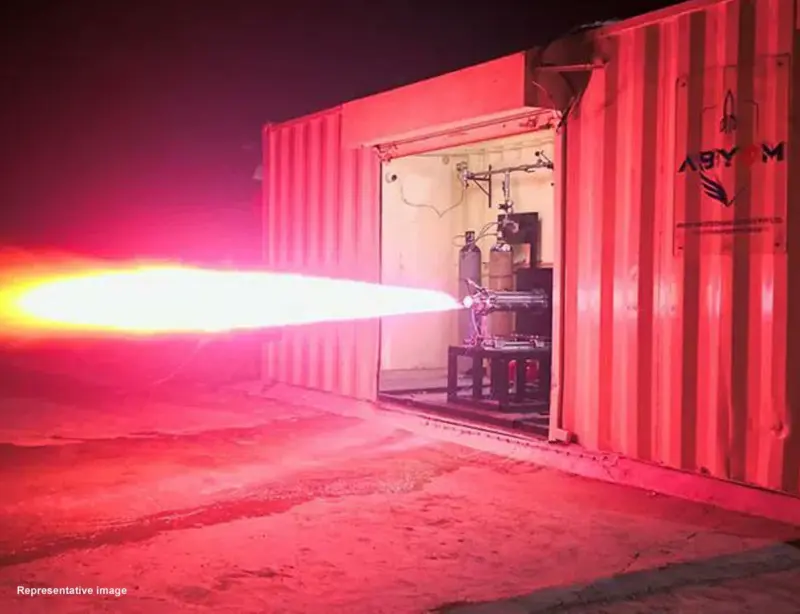
The company tested its 2.5 kiloNewton thrust-class engine in multiple runs lasting about six seconds each. During the tests, the engine generated chamber pressure of around 12 bar and temperatures exceeding 2,200°C.
Engineers designed these trials to validate combustion stability, fuel flow, and overall engine performance under launch-like conditions, as reported by DC.
Bandlaguda Jagir apartments issue: CM clarifies policy
Focus on real-world performance
Founder and CEO
'This is not just about firing an engine in isolation. We are testing whether the system performs under conditions similar to an actual launch,' he told the media.
Pintle injector boosts efficiency
Abedin said the engine uses a pintle injector system to regulate fuel and oxidiser mixing, improving efficiency.
"We demonstrated this earlier with BSE-I. With BSE-II, we have improved mixing and performance further," he said.
Collaboration with top institutes
The company is also using its testing facility for collaborative research with institutions such as BITS Pilani Hyderabad Campus, Indian Institute of Technology Madras, and Indian Institute of Technology Bombay.
Stability remains key challenge
Abedin emphasised that combustion stability remains critical for safe engine operation.
"The fuel must mix and burn in a controlled way. Without stability, the engine cannot operate safely," he said.
250+ tests help refine design
The company has conducted over 250 hot-fire tests across its BSE-I and BSE-II engines. Engineers use the data from each run to refine pressure, thrust, and performance characteristics step by step.
Abedin said the team built the entire testing ecosystem in-house, including the engine, control systems, and data acquisition setup, reducing dependence on external facilities.
Push towards reusable rockets
Abedin said reusable launch systems can significantly reduce space mission costs and improve access to space.
"If a rocket can be reused, launch costs drop sharply. That is what we are working towards," he said.
The company now plans to scale up to higher-thrust engines and develop a flight-ready system capable of vertical take-off and vertical landing.