




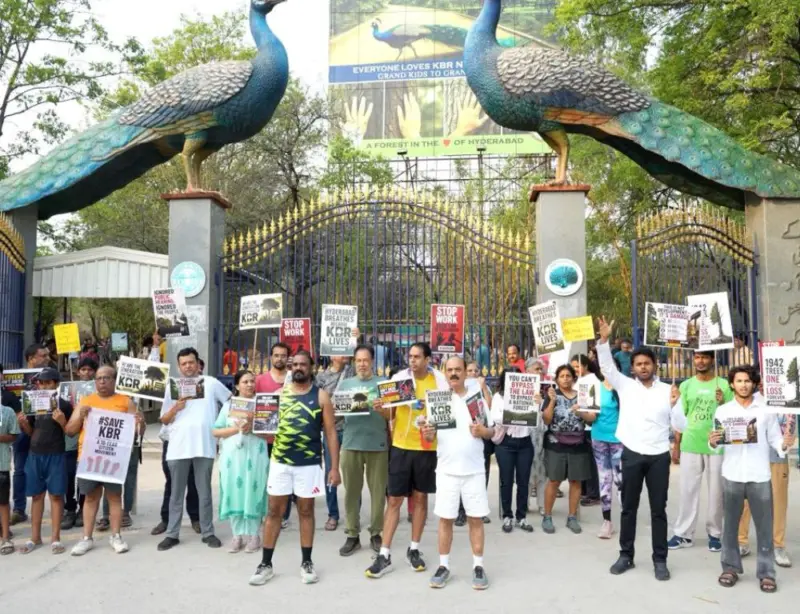

HYDERABAD: A coalition of citizens and environmental groups accuses the Telangana government of systematically misleading both the High Court and the public to advance a major infrastructure project.
They allege that this project threatens to destroy Hyderabad's only remaining green space, the Kasu Brahmananda Reddy (KBR) National Park.
The controversy centers on the H-CITI project, a Rs 930 crore flyover and underpass initiative surrounding the 142.5-hectare protected area. Citizens challenging the project in the Telangana High Court allege that the State has exploited legal loopholes, omitted affidavits, and made contradictory statements to bypass environmental review while officials cut down over 1,900 trees.
Providing a history of events, the group SaveKBR has provided a detailed timeline. Between 2012 and 2015, every expert body unanimously recommended establishing an Eco-Sensitive Zone (ESZ) of 25 to 35 metres around KBR, aligning with the existing HMDA walkway. In 2015, the State reduced the ESZ to 3 to 29.8 metres and admitted this change solely accommodated the Strategic Road Development Plan (SRDP) and avoided land acquisition costs. In 2016, officials cut trees for an SRDP flyover, prompting the National Green Tribunal (NGT) to initiate proceedings and order a status quo.
Trisha Krishnan Slams 'Inappropriate' Remark, Reaffirms Political Neutrality
Highlighting procedural lapses, on 27 October 2020, the Ministry of Environment, Forest and Climate Change (MoEF&CC) notified the diluted ESZ without conducting the required public hearing. The State later claimed Covid delayed the documents, but RTI replies confirmed that no such documents exist.
Turning to the legal battle, in 2021, petitioners filed a Public Interest Litigation (PIL) challenging the notification. On 11 August 2021, the High Court directed the State to provide proof of the public hearing within three weeks and imposed an interim stay on all tree-felling around KBR.
Examining critical court proceedings, the statement highlighted two key hearings where the State's actions were questioned. Four years after the court requested proof of a public hearing, the Union government was still seeking time to file its first counter-affidavit. When petitioners raised concerns about new construction, government counsel admitted that they had not filed an affidavit complying with the public hearing directive. The court inquired whether the activities around KBR, now identified as H-CITI works, were prohibited or regulated. Government counsel stated they were unaware and requested additional time.
The citizens group has identified four keyways in which public interest has been undermined. The court assumed the works might be permissible as pavement repair because the government did not disclose they were part of H-CITI. The release states, "Citizens feel cheated as the Government claims it does not know the nature of its own activity."
Focusing on documentation gaps, officials have not submitted any Detailed Project Report (DPR), design documents, or clearances for H-CITI to the court. If disclosed, the project would have required approval from MoEF&CC, the National Board for Wildlife (NBWL), the ESZ Expert Committee, and the State Chief Conservator of Forests. Officials have not obtained any of these approvals.
Expanding on the environmental impact, the court's directions addressed approximately 1,300 identified trees. Officials have since expanded the felling order to 1,942 trees, an increase of 548, without submitting any application for the court's approval. Despite a judicial stay, the interim stay on tree-felling around KBR, issued on 11 August 2021, remains in effect. The government has not requested its removal. However, officials continue to fell trees within 20 to 40 metres of the park boundary. The court, the public, and the petitioners have been misled.
Vijay Mallangi, an activist associated with the Save KBR campaign, said, "Through obfuscation, non-filing of reply affidavits, and ASG/AG claiming lack of knowledge, officials have kept the record before the Court incomplete on the nature of the activity, on H-CITI, on the expanded tree-count, and on the operative stay. But this fog, this facade, this farce is being used to fell trees."
The project, with an internal benchmark of ₹930 crore, proposes six multi-level flyovers and underpasses at six junctions along the KBR boundary at Jubilee Hills Check Post, KBR Park Entrance, Mughdha, Road No. 45, Film Nagar, Maharaja Agrasen, and Cancer Hospital. All structures are scheduled for completion within 24 months. The total footprint will permanently cover 38,095 square metres (3.81 hectares) of land, which is over a quarter of the 13.8 hectares originally designated for the road network in the Park's notification.
Examining ecological consequences, the citizens group has assessed the potential damage. The 38,095 square metres of asphalt and concrete will absorb solar radiation, raising junction temperatures by an estimated 2 to 5°C. The newly impervious area will divert approximately 2.74 crore litres of monsoon rainfall each year from groundwater recharge to surface runoff. Pile foundations, sunk 25 to 30 metres deep, will accelerate the de-watering of the recharge aquifer. KBR supports Schedule-I species such as peacocks, jungle cats, and civets. Pile foundations will disrupt underground mycorrhizal networks connecting over 600 tree species, and deck slabs may create bird-strike corridors.
The state has allegedly avoided all forms of public and expert review by relying on four legal technicalities. The government divides a single integrated tender into six separate projects only when someone questions the Environment Impact Assessment (EIA) threshold. The combined built-up area of 68,214 square metres remains below the 1,50,000 square metre threshold solely by treating the six junctions as independent projects. As a result, officials do not require any EIA or public hearing under EIA rules. They acknowledged that officials did not hold the ESZ public hearing. The State Board of Wildlife last reviewed a road plan around KBR in 2017, focusing on cost savings in land acquisition rather than ecological concerns. The Board has not reconvened for the redesigned H-CITI alignment. Officials have not addressed petitions with over 19,000 signatures opposing the ESZ reduction. They have not made DPRs public, and no ward-level consultations have occurred.
The State maintains that all works comply with existing rules and regulations, relying solely on the contested 2020 notification. Since the notification is under challenge and the government has not filed replies, acknowledged violations, or sought removal of the stay, citizens argue that compliance has been constructed through silence and evasion.
Looking ahead to legal developments, the next hearing scheduled for 5 May 2026, the group has urged the High Court, MoEF&CC, and the State government to place the Master Zonal Plan, survey plan, and DPRs on record, hold a genuine public hearing, order an integrated EIA for the entire H-CITI package, and stay all construction within the disputed buffer until the matter is resolved.
Further Vijay Mallangi said, "Hyderabad's last green lung was meant to absorb the city's heat, hold its rainwater, shelter its remaining wildlife and remind a fast-growing metropolis that some places are not for sale. The State now proposes to wrap that lung in 60,000 tons of cement and 5,000 tons of steel, sink a million-litre water-tomb under every junction, and call the whole exercise compliance. A Protected Area encased on every side by simultaneous concrete works is not a park, it is a grave dressed in foliage."