



Update | June 4, 2026, 16:06 IST
Shares of PhysicsWallah ended today's trading session 15.6% higher at ₹106.50 apiece on the BSE. Its market capitalisation stood at ₹30,763.6Cr (about $3.2 Bn) at end of the day.
Original Story | June 4, 2026, 12:13 IST
Edtech major PhysicsWallah has rolled back its plan to provide financing to students through its wholly owned NBFC subsidiary, FinZ Finance.
In a statement today, the Alakh Pandey-led company said it is restructuring its lending strategy and has tied up with multiple "leading" regulated third-party NBFCs to enable student lending needs.
"This decision reverses the company’s earlier approach and is intended to materially reduce balance sheet and credit related risks for the company," the company said.
Notably, the company's shares were under pressure since it announced its decision to infuse ₹120 Cr into FinZ Finance last week. Following the announcement today, the shares surged as much as 17.8% to touch an intraday high of ₹108.45 on the BSE.
"We received feedback from our partners that our core strength lies in building communities and our online business. Our lending business is best left to regulated third-party NBFCs who have created robust underwriting capabilities," PhysicsWallah cofounder Prateek Maheshwari said on the change in the company's plans.
The edtech major said it will continue operating as a technology platform that connects PhysicsWallah students with a curated network of regulated lending partners, with loan offerings tailored to a student's learning lifecycle and academic progress.
The company added that the objective is to improve affordability and accessibility while making the financing model more scalable and better integrated into its student ecosystem.
On FinZ Finance, PhysicsWallah said the future strategic direction of the NBFC arm will be decided in the near term, subject to approval from the board and relevant regulatory authorities.
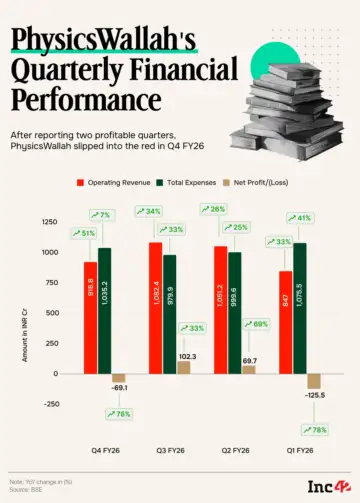
Last week, PhysicsWallah reported a 76% decline in its consolidated net loss to ₹69.1 Cr in Q4 FY26 from ₹289.3 Cr in the same quarter last year. The edtech major had posted a profit of ₹102.3 Cr in Q3 FY26. Operating revenue for the quarter rose 51% YoY to ₹918.8 Cr. Sequentially, it declined 15% from ₹1,082.4 Cr.
Student Credit Models Under Rising Scrutiny
PhysicsWallah's U-turn comes after its decision to enter student financing raised concerns among shareholders, given the edtech sector's troubled history with the segment. Earlier this week,Inc42 reported in detail about the challenges which PhysicsWallah will face by lending from its own books, with the biggest among them being maintaining lending discipline and keeping regulatory risks in check.
Caution around education financing in India's edtech sector has been rising. During the industry's high-growth phase, easy access to credit helped remove upfront affordability barriers, drive enrolments, and support the scale-up of higher-priced online and offline courses.
Over time, however, the model came under greater scrutiny as the sector matured. Concerns emerged around aggressive sales practices linked to financing, rising dependence on loan-backed enrollments and repayment stress in certain cases.
What began as a tool to improve affordability gradually became a growth lever tied closely to conversion targets, raising questions about sustainability and incentive alignment. The most cited example of this remains BYJU'S, which used third-party lenders to finance expensive learning programmes during its growth phase.
While this helped the edtech startup grow quickly at first, it later faced regulatory scrutiny, customer complaints, and allegations of mis-selling and aggressive recovery practices. Eventually, this damaged trust in edtech financing models and highlighted the risks of linking loans with student enrolments.
Against this backdrop, investors have become increasingly cautious about edtech companies expanding into lending-led models, particularly where financing and enrollment incentives overlap.