
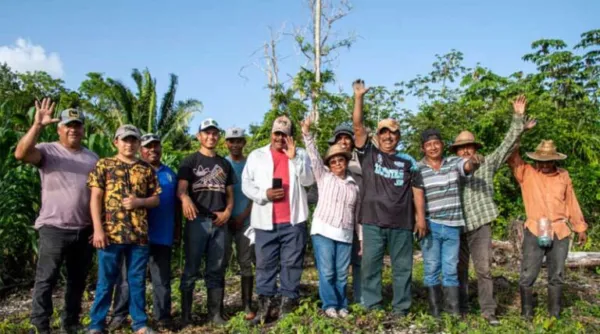

08 April 2026, Mexico: In the rural communities of southern Quintana Roo, where milpas still shape the landscape and life is organized around the cycles of the field, a movement has begun to transform the relationship with the land.
They are called the guardians of native maize, men and women who have decided to recover, protect, and return to the milpa the native seeds that fed entire generations and that in recent years seemed destined to disappear.
Their work has become the heart of the project "Food and Nutrition Security for Rural Communities of the State of Quintana Roo," promoted by the Food Security Agency (ASAQROO), the Institute of Social and Solidarity Economy (IESSOL), the Secretariat of Welfare (SEBIEN), and technically and scientifically supported by CIMMYT. Although this project includes financial inclusion training, specialized agronomic workshops, community leadership development, and the consolidation of networks of local blacksmiths capable of manufacturing hermetic silos, all of this functions as a support framework. The essence happens in the plots and in the hands of those who have decided to preserve native maize as a living heritage.
For years, the expansion of commercial materials displaced native varieties that had survived thanks to their ability to adapt to climate, soil, and traditional knowledge. But for families in communities such as Tres Garantías, Tierras Negras, Tepich, and Sacalaca, native seed was never just an agricultural input: it is memory, identity, an inheritance whose value cannot be measured only by yield. Its color, texture, and aroma preserve stories that modernization did not erase, and it is precisely those traits that today motivate the guardians to restore its place in the milpa.
Explaining their work is not simple. What they do is deeper than a technical process: it is an exercise in observation, patience, and cultural continuity. They select the most vigorous plants, wait for the grain to reach its ideal point, shell, separate, dry, and safeguard. And then they share. Small bags go from one family to another, accompanied by advice on rains, pests, soil management, or storage. It is a circulation of knowledge that strengthens community autonomy and reinforces bonds among those who recognize in the seed not just a crop, but a responsibility.
Producer Baldemar Reyes Fuentes, one of the most active guardians in Tres Garantías, expresses it with clarity that transcends the technical: "We had lost our seed due to the arrival of other maize, but now we are recovering it for our children and our children's children." His testimony condenses the meaning of this movement: it is not about nostalgia, but about the future.
The support of CIMMYT has provided data-based and scientific solutions to strengthen these processes without displacing their community roots. Training in seed selection, post-harvest management, and more resilient agronomic practices are among the contributions. The guardians integrate science and tradition in the same plot, showing that both can coexist and enhance each other.
The result of this collaborative work, between guardians, institutions, and science, is visible not only in the plots, but in the way communities see themselves. Agricultural communities share a recurring emotion: "In the plot, in my milpa… I feel happy." That happiness does not come only from a good harvest, but from the recognition that they are recovering something that seemed about to be lost: their seed, their autonomy, their bond with the land.
In a context of climate variability, profound transformations in agricultural systems, and an accelerated loss of genetic diversity worldwide, what is happening in the communities of southern Quintana Roo takes on special relevance. The work of the guardians of native maize has become an act of safeguarding biodiversity and, at the same time, a conscious bet on food sovereignty, with the potential to inspire other regions.
In parallel, the project has strengthened community organization through the creation of four machinery points in Tepich, Sacalaca, Huatusco, and Tres Garantías. These spaces bring together shared equipment and allow agricultural tasks to be carried out more efficiently, using tools adapted to the practices and needs of each territory. In addition to facilitating the implementation of regenerative agriculture approaches, they seek to ensure that technology is accessible to organized groups and communities, not limited by economic or logistical barriers. In essence, it is about freeing up time, promoting savings in production and energy costs, so that more families can focus on caring for the milpa and developing their production systems, instead of spending effort solving technical challenges that can be addressed collectively.
Although the state project provides the institutional framework and CIMMYT contributes science and technical support, the energy that sustains this process is born in the plots: in the sacks of carefully safeguarded seed, in the collective decisions of the communities, and in the shared conviction that the future is built, like the milpa, with patience, organization, and common work.
What is germinating today in this corner of southern Mexico is not just native maize. It is a way of reaffirming identity, strengthening communities, and sustaining life. And it is the guardians, with their quiet dedication and commitment to the seed, who are charting the path.
India's Designer Rice Innovation: High-Protein Breakthrough to Tackle Diabetes and Malnutrition
Global Agriculture is an independent international media platform covering agri-business, policy, technology, and sustainability. For editorial collaborations, thought leadership, and strategic communications, write to [email protected]
09 April 2026, Mumbai: Leading tractor manufacturers, including Mahindra Tractors and Swaraj Tractors, have announced price increases across their domestic tractor ranges in April
09 April 2026, Canada: In a recent interview with The Globe and Mail, CGIAR's Executive Managing Director, Dr. Ismahane Elouafi, highlighted the
07 April 2026, New Delhi: A new report authored by Omnivore, Beanstalk AgTech, and Briter argues that Southeast Asia sits on