
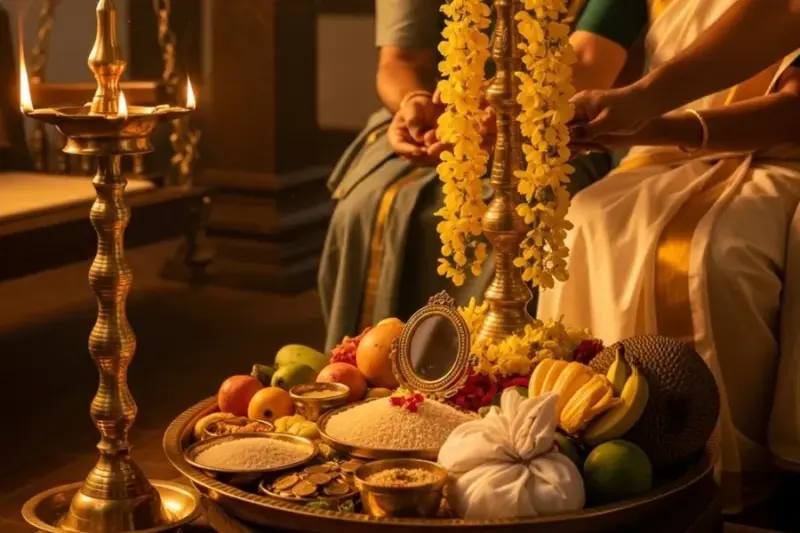

Vishu begins long before the rest of the world wakes up. In most homes, the lights are kept dim, and elders carefully prepare the Kani arrangement the previous night itself.
The idea is simple: the first thing a person sees on Vishu morning should bring positivity.
The moment itself is usually a mix of instructions and sleepy confusion. Someone gently covers your eyes, holds your hand, and slowly leads you into the room. You are half-awake, trying not to spoil the tradition, while quietly hoping you don't bump into a chair on the way.
When your eyes finally open, you see the Kani-a small but meaningful arrangement of rice, fruits, coins, flowers, a mirror, and a lamp. For many families, this is the emotional centre of Vishu, a moment believed to set the tone for the year ahead.
Kanikonna and the last-minute flower chase
The bright yellow Kanikonna flowers are central to Vishu, but finding them is often anything but easy. Even though the trees bloom naturally around this time, many households still end up in a last-minute search.
Some people depend on neighbours, some visit local markets, and some even negotiate with gardeners who guard their trees carefully. Despite the rush, the moment those golden flowers are finally placed in the Kani setup feels like everything has fallen into place.
It is not just decoration-it is a symbol of prosperity, timing, and the effort that quietly goes into keeping tradition alive.
Kaineetam: The most awaited exchange
If Vishu has one universally loved moment, it is Kaineetam. Elders give money to younger members of the family, often with a blessing and a smile. For children, it is the highlight of the day, and for many adults, it is a nostalgic reminder of their own childhood.
There is a familiar pattern every year. Children wake up early, stand near elders with a mix of confidence and expectation, and mentally calculate how many small joys their Kaineetam might buy. Elders, on the other hand, often enjoy the ritual as much as the giving itself.
In recent years, this tradition has also adapted to modern habits, with digital payments slowly entering the scene. Even so, the emotion behind it remains unchanged.
Vishu Sadya: Discipline at the beginning, surrender at the end
The Vishu Sadya is a simple but generous meal served on banana leaves. It includes rice, multiple curries, pickles, and desserts like payasam. At the start, most people promise themselves they will "eat carefully this time."
That promise rarely lasts.
The meal gradually turns into a slow celebration, where one serving leads to another. Conversations continue, laughter increases, and eventually, everyone reaches the same conclusion: they have eaten more than planned, but no one regrets it.
The Sadya is less about individual dishes and more about sitting together without hurry.
The deeper meaning behind the rituals
Beyond the food, flowers and rituals, Vishu carries a quiet emotional theme-reset. It is not a loud celebration, but a gentle reminder that time has moved forward and a new year has begun in the Malayalam calendar.
People clean their homes, plan small improvements, and hope for better days ahead. There is no need for big declarations; the feeling itself is enough.
Even in modern homes where routines are busy and time is limited, Vishu continues because it is built around simple actions that feel familiar and grounding.
Why Vishu still feels personal in 2026
In 2026, many traditions have changed shape, but Vishu still feels intimate. It does not demand perfection. Sometimes the flowers are late, the Sadya is simple, or the morning is slightly rushed-but the meaning stays intact.
It is a festival that survives because it is not about how perfectly it is done, but about how personally it is felt.