
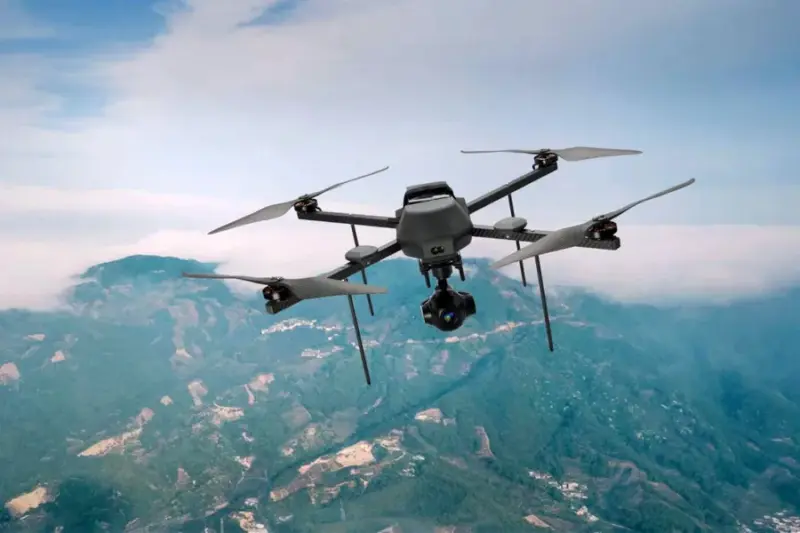

A bribery investigation by the Central Bureau of Investigation (CBI) has brought renewed scrutiny to the country's evolving drone ecosystem, with a focus on Asteria Aerospace, subsidiary of Reliance Industries.
The agency has arrested a deputy director general from the Directorate General of Civil Aviation (DGCA) and a senior executive linked to Reliance in connection with alleged bribery to secure approvals for drone imports.
According to the CBI's First Information Report (FIR), the accused include DGCA official M Devula and Bharat Mathur, a senior vice-president at Reliance Industries associated with Asteria Aerospace. The agency alleges that the two were caught during the exchange of a bribe amounting to ₹2.5 lakh, part of a larger arrangement where ₹5 lakh per file was allegedly agreed upon to clear pending import applications.
Searches conducted at Devula's premises reportedly led to the recovery of ₹37 lakh in cash, along with gold, silver, and multiple digital devices.
The modus operandi
The FIR details that Mathur first approached the DGCA official in March regarding pending approvals for drone imports. A meeting reportedly took place on April 17 at the DGCA office, where assurances were given that approvals would be processed swiftly.
Also Read: 96 drones in 5 minutes: China's Atlas swarm is a wake-up call India cannot ignore
The alleged exchange of money was scheduled for April 18 at a location near IIT Delhi, where both individuals were apprehended.
Both individuals, along with Asteria Aerospace and other unidentified persons, have been booked under the Prevention of Corruption Act and relevant provisions of the Bharatiya Nyaya Sanhita.
In response, Reliance stated that Mathur was engaged as a consultant and that the company neither authorised nor had knowledge of any such transactions.
What you should know about Asteria Aerospace?
Founded in 2011 in Bengaluru by Nihar Vartak and Neel Mehta, Asteria Aerospace has emerged as a notable player in India's drone technology landscape. The company focuses on providing actionable intelligence through aerial data, using drones equipped with advanced sensors and AI-based analytics.
Also Read: Meet the entrepreneur who wants to bring 'flying hospital' to India
In 2019, Reliance acquired Asteria for $2.45 million as part of its push into emerging technologies. Currently, Jio Platforms holds a 74% stake in the company.
Asteria has since expanded its footprint across sectors such as agriculture, construction, telecom, and oil and gas, deploying more than 400 drones for various applications.
One example of its deployment includes services to Reliance BP Mobility, where drones were used to analyse traffic patterns and vehicle speeds to support site selection for retail fuel outlets.
Financially, the company has witnessed rapid growth, with revenues rising from ₹1.1 crore in FY2020 to ₹40 crore in FY2024.
The regulatory framework
India's drone sector have seen accelerated growth since the introduction of the Drone Rules 2021, which liberalised drone operations while maintaining strict certification requirements. Under these rules, all unmanned aircraft systems must receive regulatory clearance before operation.
Also Read: HAL Tejas Mk2's final push: Fighter on the cusp of first flight
Asteria Aerospace claims to be the first Indian drone manufacturer to secure three types of certifications from the DGCA. Its indigenous drone, AT-15, was also showcased during the country's 77th Republic Day Parade, reflecting its positioning within India's domestic drone manufacturing push.
Governance challenges
India's drone ecosystem has expanded rapidly, with approximately 39,000 registered drones currently deployed for applications ranging from agricultural monitoring to infrastructure surveys and governance initiatives. The sector is increasingly seen as a critical enabler of digital transformation and economic development.
However, the current investigation highlights governance challenges within a fast-growing industry. Allegations of regulatory misconduct risk undermining confidence in approval processes that are central to ensuring safety, compliance, and fair competition.
The arrests come at a time when India's aviation regulator is already under pressure due to a series of recent incidents and operational disruptions across the sector. These include a high-profile aircraft accident, multiple airline disruptions, and increasing operational complexities linked to global geopolitical tensions.
In this context, the case underscores the need for stronger institutional transparency and accountability, particularly as India seeks to position itself as a global hub for aviation and drone technologies.
For industry stakeholders, the outcome of this investigation could shape future regulatory practices and reinforce the importance of robust compliance frameworks in emerging technology sectors.