




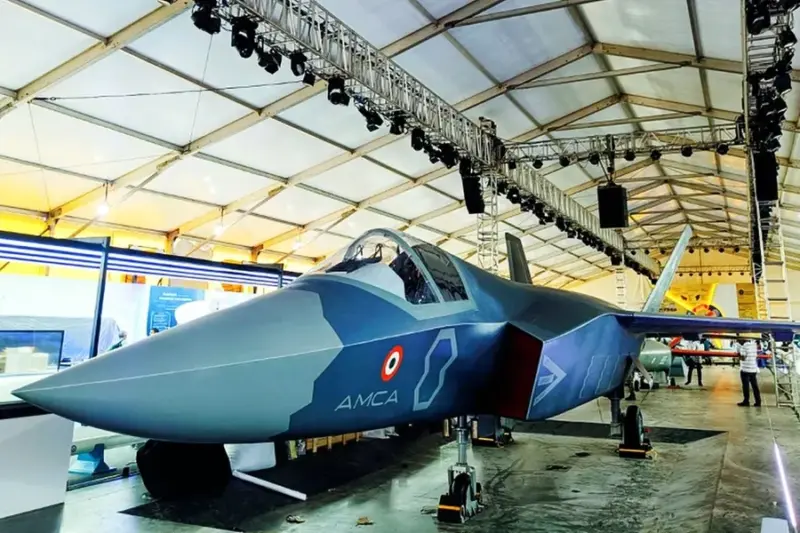

India has taken a giant step in its military aviation journey. This move could become the biggest change since Independence. The government has opened doors wide for private companies to play a central role in building the country's most advanced combat aircraft.
On May 27, the Aeronautical Development Agency (ADA) issued a Request for Proposal (RFP) for developing prototypes of the Advanced Medium Combat Aircraft, or AMCA. This fifth-generation stealth fighter is India's ambitious project to create a modern warplane that can avoid enemy radars.
Also Read: AMCA project: India's largest fighter jet programme moves to partner selection phase
In simple words, the old system where everything depended on government companies is changing.
Hindustan Aeronautics Limited (HAL), the big state-run firm that has built most Indian fighters till now, has been kept out of this main role. Instead, private players are stepping up.
Three strong groups have shown interest. First is the Tata Group as a solo bidder. Second is a team led by Bharat Forge along with some government firms like BEML and private company Data Patterns. The third is led by Larsen & Toubro (L&T) with Bharat Electronics and Dynamatic Technologies.
The winner will be chosen after checking technical capability and the lowest price, known as L1. The job is big -- they must build five flying prototypes and one structure for testing. This includes all tools, jigs, fixtures and testing setups needed.
For an average Indian, this means more than just making planes. The selected company will handle everything from manufacturing and assembly to putting together complex systems. They will create new factories, testing facilities and support the plane during flight trials and certification.
Think of it like building a house. ADA will remain the main designer, deciding the basic plan and architecture of the aircraft. But the private partner will actually construct it, fit all parts, and make sure everything works smoothly. They will bring together different equipment -- some given directly by ADA and others from chosen suppliers.
Also Read: Tejas Mark 1A: HAL's strong push for trust
The selected bidder must create a completely new Indian company within three months of winning. This new firm cannot have foreign owners beyond small permitted investments. All top management -- from board members to CEO, CFO and COO - must be Indian residents. This ensures India keeps full control over this strategic project.
The idea is to build a strong aerospace ecosystem that lasts for decades. The winner must also join future work like mass production and maintenance of the aircraft. This is not a one-time contract but a long partnership.
In the past, HAL handled most fighter work while private firms only supplied small parts. Now, responsibilities are shared. Private industry will manage tough tasks like integrating avionics, sensors and systems -- the most challenging part of modern jet development.
They will also look after maintenance, documents and fixing issues during testing. All infrastructure built for this program must be maintained by the company as long as the contract says. A special committee will first check technical bids. Only qualified ones will open their price quotes.
Final choice depends on the best technical and cost balance.
The AMCA program faces real challenges -- making the plane stealthy, developing smart electronics, combining sensor data, and engines for early versions. Yet, this is a proud moment.
For the first time, India is not just asking private companies to supply parts. It is inviting them to stand shoulder to shoulder inside the heart of the program.
This shift brings hope for more jobs, new skills and a stronger defence industry. Young engineers and workers across India can dream of building world-class fighter jets right here. By trusting private talent with strategic work, India is betting on its own people and companies to make the country self-reliant in the skies.
The success of AMCA will shape India's security and technological future for generations. It shows a new confidence -- that together, government design brains and private execution power can create something truly special.
The author is a defence, aerospace & geopolitical analyst.