
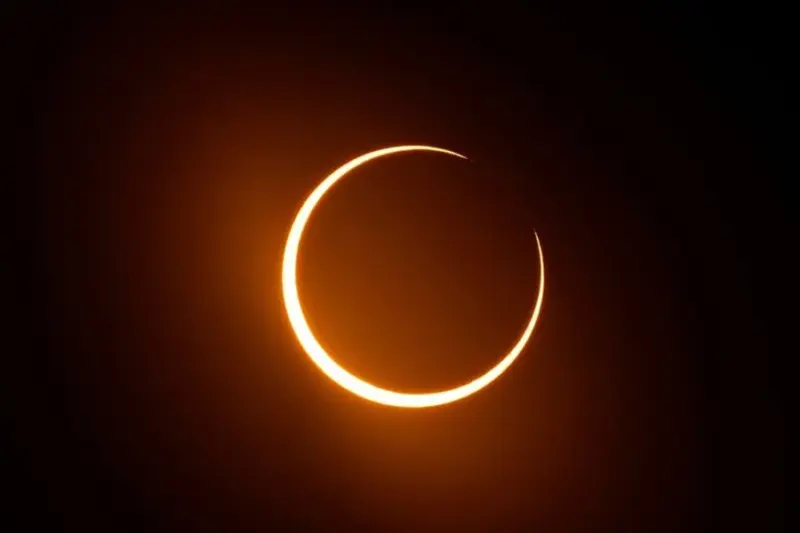

The first solar eclipse of 2026 is taking place on February 17 as an annular 'ring of fire' event, visible in parts of the Southern Hemisphere.
While astronomically significant, the eclipse also carries ritual and cultural importance in Hindu traditions.
What is happening on February 17, 2026?
On February 17, 2026, the world is witnessing an annular solar eclipse, the first solar eclipse of the year. In this type of eclipse, the Moon passes between the Earth and the Sun but is too far from Earth to completely block the Sun. As a result, a bright ring of sunlight remains visible around the Moon's silhouette.
This phenomenon is popularly called the 'Ring of Fire'.
An annular eclipse occurs during Amavasya (new moon), when the Sun and Moon align along with the Earth. However, unlike a total eclipse, the Sun is not fully obscured because the Moon appears slightly smaller in the sky.
Solar eclipse 2026 timings in India (IST)
Although the eclipse is not visible from India, its timings as per Indian Standard Time are:
- Start: 3:26 pm IST
- Peak phase: Around 5:41 pm IST
- End: 7:57-7:58 pm IST
- Total duration: Approximately 4 hours and 31-32 minutes
At its peak globally, up to 96 per cent of the Sun's surface was covered in regions along the path of annularity, leaving the distinctive bright ring.
Is the February 17 eclipse visible in India?
No. The February 17, 2026 annular solar eclipse is not visible in India.
Astronomical observatories, including officials from the Government Jiwaji Observatory in Ujjain, confirmed that the path of annularity does not pass over the Indian subcontinent.
Because the eclipse is not visible in India, many scholars state that Sutak Kaal is not considered applicable here.
What is Sutak Kaal and does it apply today?
In Hindu belief systems, Sutak Kaal refers to a period considered inauspicious during an eclipse. Traditionally:
Sutak for a solar eclipse begins 12 hours before the eclipse.
Auspicious activities such as weddings, housewarming ceremonies or religious functions are avoided.
Temples may close during the eclipse period.
However, as the eclipse is not visible in India, several religious authorities state that Sutak is not valid domestically in this case. Interpretations vary depending on local customs and sect traditions.
Religious rituals and practices associated with Surya Grahan
Even when not visible locally, many devotees observe traditional practices linked to Surya Grahan (solar eclipse). These practices are rooted in faith and cultural tradition rather than scientific evidence.
Commonly followed rituals
- Chanting Surya mantras such as: "Om Hreem Hreem Hroum Sah Suryaya Namah" and "Om Ghrinih Suryaya Namah"
- Avoiding cooking or eating during the eclipse period.
- Adding Tulsi or Kusha grass to stored food and water.
- Taking a ritual bath after the eclipse ends.
- Donating grains, clothes or food to the needy.
- Cleaning the home and sprinkling Ganga water after the eclipse.
- Pregnant women are traditionally advised to take extra precautions, though there is no scientific basis for these restrictions.
It is important to note that these practices are based on religious belief and not supported by scientific evidence.
Where was the 'ring of fire' visible?
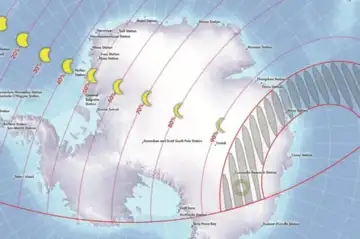
The path of annularity passed mainly through parts of the Southern Hemisphere. The eclipse was visible in:
- Antarctica
- Southern Africa, including South Africa, Namibia and Botswana
- Parts of Zimbabwe and Mozambique
- Mauritius and surrounding islands
- Southern regions of South America, including Argentina and Chile
In these areas, viewers could observe the full annular effect for up to a few minutes at peak alignment.
Why is direct viewing dangerous?
Astronomers and safety experts warn that looking directly at the Sun during an eclipse without proper eye protection can cause permanent retinal damage.
Safe viewing requires:
- Certified eclipse glasses meeting ISO 12312-2 standards
- Proper solar filters on telescopes or cameras
- Ordinary sunglasses do not provide sufficient protection.
Scientific importance of solar eclipses
From a scientific perspective, solar eclipses help astronomers:
- Study the Sun's outer atmosphere (corona)
- Observe solar radiation patterns
- Refine orbital calculations of the Earth-Moon system
- Annular eclipses are especially useful in understanding the Moon's varying distance from Earth and its orbital dynamics.
Global context: Why eclipses matter
Solar eclipses occur somewhere on Earth roughly every 18 months. However, any specific location may wait decades before seeing one.
The February 17, 2026 event highlights how celestial events are global phenomena shaped by precise orbital geometry. While India did not witness this eclipse visually, it remains part of a broader astronomical cycle affecting multiple continents.
The February 17, 2026 annular solar eclipse marked the first solar eclipse of the year and created a striking 'Ring of Fire' in parts of Antarctica, Africa and South America. Although not visible in India, its timings, religious interpretations and astronomical significance generated widespread interest.
(Disclaimer: Information related to Sutak Kaal, rituals, remedies and astrological interpretations is based on traditional beliefs and cultural practices. These views do not have scientific validation. Readers are advised to exercise personal discretion.)