




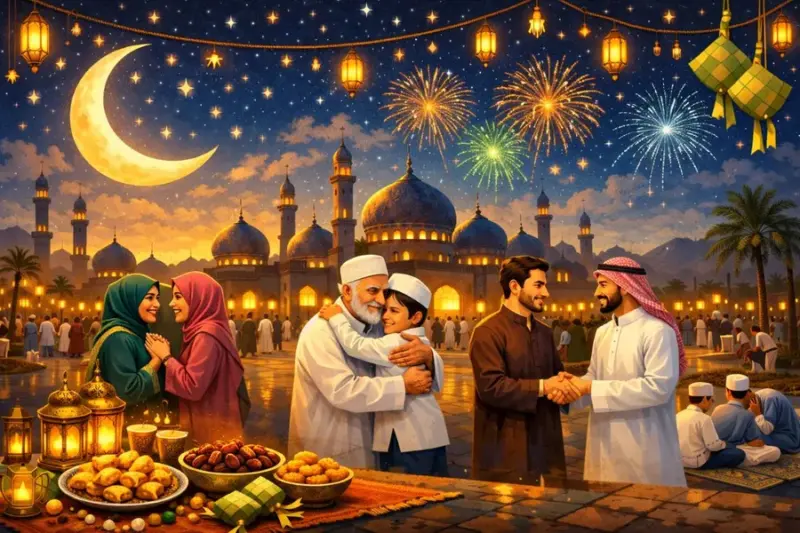

Eid Al Fitr, one of the most important festivals in Islam, is celebrated by Muslims across the world with great joy, devotion and community spirit.
The festival is observed twice in the Islamic calendar each year in different forms - Eid Al-Fitr and Eid Al-Adha - both holding deep religious and cultural significance for the Muslim community.
When is Eid Al-Fitr 2026?
Eid Al-Fitr 2026 is expected to be celebrated around March 20, 2026, depending on the sighting of the crescent moon that marks the beginning of Shawwal, the tenth month of the Islamic Hijri calendar. The exact date may vary from country to country based on moon sightings.
Eid Al-Fitr comes at the end of Ramadan, the ninth month of the Islamic calendar, during which Muslims observe a month-long fast from dawn to sunset. The festival marks the completion of this period of fasting, prayer and spiritual reflection.
Often referred to as "Meethi Eid" in many parts of South Asia because of the traditional sweets prepared for the occasion, the festival symbolises gratitude, charity and togetherness.
Also read| Eid Al Fitr 2026: Saudi Arabia announces four-day holiday for private and non-profit sectors
History and origin of Eid Al-Fitr
According to Islamic tradition, the first Eid Al-Fitr celebration is believed to have taken place in 624 AD. It is associated with the Prophet Muhammad, who established the festival after the Battle of Badr, one of the earliest and most significant battles in Islamic history.
Historical accounts suggest that sweets were distributed to mark the occasion, a tradition that continues today in many Muslim households during Eid celebrations.
Eid Al-Fitr is also closely linked to the core principles of Islam, which emphasise faith, prayer, charity, fasting and the pilgrimage of Hajj.
How Eid Al-Fitr is celebrated
Eid Al Fitr celebrations begin early in the morning, when Muslims wake up, take a ritual bath and wear new or traditional clothes before heading to mosques or open prayer grounds to offer the special Eid prayer (Eid namaz).
After the prayers, people greet one another with "Eid Mubarak", expressing joy and gratitude for completing the holy month of Ramadan.
Families prepare a variety of traditional dishes and desserts, especially sweets such as seviyan or kheer, which is why the festival is widely known as Meethi Eid.
The day is also marked by family gatherings, festive meals and visits to relatives and friends. Many people break their fast on Eid morning with dates and water, following the tradition associated with the Prophet.
Also Read| When are schools closed in March 2026? Festival-wise holiday guide
Charity and traditions on Eid
Charity plays an essential role during Eid Al-Fitr. Muslims are encouraged to support those in need by giving food, clothing or money, reinforcing the values of compassion and social responsibility.
Children often receive Eid Al-Fitr, small gifts or money given by elders as part of the celebrations.
Women traditionally wear new outfits, jewellery and apply mehendi, adding to the festive atmosphere of the day.
A festival of gratitude and community
For millions of Muslims worldwide, Eid Al-Fitr is not only a religious celebration but also a day of gratitude to Allah for the strength to complete Ramadan. The festival brings families and communities together, emphasising unity, generosity and joy at the end of the holy month.