
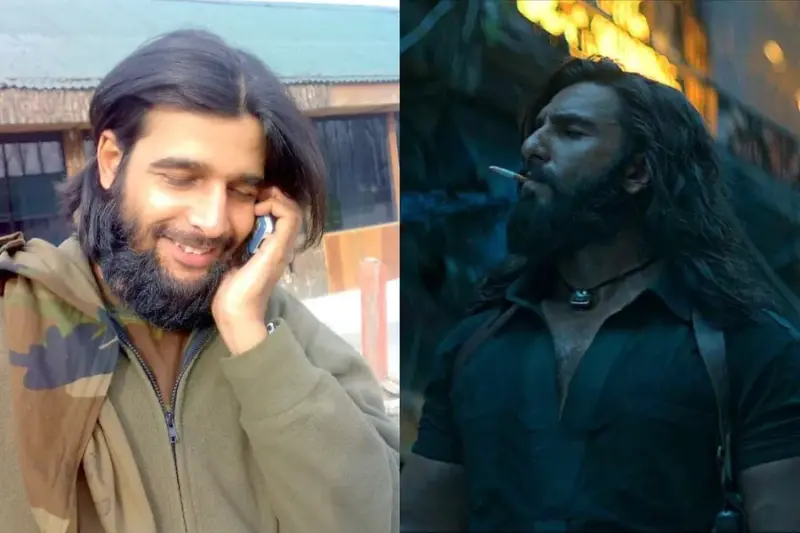

With only days to go before 'Dhurandhar: The Revenge' reaches cinemas, renewed attention has turned to the life of decorated Indian Army officer Major Mohit Sharma.
The film stars Ranveer Singh as a soldier who infiltrates militant networks in Kashmir, a storyline many believe draws heavily from the real-life exploits of the late para-commando.
The film, directed by Aditya Dhar, also features Sanjay Dutt, Arjun Rampal, R Madhavan and Akshaye Khanna. As the debate over the inspiration behind the film grows, interest in Major Sharma's extraordinary life, from undercover missions to his final battle, has surged.
Early life and education
Major Mohit Sharma was born on 13 January 1978 in Rohtak, in the northern Indian state of Haryana, to Rajendra Prasad Sharma and Sushila Sharma. Known affectionately as "Chintu" among family members and "Mike" to his friends and colleagues, he displayed a wide range of talents from an early age.
Apart from academics, Sharma had a deep interest in music. He played several instruments - including the guitar, synthesiser and mouth organ - and often entertained audiences with live performances.
His schooling began at Manav Sthali School in South Extension, New Delhi. He later attended Holy Angels' School in Sahibabad before completing his studies at Delhi Public School, Ghaziabad in 1995.
Although he initially enrolled at Shri Sant Gajanan Maharaj College of Engineering in Maharashtra, his ambition to serve in the armed forces soon took precedence. That same year, he joined the National Defence Academy, where he trained as a cadet in the India Squadron.
From NDA to the elite Para Special Forces
After graduating from the Indian Military Academy, Sharma was commissioned into the 5th Battalion of the Madras Regiment in December 1999.
His first posting was in Hyderabad. He later served with the 38 Rashtriya Rifles in Kashmir, where he took part in counter-insurgency operations and earned the Chief of Army Staff Commendation Card in 2002.
Driven by a desire to join one of the Army's most demanding combat units, Sharma moved to the elite 1 Para Special Forces in June 2003. The unit, often referred to as Para (SF), is known for undertaking some of the military's most sensitive and dangerous missions.
The undercover mission that changed the fight
In 2004, Sharma carried out one of his most daring assignments by infiltrating the militant organisation Hizbul Mujahideen.
To penetrate the group, he adopted the alias "Iftikhar Bhatt," presenting himself as a man hostile to the Indian Army and claiming that soldiers had killed his brother. He altered his appearance by growing long hair and a heavy beard and dressing like locals in the region.
The disguise enabled him to win the trust of militants and gather crucial intelligence that ultimately led to the elimination of two key insurgent leaders, Abu Torara and Abu Sabzar.
For his bravery and tactical skill during the operation, Sharma was awarded the Sena Medal.
The final battle in Kupwara
Five years later, Sharma was involved in another high-risk operation in the forests of Kupwara district in north Kashmir, an area known for infiltration routes and unpredictable combat conditions.
According to official Defence Ministry records, on 21 March 2009 he led a Bravo Assault Team after intelligence indicated the presence of militants in the dense forest. During the encounter, four of his commandos were injured in heavy gunfire.
Despite sustaining critical injuries himself, Sharma continued directing the operation, repeatedly exposing himself to danger while rescuing wounded soldiers and engaging the militants in close-quarter combat.
He successfully neutralised four terrorists during the mission but later succumbed to his injuries.
India's highest peacetime gallantry honour
In recognition of his courage, leadership and sacrifice, Sharma was posthumously awarded the Ashoka Chakra, the country's highest peacetime decoration for valour.
The award acknowledged not only his final battle but also his years of service in covert and high-risk counter-insurgency missions.
Life beyond the battlefield
He married Lieutenant Colonel Rishima Sharma, who also serves in the Indian Army, reflecting the family's continued association with the armed forces.
From his early days as a student to his role as one of India's most decorated para-commandos, Sharma's life story has become a symbol of dedication and patriotism.
His decorations, including the Sena Medal and the Ashoka Chakra, highlight a career defined by courage, intelligence and unwavering commitment to duty. Today, he remains a powerful example of valour within the Indian Army and beyond.
Why his name is back in the spotlight
As 'Dhurandhar 2' reaches theatres, debate has emerged over whether the film's central character is inspired by Sharma's life.
Many viewers, including members of his family, believe the protagonist mirrors the officer's appearance, undercover operations and combat history. His family had approached the Delhi High Court, arguing that the film appears to be based on his story without their consent and raising concerns about portrayal and respect for a national hero.
Running for 3 minutes and 25 seconds, the trailer, which was released on March 07, signals a darker and more intense continuation of the story led by Ranveer Singh. The actor reprises his role as undercover operative Jaskirat Singh Rangi, who is now deeply embedded within Pakistan's criminal underworld under the alias Hamza Ali Mazari.
The sequel arrives after the massive success of 'Dhurandhar', which released in December last year and went on to become the highest-grossing Hindi film of all time, overtaking 'Pushpa 2: The Rule'. The new film is scheduled for a worldwide theatrical release on March 19, 2026.