




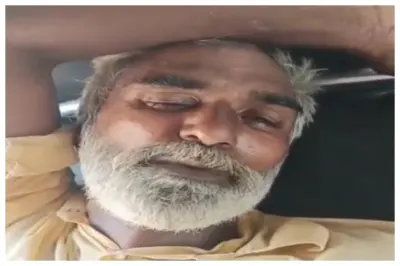

The latest controversy began in Sangrur, where Gulzar Singh, a daily-wage worker from Toor Banjara village, publicly raised the issue of the easy availability of 'chitta' before Punjab Finance Minister Harpal Singh Cheema.
His own son was struggling with addiction. Singh later died after consuming poison. His family has alleged that he was pressured to apologise after raising the issue. Police have registered a case against five persons, including the village sarpanch, and a Special Investigation Team has been constituted. The allegations are serious and must be established through an impartial investigation.
But the political significance of the episode cannot be ignored. A citizen was not protesting about some abstract policy. He was talking about drugs allegedly available in his own village and about the destruction of his own family. That is precisely the kind of complaint a government fighting a war against narcotics should want to hear. Instead, the controversy has raised a more uncomfortable question: Can Punjab win the drug war if those who complain about drugs lose faith in the system?
The government has substantial numbers to present in its defence. Under its 'Yudh Nashean Virudh' campaign, launched in March 2025, authorities say 51,979 citizen tip-offs through the Safe Punjab Helpline contributed to 25,339 arrests. During the same period, 59,293 FIRs were registered under the NDPS Act. The reported seizures include 3,757 kg of heroin, 964 kg of opium, 45 tonnes of poppy husk, 1,288 kg of ganja and 71 kg of methamphetamine.
These are not insignificant figures. They demonstrate that the state machinery is acting and that citizens themselves are providing intelligence. The government therefore has a legitimate case when it says that the anti-drug campaign is not merely political rhetoric.
But statistics cannot by themselves establish victory.If thousands of arrests and tonnes of narcotics seized were enough, Punjab should already be witnessing a dramatic transformation. Instead, reports from villages continue to describe the accessibility of drugs and the devastation caused to families. The most painful evidence is not found in an FIR register. It is found in the house where a son sells household possessions to finance addiction, or where parents watch helplessly as a child disappears into the drug economy.
And then comes another disturbing episode. Mohanjeet Singh, a youth from Sangrur's Sheron village, alleged that he was tortured in custody after displaying a black flag and protesting against the government's handling of the drug problem during Chief Minister Bhagwant Mann's public programme. Police have disputed aspects of his account and an inquiry has been ordered. Again, the allegations must be investigated rather than converted into established facts.

But two controversies appearing in close succession should make any government pause. The drug war requires citizens. It requires informants. It requires parents willing to identify peddlers. It requires villagers willing to tell police where drugs are being sold. It requires addicts and their families to approach the state without fear. A government cannot simultaneously ask citizens to become partners in the anti-drug campaign and create an atmosphere in which citizens fear the consequences of speaking about drugs. This is where the Punjab debate becomes larger than AAP versus Congress.
Rahul Gandhi has demanded Harpal Cheema's resignation and an independent investigation, while Bhagwant Mann has accused him of exploiting a tragedy for political purposes. But political accusations will not solve Punjab's drug crisis. Nor will blaming previous governments.
The real test is simpler. Can a citizen stand before a minister and say - drugs are being sold in my village—and expect the state to protect him rather than make him feel vulnerable?Punjab does not merely need more arrests. It needs a government that can combine enforcement with rehabilitation, dismantle the supply network, protect whistle-blowers and restore public confidence. A drug war is ultimately a war for society. The government may win the statistics and still lose the battle if ordinary Punjabis stop believing that the state is on their side.
Punjab needs not merely a drug-free campaign. It needs a fear-free citizenry willing to speak about drugs without fear.
This is deliberately hard on the governance contradiction without prejudging the ongoing investigations. It also gives the piece a broader national-security/governance dimension if you want to connect it later to the Amit Shah-Drug Free India argument.The irony is difficult to escape. AAP did not inherit the drug issue as an unknown problem. It rode to power in Punjab on an explicit promise to defeat it. Arvind Kejriwal had promised to make Punjab drug-free within three months; Bhagwant Mann subsequently gave his own deadlines. Years later, the deadlines have multiplied, while the drug problem remains alive in Punjab's villages.
The government can point to arrests, seizures, demolitions and rehabilitation. But the ultimate test is not the number of press conferences or police statistics. It is whether a parent can say, without fear: 'My child is an addict. Drugs are being sold in my village. Please save us.'
That was AAP's promise. Punjab is still waiting for its fulfilment.