





Reported by Roopak Goswami
Guwahati: A new study by researchers from Nagaland University has proposed a GIS-based scientific framework to address the growing threat of soil erosion in Northeast India, warning that unchecked land degradation could severely impact agriculture, water resources, and ecological stability in the region.
Published in the peer-reviewed journal Discover Geoscience, the study focuses on the Siji watershed in Assam's Gai River Basin, one of the most erosion-prone landscapes in the eastern Himalayan region.
Using the Revised Universal Soil Loss Equation (RUSLE) integrated with Geographic Information System (GIS)-based modelling, the researchers mapped erosion hotspots and assessed sediment transport patterns across the watershed.
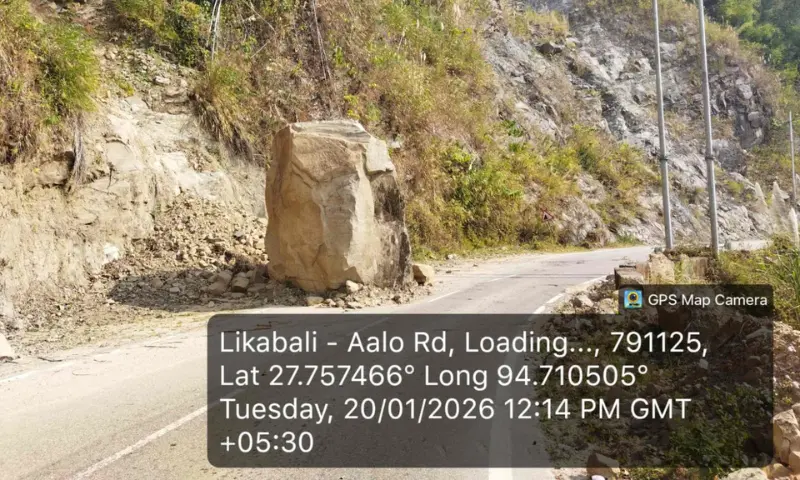
The study highlights that steep slopes, intense rainfall, deforestation, shifting cultivation, mining activities, and infrastructure expansion are accelerating soil erosion across the Northeast, increasing pressure on fragile hill ecosystems.
The research was conducted by M. S. Rawat of the Department of Geography, Nagaland University, along with research scholar Tulumoni Gogoi and Pradeep Kumar Rawat of Asian International University, Manipur.
According to the findings, areas with dense forest cover and gentle slopes recorded minimal soil loss, while croplands, barren terrain, and regions affected by road construction and mining showed extremely high erosion rates, posing serious risks to land stability and local ecosystems.
The researchers recommended an Integrated Watershed Management (IWM) approach that combines sustainable land-use planning with conservation measures such as terracing, contouring, and increased vegetation cover to reduce soil degradation and improve water retention.
"The recent study on GIS-based solutions for soil erosion marks a significant step towards addressing one of the most pressing environmental challenges in North-East India," said Prof. Jagadish K. Patnaik, Vice-Chancellor of Nagaland University.
He said geospatial technology could help guide conservation planning while strengthening agricultural productivity and water resource management.
M. S. Rawat said the watershed-based modelling approach allows researchers to identify erosion hotspots at a micro level and design location-specific interventions instead of applying uniform conservation measures across diverse landscapes.
The study also underlined the wider applicability of the framework, stating that the model could be adapted to other environmentally sensitive regions facing similar topographical and climatic challenges.
Researchers further called for the development of flood prediction systems and improved environmental monitoring mechanisms in the Northeast, warning that climate change and growing human interventions could intensify ecological degradation if timely measures are not adopted.