

'The BJP and its allies can decide the fate of many candidates.'
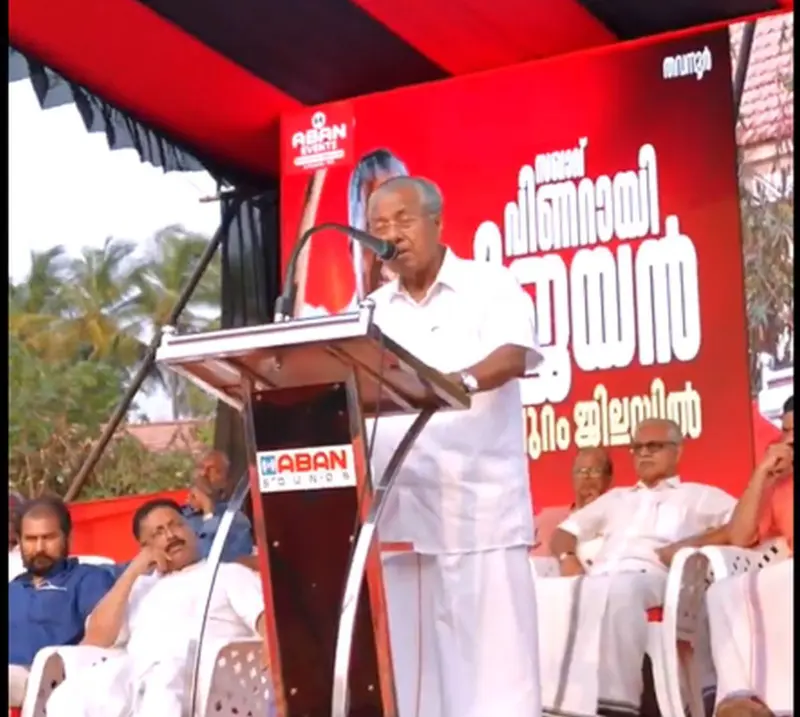
IMAGE: Kerala Chief Minister Pinarayi Vijayan at an election rally in Thavanur.
Photograph: Kind courtesy Video Grab/CPI(M)/X
Key Points
- 'Earlier, it was the upper caste people who supported the BJP. Now, it is the middle class that is supporting the BJP.'
- 'The position taken by many CPM leaders is more or less in line with the ideals of the RSS-BJP.'
- 'Muslim politics has been very powerful in Kerala for decades.'
140 seats in the Kerala state assembly.
71 seats to be won to get the majority.
In the 2021 assembly election, the Left Democratic Front created history by coming back to power for a second term. A ruling party coming back to power had never happened in the history of Kerala till then. The state had always been rotating between the UDF (United Democratic Front) and the LDF.
The LDF won a record 99 seats and Pinarayi Vijayan became the chief minister of Kerala the second time.
In 2026, the fight is not between the UDF and the LDF alone. The Bharatiya Janata Party led National Democratic Alliance is giving a strong fight to the LDF and UDF.
Will the 2026 election spring ia surprise? Or will it be on expected lines with the UDF coming to power?
N P Chekkutty worked with Desabhimani, the Indian Express and Kairali TV before becoming the executive editor of the now defunct newspaper Tejas. He is a much sought after political pundit in Kerala.
"In the Lok Sabha election, the BJP got around 20% vote share. The recent Manorama survey shows that their vote share will come down to 14% to 15% in the assembly election," Mr. Chekkutty tells Rediff's Shobha Warrier in the first of a two-part interview:
For the first time, the fight in the Kerala assembly election is between three fronts.
If you look at the Kerala political scene, the BJP has been slowly making its presence felt in various elections.
In the last election, there were substantial number of constituencies where the BJP could come second pushing the LDF or UDF to the third position.
It is a fact that now the BJP and its allies are a force that can actually decide the fate of many candidates.
Still, their strength is not throughout Kerala.
They have influence in the south of Kerala. They are strong in Palakkad and also the Kasargod region.
What are the reasons behind the strength of the BJP in the south and in the north in Palakkad and Kasargod?
There are a variety of reasons. One is that from the 1980s onwards, Hindu right-wing politics has been making serious inroads all over India, and it had its repercussions in Kerala society also. The right-wing ideological shift is very clear.
But in Kerala, it is confined to certain areas only. It was mainly because districts like Alappuzha, Kozhikode, Kannur, etc had strong left-wing political consolidation for decades. The first trade union movement started in Alappuzha in the 1920s. In Malabar also, there was a strong left-wing movement. This consolidation was on political and secular issues.
In the extreme north of Kerala, Kasargod is influenced by Kannada politics, and from the 1970s onwards the RSS had started its operations there. Mangalore-based RSS groups came to Kannur and became a challenge to the CPM controlled trade union movement there.
In the south, this kind of secular consolidation was less.
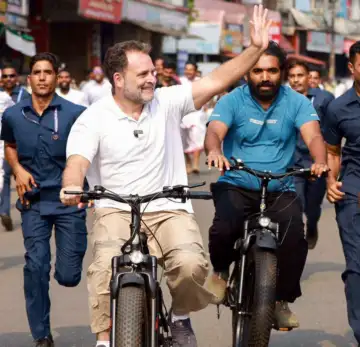
IMAGE: Congress leader Rahul Gandhi pedals through the streets during his visit to campaign for the Kerala assembly elections, March 30, 2026. Photograph: Kind courtesy @INCIndia/ANI Photo
Do you think the BJP couldn't make inroads in central Kerala due to the large Christian population?
It could be a reason. Christians have been distancing themselves from their kind of Hindutva politics.
Similarly, in Malabar, there is a strong Muslim consolidation. So, the BJP could not make inroads there too.
So, it is either the secular consolidation of politics or the presence of minorities that did not give the BJP entry in these areas.
It is in the extreme south and extreme north that they have made their presence felt.
In the Lok Sabha election, the party had got around 20% vote share. That is not the real picture. The vote for the BJP at that time was because people tend to vote for the winning side.
The recent Manorama survey shows that their vote share will come down to 14% to 15% in the assembly election. This is the real picture.
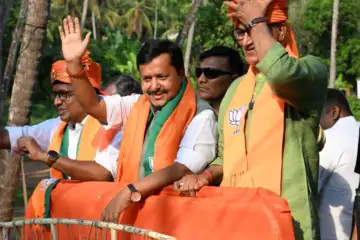
IMAGE: BJP national President Nitin Nabin during a roadshow in Attingal, March 31, 2026. Photograph: Kind courtesy Nitin Nabin/X
Are the Hindu votes going to the BJP at the expense of the LDF?
In certain areas, yes. But in certain areas, no.
For example, the Thrissur constituency from where Suresh Gopi won the Lok Sabha seat. If you look at the votes scored by both the LDF and the UDF in 2019 when Suresh Gopi lost, there was an erosion of votes from the Left. But in 2024, when he won, you will see the erosion of Hindu votes happened from the UDF too.
So, this phenomenon is not confined to one political front but leaning more towards a social formation.
Earlier, it was the upper caste people who supported the BJP. Now, it is the middle class that is supporting the BJP.
You see the OBC communities are being roped in by the BJP now.
But if you look at the scheduled castes, they are generally keeping away from the BJP and its politics.
I feel the problem now is the CPM has been taking a position that is more or less Islamophobic.
I wrote about this in my column in The Times of India that the position taken by many CPM leaders is more or less in line with the ideals of the RSS-BJP.
Naturally, a strong messaging is getting deepened in the Kerala psyche, that the CPM follows Sangh Parivar politics when it is expected to follow secular politics.
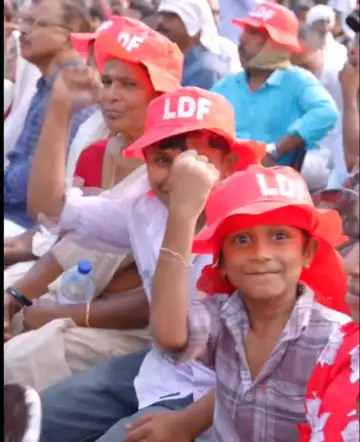
IMAGE: LDF supporters at a Pinarayi Vijayan election rally in Thavanur. Photograph: Kind courtesy Video Grab CPI(M)/X
Islamophobic is a very strong word...
Muslim politics has been very powerful in Kerala for decades. From the 1960s, they have been part of Kerala's mainstream politics, which is more than half a century. They have been part of various governments too.
Now, some senior Communist leaders are making statements like, if the UDF comes to power, (Indian Union Muslim League leader) Thangal will be in the government, (Indian Union Muslim League leader) Kunjalikutty will be there, (Congress leader)Chandy will be there, etc.
It is like they are saying, there will be a minority consolidation if the UDF comes to power.
You mean by making such statements, they are alienating the minorities?
Certainly.
- Part 2 of the Interview: 'Keralites Accept BJP As A Mainstream Contender For Power'
Feature Presentation: Aslam Hunani/Rediff