





India's attempt to balance competing powers in West Asia is entering dangerous territory.
As chair of BRICS in 2026, New Delhi now finds itself trapped between Iran and the UAE, two increasingly hostile regional rivals whose confrontation threatens not only the unity of BRICS but also India's energy security, connectivity ambitions, and broader geopolitical strategy.
The immediate diplomatic problem is stark.
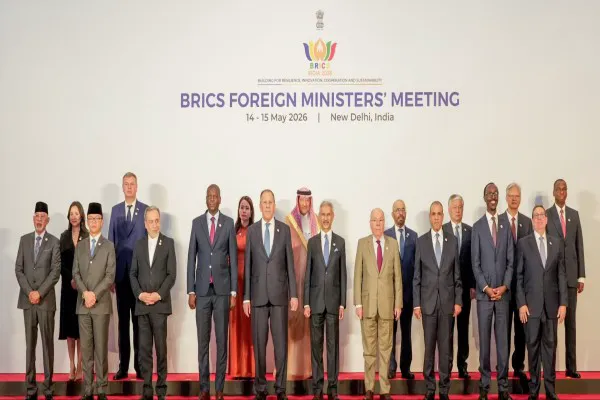
The BRICS foreign ministers' meeting in New Delhi is likely to conclude without a joint statement because Iran and the UAE cannot agree on language linked to the regional conflict.
Tehran wants India, as BRICS chair, to take a clearer political stand against the United States and Israel. The UAE and Gulf partners expect India to prioritise maritime security and the protection of energy infrastructure.
For India, this is more than a procedural embarrassment. It is a direct challenge to its credibility as BRICS chair and as a self-styled bridge between rival global camps.
The current crisis is already testing the limits of what Indian officials privately describe as 'calculated ambiguity'.
BRICS operates by consensus. Without consensus, the bloc's claims of representing a cohesive Global South begin to collapse.
The fact that India may have to settle for a weak 'chair's statement' instead of a unified declaration exposes how deeply fractured the grouping has become.
At the centre of the dispute is a widening Iran-UAE confrontation. Tehran has accused the UAE of assisting military operations against Iran by providing bases, intelligence support, and airspace access. The UAE has meanwhile pushed for condemnation of Iranian strikes on regional energy infrastructure.
India cannot afford to alienate either side.
That is what makes this crisis uniquely difficult for New Delhi.
Over the past decade, India has built a deep strategic partnership with the UAE. Prime Minister Narendra Modi has invested enormous political capital in the relationship, transforming Abu Dhabi into one of India's closest economic and security partners in West Asia.
His repeated visits to the UAE helped cement agreements on investment, trade, logistics, digital infrastructure, defence and the India-Middle East-Europe Economic Corridor, or IMEC.
The UAE is not simply another Gulf partner anymore. It has become central to India's westward economic strategy.
That strategy now faces serious disruption.
The IMEC corridor was envisioned as a geopolitical and commercial counterweight to China's Belt and Road Initiative. The project would connect India to Europe through the UAE, Saudi Arabia, Jordan, and Israel. It was meant to reduce shipping times, deepen economic integration, and anchor India more firmly in emerging trade networks across West Asia and Europe.
But the current conflict has effectively paralysed the project. The war has frozen regional normalisation efforts, intensified maritime insecurity, and raised fundamental questions about whether stable overland and port connectivity across the region is even viable in the near term.
For India, the consequences are strategic as much as economic.
IMEC was designed to position India at the centre of a new transcontinental trade architecture. If the corridor stalls indefinitely, New Delhi risks losing momentum in one of its most ambitious connectivity initiatives. It also weakens India's attempt to compete with Chinese infrastructure influence across Eurasia.
At the same time, India cannot afford to abandon Iran.
Tehran remains critical to India's long-term access to Central Asia and Eurasia through routes such as Chabahar. Iran also retains enormous importance in India's energy calculations, particularly at a time when global oil markets are under severe pressure.
That pressure is already mounting. Maritime traffic through the Strait of Hormuz has collapsed dramatically because of the conflict. Nearly 20 per cent of India's imports and almost all LPG imports pass through Hormuz. Any prolonged instability directly threatens India's inflation outlook, industrial costs, and fuel security.
This is where the Russia factor becomes increasingly important.
The regional crisis is forcing India back toward deeper energy dependence on Russia. New Delhi is once again compelled to rely on uninterrupted Russian supplies to offset West Asian instability. But this comes with its own complications.
India's leverage over Moscow has weakened significantly. Earlier sanctions disruptions had already altered the energy relationship. Now, with Gulf routes under threat and West Asian supplies vulnerable, Russia gains greater bargaining power in pricing, shipping, and payment negotiations.
In effect, the Iran-UAE crisis is shrinking India's strategic flexibility.
New Delhi is being pushed into a situation where every major choice carries costs.
Leaning too closely toward the UAE risks damaging ties with Iran at a moment when Tehran wants stronger diplomatic backing inside BRICS. Moving closer to Iran risks undermining Delhi's Gulf partnerships, threatening investment flows and weakening cooperation on projects like IMEC.
This is why India's traditional policy of 'calculated ambiguity' is becoming harder to sustain.
For years, India successfully managed parallel relationships with rival powers across West Asia. It maintained ties with Israel and Iran, Saudi Arabia and Qatar, the UAE and Tehran, often without being forced into binary choices. But a direct confrontation between BRICS member states fundamentally changes the equation.
The crisis also exposes a deeper problem within BRICS itself.
Iran and the UAE were brought into the grouping as part of BRICS expansion aimed at creating a more influential alternative global order. Instead, their rivalry now risks paralysing the bloc internally. A grouping that cannot produce consensus during a major international crisis involving its own members will struggle to project geopolitical coherence.
And because India currently chairs BRICS, the burden of managing that dysfunction falls squarely on New Delhi.
India's diplomatic doctrine in West Asia has long depended on avoiding hard alignments. But the region is entering a phase where neutrality itself may no longer be enough.