
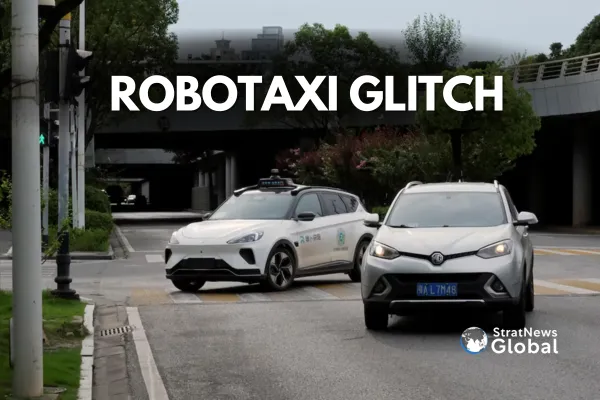

A system failure involving robotaxis operated by Baidu has disrupted traffic in the central Chinese city of Wuhan, raising fresh concerns about the safety and reliability of autonomous driving services.
According to local police, multiple vehicles from Baidu's Apollo Go fleet stalled on roads late Tuesday, with several cars stopping in the middle of traffic and becoming unresponsive. The incident affected at least 100 vehicles, prompting authorities to intervene.
Passengers inside the robotaxis were able to exit safely, and no injuries were reported. However, some individuals hesitated to leave the vehicles due to heavy traffic conditions and called police for assistance.
Videos circulating on Chinese social media showed several autonomous vehicles halted on busy roads, creating congestion and confusion. Reports suggested that in some cases, passengers remained inside the vehicles for extended periods before assistance arrived.
Authorities have described the incident as a 'system failure,' though the exact cause remains under investigation.
The disruption has reignited debate over the readiness of autonomous vehicle technology, particularly as robotaxi services expand rapidly across China's major cities.
Baidu's Apollo Go is among the country's leading robotaxi platforms, operating alongside firms like Pony.ai and WeRide. These companies have been scaling up operations domestically while also expanding into overseas markets, including the Middle East.
The Wuhan outage adds to a series of recent incidents involving autonomous vehicles. In August, an Apollo Go robotaxi fell into a construction pit in Chongqing, while a vehicle operated by Pony.ai caught fire on a road in Beijing earlier this year. No injuries were reported in either case.
Similar disruptions have occurred globally. A major power outage in San Francisco last year caused robotaxis operated by Waymo to stall, leading to traffic gridlock.
China has emerged as a key testing ground for autonomous mobility, with large-scale deployments of driverless taxis in multiple cities. The technology is seen as a major component of future urban transport systems.
However, incidents like the Wuhan outage highlight the challenges of scaling autonomous systems in complex, real-world environments. As adoption grows, questions around safety, system reliability and emergency response are becoming increasingly central.
For now, the investigation into the latest failure continues, even as public scrutiny over robotaxi operations intensifies.
(with inputs from Reuters)