




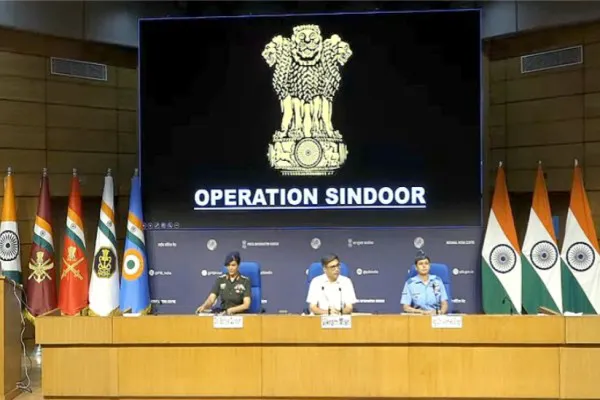

The first anniversary of Operation Sindoor is producing a picture very different from the breathless narratives that dominated the first 48 hours of the conflict.
What initially looked like an embarrassing stumble for India after the loss of three fighter aircraft now appears, in retrospect, to have been a tightly controlled, carefully sequenced military campaign designed to stay below the nuclear threshold while imposing overwhelming operational costs on Pakistan.
At almost the same moment that new details are surfacing about how India fought its brief war with Pakistan, the United States and Israel are struggling with the opposite problem in West Asia.
What was expected to be a crushing demonstration of American and Israeli military superiority over Iran has instead exposed the limits of raw firepower, the fragility of Western military supply chains, and the danger of entering escalation ladders without a realistic political exit strategy.
The contrast is stark.
India and Pakistan are nuclear powers with a long history of crises spiralling unpredictably. The United States and Israel, by comparison, entered the Iran conflict with overwhelming technological, economic and military superiority. Yet it is India that now appears to have fought the cleaner, more disciplined and more strategically coherent campaign.
Operation Sindoor lasted just 88 hours. It began after the terror strike in Pahalgam on April 22 and moved through three distinct phases. First came the precision strikes on terror infrastructure linked to Jaish-e-Mohammad and Lashkar-e-Taiba in Bahawalpur and Muridke. Then came the suppression of Pakistani air defences. Finally came the deep precision strikes on critical Pakistani airbases and command nodes.
The opening exchanges undeniably hurt India. Pakistan managed to down three Indian fighters during the first aerial clashes, including a Rafale, a Mirage 2000 and either a Su-30MKI or MiG-29UPG. Those losses shaped the global narrative almost instantly. Pakistan and China aggressively amplified claims that India's prized Rafales had been humiliated by Chinese-origin systems. Fake videos, manipulated imagery and coordinated online propaganda flooded social media.
But the problem with first-day narratives is that wars do not end on the first day.
Over the next 72 hours, India systematically dismantled Pakistan's ability to fight.
Pakistani radar sites at Chunian and Pasrur were struck. HQ-9 air defence batteries were targeted. Drone swarms and missile attacks were absorbed by India's integrated air defence architecture using IACCCS and Akashteer networks. More than half the incoming drones were physically destroyed. The rest were neutralised electronically through jamming and spoofing.
This mattered because Sindoor was not fought as a prestige contest between individual fighter jets. It was fought as a systems war.
India's real advantage was not any single aircraft. It was the integration of sensors, electronic warfare, missile systems and battle management networks into a layered architecture capable of absorbing initial shocks without losing escalation control.
That becomes even clearer in the decisive final phase.
Between 2 am and 5 am on May 10, India launched coordinated long-range strikes using BrahMos, SCALP-EG and Rampage missiles fired from within Indian airspace. Pakistani airbases across the country's operational depth were hit, including Nur Khan near Rawalpindi, Murid, Sukkur, Sargodha, Jacobabad and Bholari. Satellite imagery later confirmed damage to command facilities, radar infrastructure, drone hangars and support facilities for airborne early warning aircraft.
The symbolism of Nur Khan mattered enormously. It sits close to Pakistan's military nerve centre near Rawalpindi. Striking it without crossing into an uncontrolled escalation cycle sent a deliberate signal. India demonstrated reach, precision and escalation dominance without touching Pakistan's nuclear infrastructure.
That restraint may ultimately prove the most important part of the operation.
India fought hard enough to compel a ceasefire, but not recklessly enough to trigger uncontrolled escalation between two nuclear powers. Pakistan requested a ceasefire by midday on May 10 after its command-and-control infrastructure and air defence network had been significantly degraded.
Now compare that with the US-Israel campaign against Iran.
Operation Epic Fury was supposed to demonstrate what happens when the world's strongest military coalition unleashes overwhelming force on a heavily sanctioned regional adversary. Instead, it exposed deep structural weaknesses inside the Western military system itself.
Iran suffered catastrophic losses. Thousands were killed. Senior IRGC leadership was wiped out. Ayatollah Ali Khamenei himself was assassinated in an Israeli airstrike. Missile infrastructure, launchers and military bases were devastated.
But despite all that destruction, the United States and Israel still found themselves searching for an off-ramp.
That is the extraordinary part.
According to Western media outlets, America lost aerial equipment worth between $2.3 billion and $2.8 billion, including a $700 million E-3 airborne command aircraft, multiple refuelling aircraft, THAAD radar systems and several fighter jets lost even to friendly-fire incidents. The USS Gerald R. Ford was knocked temporarily out of operations after a fire. Critical munitions stockpiles were burnt through at astonishing speed.