

Dailyhunt
From Manimegalai To Paripadal To Silappadikaram, Sage Agastya Is Everywhere, Except In This Dravidian Stock's Scholarship

From Manimegalai To Paripadal To Silappadikaram, Sage Agastya Is Everywhere, Except In This Dravidian Stock's Scholarship

The Commune 3 weeks ago

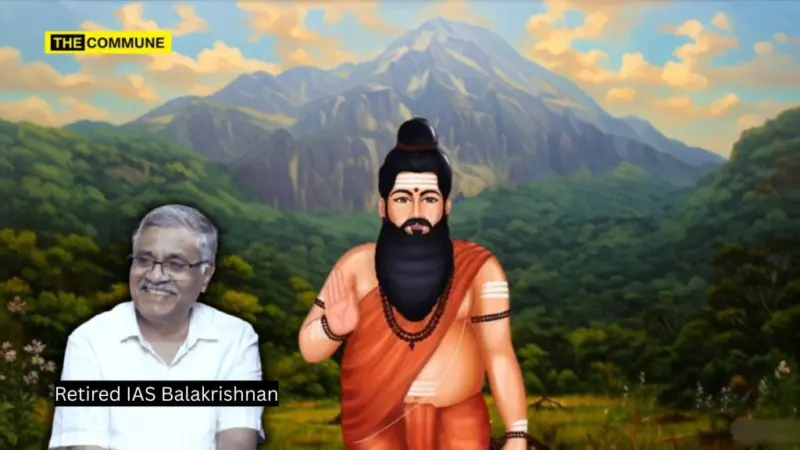
A few months ago, we reported on how news portal The Federal published an interview with so-called 'Indologist' retired IAS Balakrishnan, where he claimed Sage Agastya never existed.

In the half-hour podcast, Balakrishnan makes several claims. In this article, we will debunk all of his manufactured claims with evidence.

Claim 1: "Agastya is a Fictional Character"

Balakrishnan opens the podcast by stating that Agastya is "ஒரு புனை கதை" and that he was inserted in the 13th century. Balakrishnan says a fictional character and that despite having a BA and MA in Tamil literature, he has never once read anything written by Agastya. He infers from the absence of Agastya's texts in his curriculum that the figure himself is mythological.

Truth:

This is a logical fallacy - the argument from personal ignorance. The absence of a text in one's university syllabus does not prove the non-existence of the figure who authored it. By the same reasoning, one could argue that Valmiki or Vyasa are fictional because their original manuscripts are not available in modern classrooms.

Agastya's grammar text Agattiyam (அகத்தியம்) is indeed non-extant as a complete work but this is well-documented and openly acknowledged in scholarship. Several of its sutras survive as quotations in medieval commentaries. According to Wikipedia's entry on Agattiyam, it is "traditionally believed to have been compiled and taught in the First Sangam (circa 300 BCE) by Agattiyar (Agastya) to twelve students." The fact that a text has been lost over two millennia is not evidence of its author's non-existence, we have lost thousands of ancient texts across every civilisation. ​

The tradition of Agastya as a grammatical authority is also directly referenced by BHU's scholarly paper published from Kashi Tamil Sangamam, which notes: "Professor K. Vellaivarananar explains with several pieces of evidence that Agastya's work, Agathiyam, is regarded as the primary grammar text and that Tolkāppiyam is a structured text based on the foundational principles outlined by Agastya's grammar."

Copper Plate Inscriptions

Pandya-era copper-plate charters refer to Agasthya as the Kula Guru (royal preceptor) of certain Pandya kings - an epigraphic acknowledgment.

Counter-scholars argue that given this breadth of textual and inscriptional evidence, the claim that Agasthya appears "nowhere in Tamil literature" reflects poor scholarship or ideological posturing, not evidence-based research.

Additionally, Thalavaipura copper plate inscriptions also mention Sage Agastya. This was written 100 years before the birth of Raja Raja Chola.

The distinction the scholarly world draws is between Agastya as historical sage and Agastya as literary-traditional figure. Balakrishnan conflates these two to dismiss both.

Claim 2: "Tolkappiyar Never Mentions His Teacher Agastya - Therefore the Connection is Fabricated"

Balakrishnan argues that Tolkappiyar, despite listing many grammarians before him, never once mentions his supposed teacher Agastya. He uses this silence as proof that the Agastya-Tolkappiyar teacher-student link was invented later.

Truth:

This is the most cited argument in the anti-Agastya position and it sounds compelling, until you examine it carefully.

Tolkappiyam's Purapporul preface, composed by Panamparanar (not Tolkappiyar himself), states: "vaḻiyeṉap paṭuva tataṉvaḻit tākum" - a phrase that BHU scholars read as establishing Agastya as "the foundational guide, or 'the first source,' for Tolkāppiyam." The question of whether Tolkappiyar explicitly names Agastya is therefore more nuanced than Balakrishnan presents. ​

Furthermore, ancient texts routinely do not name their teachers directly. Silence in a text is not the same as denial. The Tolkappiyam itself does not name Tolkappiyar in the body of the text, that name comes from the preface. By Balakrishnan's own logic, we could question Tolkappiyar's existence too.

The teacher-student tradition linking Agastya and Tolkappiyar is attested by Nachinarkiniyar (13th-14th century), whom Balakrishnan dismisses, but also appears in references far older. The book Agastya in the Tamil Land (KN Sivarajapillai), ironically a work Balakrishnan himself mentions, traces the Agastya tradition through multiple textual layers.

Claim 3: "Agastya Enters Tamil Literature Only in the Bhakti Period - He Has No Sangam Presence"

Balakrishnan asserts that Agastya is completely absent from Sangam literature, and that he was "gradually introduced" into Tamil culture only after the Bhakti movement.

Truth:

This claim has been directly rebutted by scholars citing specific Sangam-era references. In our report, we rebut the same set of arguments by Balakrishnan, and others notes multiple textual references to Agastya that predate the Bhakti period:​

  • Paripadal (a Sangam anthology): Contains a line referencing the star Agastya (Canopus), named after the sage associated with Podhigai - "பொதியில் முனிவன் புரை வரைக் கீறி மிதுனம் அடைய"
  • Thirumandiram (Thirumoolar): Records Shiva's instruction to Agastya to travel south and restore balance
  • Thevaram hymns by Appar and Sambandar: Contain direct references to Agastya​

From Sangam Literature

Paripadal contains a well-known line referencing the star Agastya, named after the sage associated with Podhigai:

"பொதியில் முனிவன் புரை வரைக் கீறி மிதுனம் அடைய"
(The star Agastya - named after the sage residing in the Podhigai hills.)

Post-Sangam Epic Literature

In Manimegalai, Agasthya is said to have released the sacred Kaveri from his kamandala:

"அமர முனிவன் அகத்தியன் றனாது கரகங் கவிழ்த்த காவிரிப் பாவை"

Manimegalai does not allude to Agasthiyar obliquely - it names him directly and explicitly. This above text is from the
Patikam (prologue) of Manimegalai (lines 10-12). The Central Institute of Classical Tamil, Chennai, which published a full scholarly study in 2025, identifies this as "the earliest Tamil literary work to explicitly mention Agasthya by name". There is noambiguity - this is not commentary, not interpolation, not post-medieval addition. It is the original text of Manimegalai, composed around the 5th-6th century CE.

Furthermore, Manimegalai records that the Chola king
Sembiyan followed Agasthiyar's counsel and conducted the grand
Indra Vizha festival for 28 days. The "sage of the high mountains" here is Agasthiyar - the sage of Podhigai, the high range of the Western Ghats.

Shaivite Canon

Thirumandiram records Shiva's instruction to Agasthya to travel south and restore balance:

"நடுவுள அங்கி அகத்திய நீ போய் முடுகிய வையத்து முன்னிர்"

Thevaram hymns by Appar and Sambandar also contain references to Agasthya.

Medieval and Later Texts

Kamba Ramayanam describes him as:

"தென் தமிழ்நாட்டகன் பொதியில் திருமுனிவன்"
(The sage who resides in Podhigai, in the southern Tamil land.)

Silappadikaram

The classical Tamil epic Silappadikaram contains multiple references across different cantos. Here are two specific textual citations:

Both references to "the divine sage of the sacred mountain" and "thegreat sage of Podhigai" are understood through the classicalcommentary tradition, specifically Adiarkkunallar's commentary as direct references to Agasthiyar

Balakrishnan himself acknowledges in the podcast that Agastya is mentioned in the context of Podhigai mountain in the Manimegalai - but then dismisses it as a late addition. This is circular reasoning: any text that mentions Agastya gets labelled "late," and the label is then used to prove Agastya is a late invention.

Claim 4: "The Central Government Orchestrated the Agastya Revival as a Political-Cultural Agenda"

Balakrishnan claims that Indian embassies abroad, Union government research institutions, and Tamil diaspora associations were all coordinated to hold Agastya-themed events, with Google-searchable circulars as "proof." He compares this to how Thiruvalluvar was "pushed" earlier.

Truth:

This is a conspiracy claim dressed as historiography. The logical problem is: even if a government organises conferences on Agastya, that cannot change the historical record of whether Agastya existed or not. This is a classic genetic fallacy - attacking the motivation behind a claim rather than the claim itself.

The Kashi Tamil Sangamam (organised by the central government in 2022-2023) included scholarly presentations on Agastya, but those presentations drew on centuries of existing Tamil literary tradition, not fabricated narratives. Government sponsorship of cultural conferences is not the same as fabricating history. Balakrishnan provides no evidence that the scholarship presented at those events was manufactured or falsified.

More importantly, Agastya's place in Tamil tradition did not originate in 2022. Periyar's Kudi Arasu press published a book on Agastya a hundred years ago, which Balakrishnan himself acknowledges - this predates the BJP government by nearly a century. If Periyar's publication house found Agastya worthy of printing, the figure's Tamil cultural relevance cannot be dismissed as a recent Hindutva invention.​

Scholarship or Selective Erasure?

What Balakrishnan is doing is not having an enriching conversation. It is the systematic erasure of a figure embedded in Tamil's oldest texts, driven not by evidence but by the ideological need to sever Tamil civilisation from its own recorded past, just what the Dravidianists routinely do.

Dailyhunt
Disclaimer: This content has not been generated, created or edited by Dailyhunt. Publisher: The Commune