
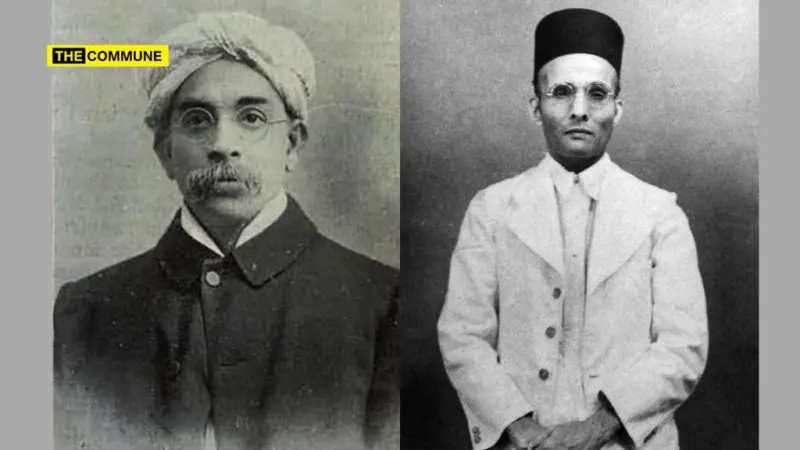

There is a historical irony so sharp it cuts through decades of political spin: the judge who sentenced Vinayak Damodar Savarkar to 50 years of imprisonment - one of the harshest sentences ever handed to an Indian freedom fighter, was himself a former President of the Indian National Congress.
Yet today, it is that same Congress party and its intellectual ecosystem that brands Savarkar a "British loyalist" and a traitor to the freedom movement. The audacity of this position deserves to be examined closely.
The Judge: A Congress President in British Robes
Justice Narayan Ganesh Chandavarkar was no ordinary colonial judge. He had been elected President of the Indian National Congress at its Lahore session in 1900. He was a Chitpavan Brahmin lawyer, social reformer associated with the Prarthana Samaj, and a vocal moderate voice within Indian public life. He was also knighted by the British Crown in 1910 - the very year he sentenced Savarkar.
In December 1910, sitting on the Special Tribunal of the Bombay High Court alongside Chief Justice Basil Scott and Justice Heaton, Chandavarkar pronounced judgment in the Nasik Conspiracy Case - convicting Savarkar on charges of sedition, abetment of murder, and waging war against the King-Emperor. The sentence: two consecutive life terms of 25 years each, 50 years total, of transportation to the Cellular Jail, Andamans.
A Congress president, knighted by the British, locking away one of India's most fearless revolutionaries for half a century. This is the foundation on which Congress's "Savarkar was pro-British" narrative rests.
Who Was Savarkar Before He Was Jailed?
The Congress attack on Savarkar is built almost entirely on his mercy petitions written from prison. What they erase is who Savarkar was before the prison gates shut.
By the time of his arrest in London in March 1910, Savarkar had already:
- Founded Abhinav Bharat, a pan-India revolutionary secret society, in 1904
- Written The Indian War of Independence 1857 - a book so dangerous the British banned it before publication
- Organised armed revolutionary networks stretching from Pune to London to Paris
- Supplied the Browning pistol used by 17-year-old Anant Laxman Kanhere to assassinate Nasik Collector A.M.T. Jackson on 21 December 1909 - a direct act of armed resistance against colonial rule
When arrested in London, Savarkar did not submit quietly. Aboard the SS Morea en route to India on 8 July 1910, he slipped through a ship porthole at Marseille, dived into the sea, and swam to French soil, triggering a landmark international legal battle at the Permanent Court of Arbitration at The Hague, one of the first such cases involving an Indian. France and Britain clashed diplomatically over the legitimacy of his re-arrest on French territory. The Hague ruled against him, but the episode alone marks Savarkar as a man of extraordinary defiance.
The Cellular Jail: What Congress Doesn't Tell You
From 4 July 1911, Savarkar endured the Cellular Jail in the Andamans - not as a political prisoner but classified as a dangerous "seditionist" by the British. He spent years performing brutal oil-pressing labour, suffered 6 months of solitary confinement, was subjected to standing handcuffs as punishment, and was systematically isolated from other political prisoners. The Cellular Jail's mortality rate in its early decades approached 30%.
It was from within this living hell that Savarkar wrote his clemency petitions - in 1911, 1913, 1917, and 1920. Congress has weaponised these petitions for decades, with Rahul Gandhi in 2022 unfavourably comparing Savarkar to Bhagat Singh in the middle of an election campaign in Maharashtra. The petitions, stripped of context - stripped of the oil press, the solitary cell, the standing handcuffs, are presented as proof of cowardice and collaboration.
What Congress never asks is this: how many Congress leaders endured even a fraction of what Savarkar did inside the Cellular Jail?
The Double Standard at the Heart of Congress History
The selective moral lens applied to Savarkar becomes grotesque under scrutiny. The very Congress tradition that produced a knighted judge who happily signed Savarkar's 50-year sentence, that produced leaders who accepted British titles, worked within colonial institutions, and led negotiations with the Crown holds Savarkar alone to the standard of unbroken, uncompromising defiance.
When Chandavarkar accepted his knighthood from the British Crown and then sentenced Savarkar in the same breath, he was the Congress movement's moderate, loyal, establishment face. He was celebrated, not condemned. But when Savarkar, broken by a decade of colonial torture, wrote a petition seeking conditional release - he became the traitor.
Conclusion
History's verdict on Savarkar cannot be compressed into a mercy petition. It must account for the Abhinav Bharat network, the banned book, the Marseille dive, the Hague arbitration, and a decade in the most brutal prison in the British Empire - all of it set in motion by a trial presided over by a Congress president in a British judge's robe.
That Congress today leads the charge calling Savarkar a British loyalist is not historical analysis. It is political convenience and one of the most brazen reversals of historical record in modern Indian politics.